
And with saudi Arabia's suspicious activity with Israeli officials, we as an ummah are bound to ask ourselves few questions
***Thread - The current state of Ummah***
We muslims and the muslims scholars always say - the Quran is the final, complete, universal and incorruptible word of god (which is true), but why is it that our "islamic governments" fail to enforce laws based on the Qur'an...
And with saudi Arabia's suspicious activity with Israeli officials, we as an ummah are bound to ask ourselves few questions
Who is responsible?
What are we doing?
Does the majority of our ummah even want to do something about it?
What can be done?
Who can do it?
This question has answers we all know, but we turn a blind eye towards it.
After the fall of the Ottoman Islamic khilafath we can safely say that it's secularism (Ataturk) which responsible for it...
The larger part of this question's answer is "we our selves are responsible", but lets see who really are responsible for this.
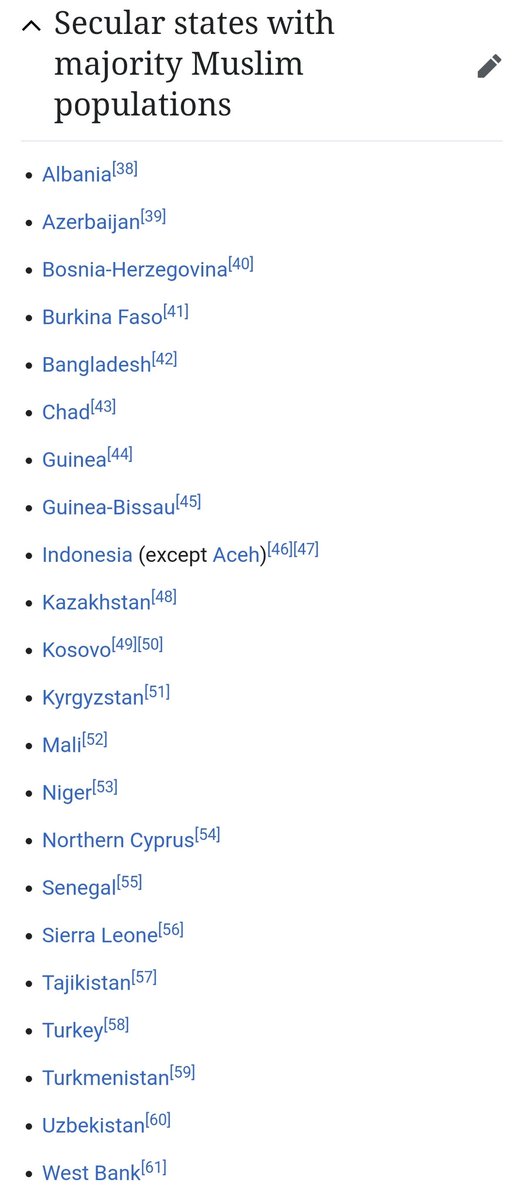
After the WW2, this world saw unprecedented changes, which involved forming of athiestic states in the Muslim world...
Here is a picture to potray what I am referring to
And the reason this happened is either colonialism or the involvement of colonialist in muslim states
The gross inferiority complex they inculcated in the people is embarrassing.
The simple answer could be "nothing"
But let's dive deep
The country which holds the highest amount of muslims is now probably India (yes, its quite possible based on the growth rate and all), and the state of muslims there can tell enough...
And with the advent of UCC (a law which can mean that muslims cannot practice the laws mentioned in the Qur'an (law of marriage, divorce, property)
The Muslims in Rohingya, Uighur, Kashmir, Palastine, Syria, Iraq (and more) are helpless even when a quarter of the population of this world is muslims
Why?...
The answer is simple
The majority of the ummah is the victim in this case ( and the minority with the power are the lapdogs of seculars states )
We could just sit in our homes and tweet about this stuff, we have no leader, no reliable government nothing!
What we can do is introduce a system with which our generation and the following generation has respect for the scholars of islam...
The scholars of islam should be in the places of uncorrupted power and should lead the ummah
Is this possible?
Yes it is, if we start with the Muslim states
The lack of intelligent people for muslim scholarship gives rise to...
It could be done right at our homes, send your children to madrasas (most muslims do not send children to madrasas as they find the quality of education there very low)
Build madrasas with education centred around islam, (if this is done in the real sense...
More from Islam




You May Also Like



One of the most successful stock trader with special focus on cash stocks and who has a very creative mind to look out for opportunities in dark times
Covering one of the most unique set ups: Extended moves & Reversal plays
Time for a 🧵 to learn the above from @iManasArora
What qualifies for an extended move?
30-40% move in just 5-6 days is one example of extended move
How Manas used this info to book
Post that the plight of the
Example 2: Booking profits when the stock is extended from 10WMA
10WMA =
Another hack to identify extended move in a stock:
Too many green days!
Read
Covering one of the most unique set ups: Extended moves & Reversal plays
Time for a 🧵 to learn the above from @iManasArora
What qualifies for an extended move?
30-40% move in just 5-6 days is one example of extended move
How Manas used this info to book
The stock exploded & went up as much as 63% from my price.
— Manas Arora (@iManasArora) June 22, 2020
Closed my position entirely today!#BroTip pic.twitter.com/CRbQh3kvMM
Post that the plight of the
What an extended (away from averages) move looks like!!
— Manas Arora (@iManasArora) June 24, 2020
If you don't learn to sell into strength, be ready to give away the majority of your gains.#GLENMARK pic.twitter.com/5DsRTUaGO2
Example 2: Booking profits when the stock is extended from 10WMA
10WMA =
#HIKAL
— Manas Arora (@iManasArora) July 2, 2021
Closed remaining at 560
Reason: It is 40+% from 10wma. Super extended
Total revenue: 11R * 0.25 (size) = 2.75% on portfolio
Trade closed pic.twitter.com/YDDvhz8swT
Another hack to identify extended move in a stock:
Too many green days!
Read
When you see 15 green weeks in a row, that's the end of the move. *Extended*
— Manas Arora (@iManasArora) August 26, 2019
Simple price action analysis.#Seamecltd https://t.co/gR9xzgeb9K




Speech Delay is most common in children nowadays
In ancient times, our grandparents used to follow typical natural way of caring the needs of a child. All they used were more of natural products than chemical based for the growth of child.

One of major step followed was to feed Gurbach Jadd/ Vasa Kommu/ Acorus Calamus for initiating good speech ability in a child. This stem was needed to babies on Tuesdays and Sundays in mother's milk.
Vasa is feed to baby after the 1st bath on 12th day in week. Weekly only thrice it is fed and named as :
Budhwar - Budhi Vasa
Mangalwar - Vaak Vasa
Ravi Vaar - Aayush Vasa
This stem is burnt and rubbed against the grinding stone in mother's milk or warm water to get a paste
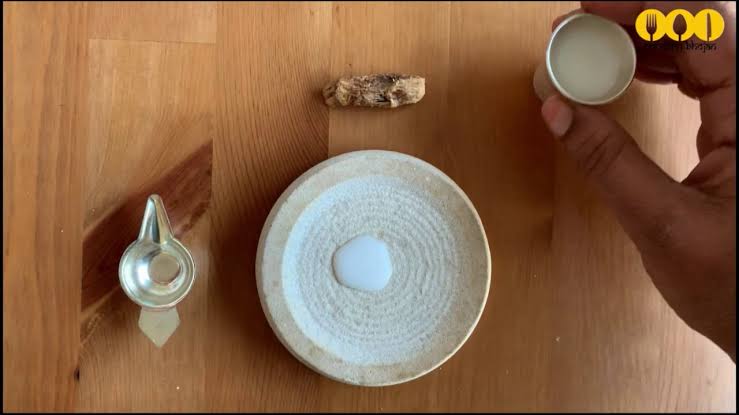
The procedure to make it is in the link
https://t.co/uo4sGp7mUm
It should not be given daily to the child. Other main benefits are
1. It clears the phlegm in child's throat caused due to continuous milk intake. It clears the tracts and breathing is effortless.
2. Digestion
For children who haven't got their speech and is delayed than usual should feed this vasa on these days in week atleast for 6months. Don't get carried away with this dialogue
"Some gain speech little late"
In ancient times, our grandparents used to follow typical natural way of caring the needs of a child. All they used were more of natural products than chemical based for the growth of child.
One of major step followed was to feed Gurbach Jadd/ Vasa Kommu/ Acorus Calamus for initiating good speech ability in a child. This stem was needed to babies on Tuesdays and Sundays in mother's milk.
Vasa is feed to baby after the 1st bath on 12th day in week. Weekly only thrice it is fed and named as :
Budhwar - Budhi Vasa
Mangalwar - Vaak Vasa
Ravi Vaar - Aayush Vasa
This stem is burnt and rubbed against the grinding stone in mother's milk or warm water to get a paste
The procedure to make it is in the link
https://t.co/uo4sGp7mUm
It should not be given daily to the child. Other main benefits are
1. It clears the phlegm in child's throat caused due to continuous milk intake. It clears the tracts and breathing is effortless.
2. Digestion
For children who haven't got their speech and is delayed than usual should feed this vasa on these days in week atleast for 6months. Don't get carried away with this dialogue
"Some gain speech little late"