Since tweets by @rihanna and @miakhalifa are now considered 'external forces' and 'foreign interference', a small reminder... During the first Emergency, the Sangh's main line of dissent was through foreign press, governments, activists, and funding.
A short thread.
(2) The RSS has a fanciful mythology of its resistance within India, but there's not much evidence of it. @Swamy39 wrote in the year 2000 that ‘most of the leaders of the BJP/RSS had betrayed the struggle against the Emergency,’ offering ‘to work for the nation’s tormentors’...
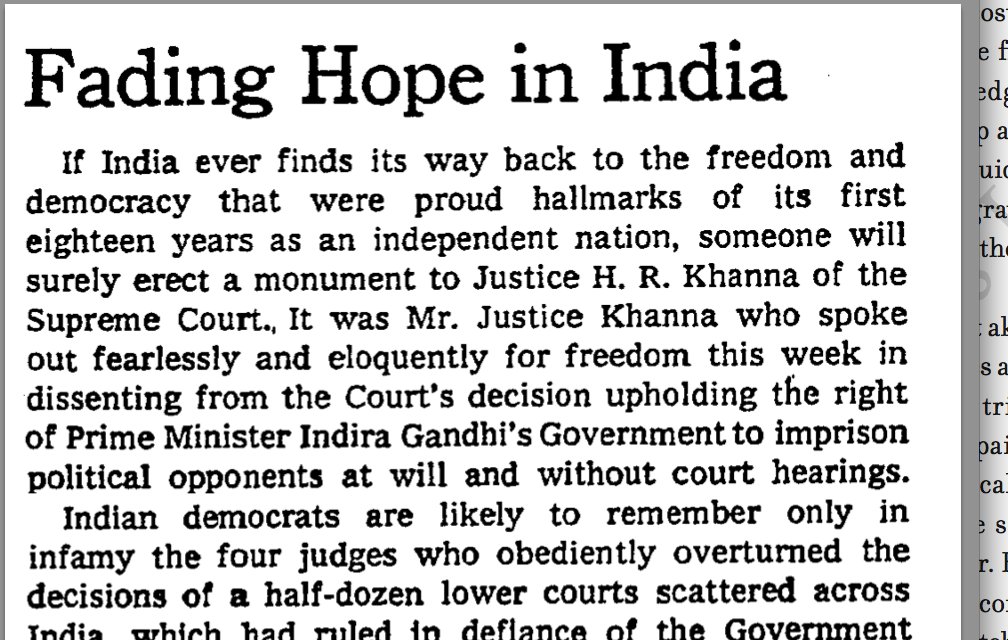
(3) Instead it was overseas intelligentsia (from the Left) who gave the anti-Emergency movement early moral support. But Sangh leaders like Makarand Desai also lobbied @nytimes & other Western papers to editorialise on the silencing of dissent & capture of the judiciary in India.
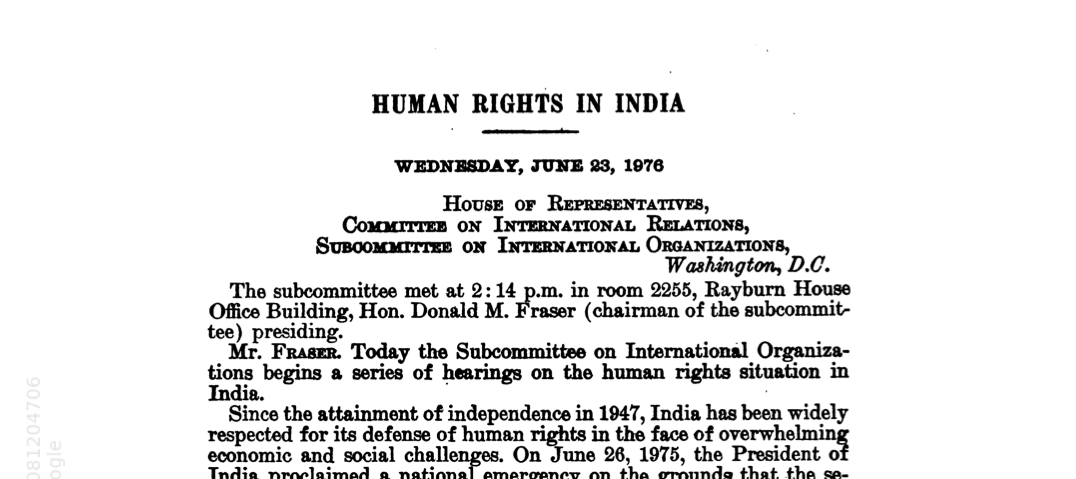
(4) Following this, the US Congressional Committee on International Relations held hearings about human rights in India. Witnesses included Ram Jethmalani; Jagjit Singh Chohan, of the Int'l Council of Sikhs; and Leila Kabir Fernandes, married to union leader George Fernandes.
(5) Questions were also asked in the UK House of Commons – just as they were last year, in the US Congress, in the House of Commons, and in the European Parliament, in support of the anti-CAA Citizenship movement. https://t.co/SeH55OrVll
(6) It was this international pressure on Indira Gandhi that helped to bring the Emergency to an end in 1977. MG Chitkara, an RSS ideologue, said that overseas activism ‘proved to be one of the decisive factors in upsetting the calculations of the dictatorial regime here’.
(7) Predictably, the Indira government's response was to accuse Western media of ‘foreign interference’ and to call their coverage ‘slanderous and malicious’.
Its language – of ‘anti-India propaganda’, ‘external enemies’ – was exactly the same we're hearing today.
(8) Even when the Emergency ended, the linkages with overseas Indians did not. The BJP's popularity in the older generation of Indian expats, the 'Howdy Modi' crowd, is an artifact of foreign states providing safe harbour for dissent & protest when it was not safe in India.
(9) Today, younger generations of Indian expats and diaspora uphold a strong, non-sectarian, progressive South Asian identity – led by role models who represent all that too.
The anti-CAA movement, and now #FarmersProtests, are naturally finding support and safety there.
(10) Don't expect this to end just because @MEAIndia is upset about it. As a young Indian in the US wrote to me, after the Citizenship protests: 'New regimes of control in India will require new forms of resistance in spaces where it remains possible'.

More from India

You May Also Like

I just finished Eric Adler's The Battle of the Classics, and wanted to say something about Joel Christiansen's review linked below. I am not sure what motivates the review (I speculate a bit below), but it gives a very misleading impression of the book. 1/x


The meat of the criticism is that the history Adler gives is insufficiently critical. Adler describes a few figures who had a great influence on how the modern US university was formed. It's certainly critical: it focuses on the social Darwinism of these figures. 2/x

Other insinuations and suggestions in the review seem wildly off the mark, distorted, or inappropriate-- for example, that the book is clickbaity (it is scholarly) or conservative (hardly) or connected to the events at the Capitol (give me a break). 3/x

The core question: in what sense is classics inherently racist? Classics is old. On Adler's account, it begins in ancient Rome and is revived in the Renaissance. Slavery (Christiansen's primary concern) is also very old. Let's say classics is an education for slaveowners. 4/x

It's worth remembering that literacy itself is elite throughout most of this history. Literacy is, then, also the education of slaveowners. We can honor oral and musical traditions without denying that literacy is, generally, good. 5/x
Recently, the @CNIL issued a decision regarding the GDPR compliance of an unknown French adtech company named "Vectaury". It may seem like small fry, but the decision has potential wide-ranging impacts for Google, the IAB framework, and today's adtech. It's thread time! 👇

It's all in French, but if you're up for it you can read:
• Their blog post (lacks the most interesting details):
https://t.co/PHkDcOT1hy
• Their high-level legal decision: https://t.co/hwpiEvjodt
• The full notification: https://t.co/QQB7rfynha

I've read it so you needn't!

Vectaury was collecting geolocation data in order to create profiles (eg. people who often go to this or that type of shop) so as to power ad targeting. They operate through embedded SDKs and ad bidding, making them invisible to users.

The @CNIL notes that profiling based off of geolocation presents particular risks since it reveals people's movements and habits. As risky, the processing requires consent — this will be the heart of their assessment.

Interesting point: they justify the decision in part because of how many people COULD be targeted in this way (rather than how many have — though they note that too). Because it's on a phone, and many have phones, it is considered large-scale processing no matter what.