Charles Ponzi and the Postal Service

The story of the man who put the 'Ponzi' in 'Ponzi scheme'

/THREAD/

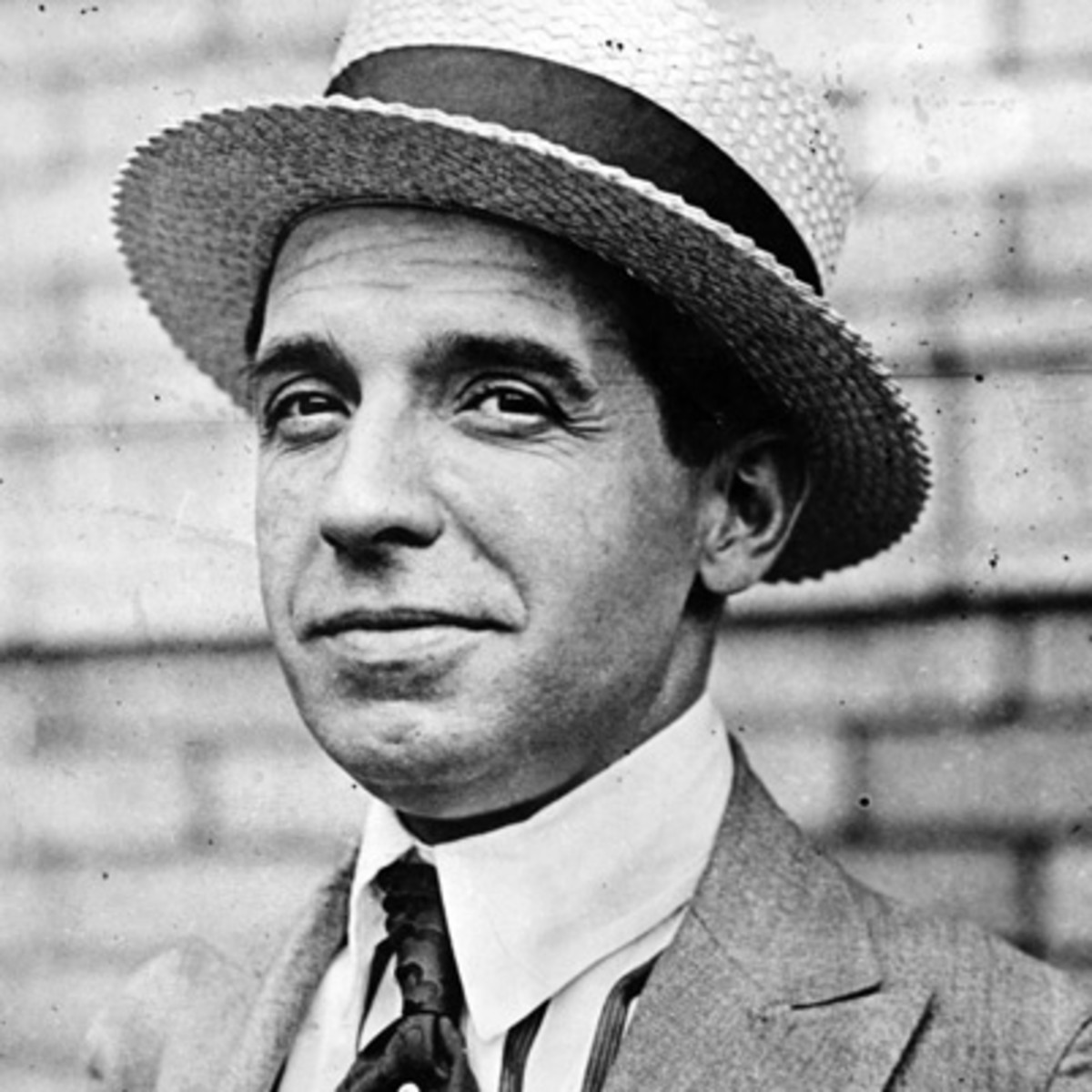
1/ Carlo Pietro Giovanni Guglielmo Tebaldo Ponzi, a.k.a. Charles Ponzi, was an italian swindler and con-artist.

Born in 1882 in Italy, he became notorious for his money-making fraudulent schemes in North America in the 1920s.
2/ He arrived in Boston in late 1903 with $2.50 in his pocket.

After many professional failures, he moved to Montreal in 1907 and started working as a bank teller at Banco Zarossi, where he rose to the position of bank manager.
3/ This is where he first witnessed the bank's scheme, where Zarossi was funding interest payments using deposits from newly opened accounts instead of investment profits.
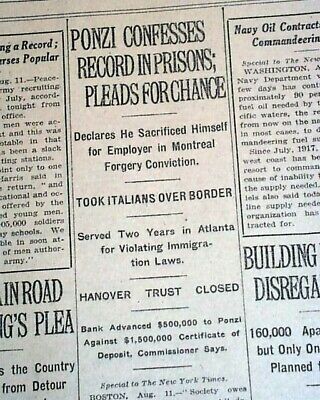
4/ Ponzi served 3 years in jail for check forgery and returned to the US after his release.

However, he got involved in smuggling illegal immigrants into the country landing in prison for another 2 years, moving back to Boston after that.
5/ There he came up with the idea of profiting from the arbitrage of postal reply coupons (IRCs).

Post-WW1 inflation decreased the postage cost in Italy in terms of US dollars, with Ponzi claiming that redeeming them for a higher price in the US would net him a profit of 400%.
6/ He promised his investors a 100% return in 90 days, promising later a more.... reasonable 50% in 45 days.

He then proceeded to set up a stock company to attract capital from investors.
7/ In 1920, he started the company Securities Exchange Company (not to be confused with the S.E.C.).

As the word spread around town many investors rushed in at an increasing rate.
8/ By June 2020, the total investment came up to $2.5 million, equivalent to today's $30 million, and by July the capital influx reached $1 million daily.

Ponzi used some of the invested capital to buy a controlling interest at a local bank in Boston.
9/ At the same time, his investors were mortgaging their houses and using their life savings to invest in his company.

However, for Ponzi to create his promised returns he would need to buy and resell millions of IRCs, with only a few tens of thousands in circulation.
10/ He instead paid his investors using the capital from the new investors.

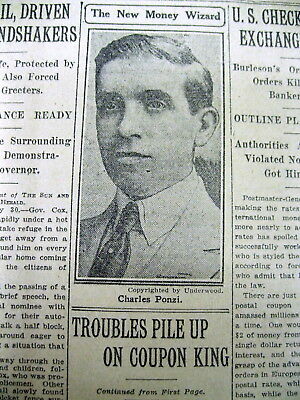
Despite many newspaper articles questioning his quickly acquired wealth and a criminal investigation, he managed to continue operating his scheme.
11/ An investigation by the US District Attorney prompted the audit of his company's books, with Ponzi's publicist leaking information to the investigators.

It was finally revealed that Ponzi had amassed a debt of $7 million, having taken many loans from the bank he controlled.
12/ As the articles kept pilling up, revealing Ponzi's past criminal activities and prison sentences, he surrendered to the authorities and was charged with mail fraud.

The losses for his investors came up to $20 million, approximately $250 million in today's terms.
13/ Despite the fact that Charles Ponzi was not the first one to engage in such a scheme, his name was identified with it due to its vast success and huge amount of invested capital.

/END
If you liked this thread click below and retweet the first tweet

https://t.co/d3wvXyvo5X
For more educational threads on financial independence and investing for beginners see below for a collection of threads 👇👇👇

https://t.co/6o3A2IQCMs

More from Kostas 👨‍💼 📈 💸

The Mother of All Squeezes

How Volkswagen went from being on the brink of bankruptcy to the most valuable company in the world in two days

/THREAD/


1/ At the peak of the 2008 financial crisis, Volkswagen was considered a very likely candidate for bankruptcy.

Heavily indebted and already financially struggling before 2008, with car sales expected to plummet due to the ongoing global crisis.


2/ With GM and Chrysler filing for bankruptcy in 2009, shorting the VW stock would seem a safe bet.

If you are not familiar with stock shorts and short squeezes check my thread


3/ On October 26, 2008, Porsche announced it had increased its stake at VW from 30% to 74%.

This was a surprise to many who were led to believe that Porsche wasn't planning a takeover of VW, based on the company's announcements.


4/ Before the announcement, the short interest was approximately 13% of the outstanding shares, a number considered relatively low.

Porsche had a 30% stake, the Lower Saxony government fund held 20% of the shares, and another 5% was held by index funds.

More from History

This is THEFT!

Indians had Algebra BEFORE Mμslim prophet & religion was even born.

Here is Bakhshali Manuscript dating back to 3rd century CE. It is an Algebraic treatise. Have you anything like this from the Arabian desert? No, you simply plagiarized Algebra from Indians! https://t.co/cWXRNYMgDt


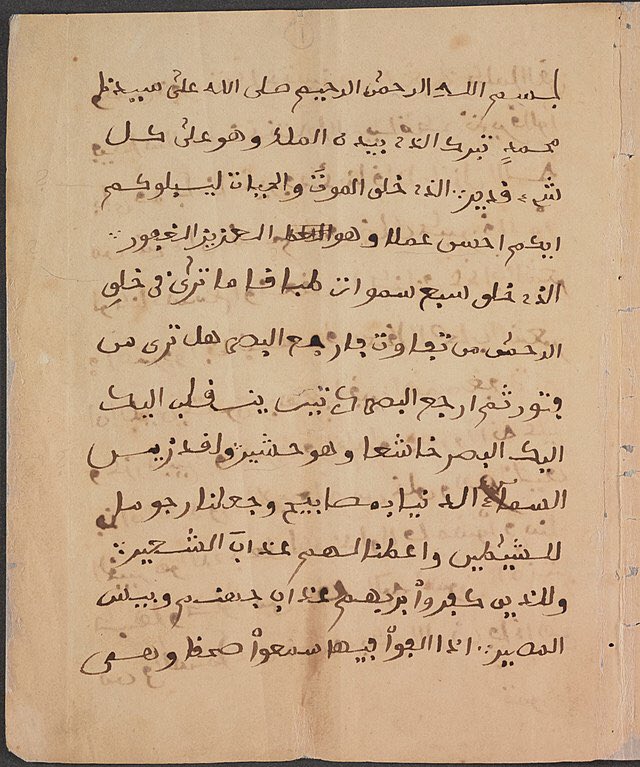
The Bakhshali manuscript, which has been carbon dated to 3rd century CE, is an ancient Hindu treatise on Arithmetic and Algebra.

The Algebraic problems deal with simultaneous equations, quadratic equations, arithmetic
geometric progressions & quadratic indeterminate equations.


Bakhshali isn't earliest Indian Algebraic treatise. Early Algebra is found in Shulba Sutras dating back to at least 800 BC. Traditional Algebra reached its pinnacle in the works of Aryabhata & Bhaskara.

What makes Bakhshali special is it offers mathematical proof to its theories


It is surprising to see that even after the ancient Indian algebraic treatise has been carbon dated to 3rd century CE by Oxford, they persist with "oh we invented Algebra. It is Halal".

A brief examination of the origins of "Halal Algebra" follows

https://t.co/eFIZ98FDrI


The earliest work of "Arabic Algebra" is the "Al-Kitāb Al-Jabr wal-muqābala" by Al Khwarizmi. The term "Algebra" comes from this book ("Al Jabr").

Before writing his treatise, Al Khwarizmi visited India. His book is a plagiarism from Indian Mathematics and an obvious one at that
THREAD: With #silversqueeze trending on Twitter, it appears that this week's market spectacle may well be in the silver market.

A perfect moment for a thread on the Hunt Brothers and their alleged attempt to corner the silver market...


1/ First, let's set the stage.

The Hunt Brothers - Nelson Bunker Hunt, William Herbert Hunt, and Lamar Hunt - were the sons of Texas tycoon H.L. Hunt.

H.L. Hunt had amassed a billion-dollar fortune in the oil industry.

He died in 1974 and left that fortune to his family.


2/ After H.L.'s passing, the Hunt Brothers had taken over the family holdings and successfully managed to expand the Hunt empire.

By the late 1970s, the family's fortune was estimated to be ~$5 billion.

In the financial world, the Hunt name was as good as gold (or silver!).


3/ But the 1970s were a turbulent time in America.

Following the oil crisis of the early 1970s, the U.S. had entered a period of stagflation - a dire macroeconomic condition characterized by high inflation, low growth, and high unemployment.


4/ The Hunt Brothers - particularly Nelson Bunker and William Herbert - believed that the inflationary environment would persist and destroy the value of their family's holdings.

To hedge this risk, they turned to silver.

They began buying the metal at ~$3 per ounce in 1973.

You May Also Like