Time for panel #3: Big Tech and regulation!
I will be live-tweeting again, and you can also watch video at either the Twitter or Facebook links below!
Bloomberg Ideas conference now starting! I will be live-tweeting it. You can watch on our Facebook or Twitter pages (links below)! https://t.co/Mbr9dZzWBy
— Noah Smith (@Noahpinion) October 25, 2018
Feldman: Inevitably, it will be the government.
Feldman: OK, so you mess up, you apologize, you replace your CEO, and you're fine!
Ritholtz: Uber lost market value because of Kalanick.
More from Noah Smith
Today's @bopinion post is about how poor countries started catching up to rich ones.
It looks like decolonization just took a few decades to start
Basic econ theory says poor countries should grow faster than rich ones.
But for much of the Industrial Revolution, the opposite happened.
https://t.co/JjjVtWzz5c
Why? Probably because the first countries to discover industrial technologies used them to conquer the others!
But then colonial empires went away. And yet still, for the next 30 years or so, poor countries fell further behind rich ones.
https://t.co/hilDvv0IQV
Why??
Possible reasons:
1. Bad institutions (dictators, communism, autarkic trade regimes)
2. Civil wars
3. Lack of education
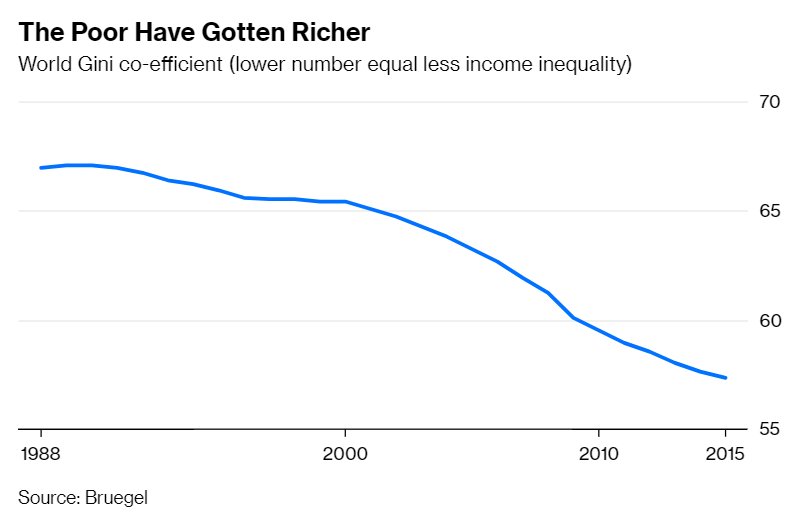
But then, starting in the 80s (for China) and the 90s (for India and Indonesia), some of the biggest poor countries got their acts together and started to catch up!
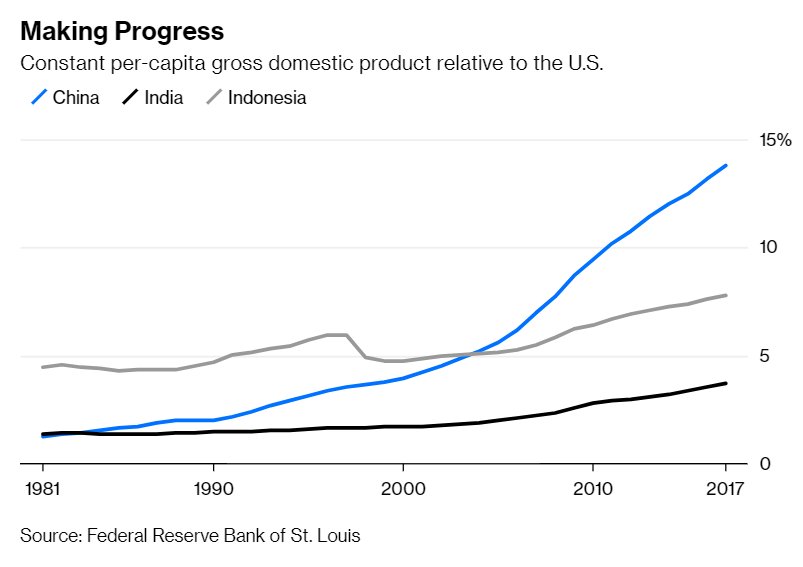
Global inequality began to fall.
It looks like decolonization just took a few decades to start
Basic econ theory says poor countries should grow faster than rich ones.
But for much of the Industrial Revolution, the opposite happened.
https://t.co/JjjVtWzz5c
Why? Probably because the first countries to discover industrial technologies used them to conquer the others!
But then colonial empires went away. And yet still, for the next 30 years or so, poor countries fell further behind rich ones.
https://t.co/hilDvv0IQV
Why??
Possible reasons:
1. Bad institutions (dictators, communism, autarkic trade regimes)
2. Civil wars
3. Lack of education
But then, starting in the 80s (for China) and the 90s (for India and Indonesia), some of the biggest poor countries got their acts together and started to catch up!
Global inequality began to fall.
1/I'm thinking about the end of Apu in the context of the national debates on immigration and diversity.
2/Apu's presence in Springfield represented a basic reality of America in the late 20th and early 21st century: the presence of nonwhite immigrants.
3/As Tomas Jimenez writes in "The Other Side of Assimilation", for my generation, immigrants from India, China, Mexico, and many other countries aren't strange or foreign. On the contrary, they're a
4/But that America I grew up with is fundamentally ephemeral. The kids of immigrants don't retain their parents' culture. They merge into the local culture (and, as Jimenez documents, the local culture changes to reflect their influence).
5/Simpsons character don't change. But real people, and real communities, do. So a character who once represented the diversity that immigrants brought to American towns now represents a stereotype of Indian-Americans as "permanent foreigners".
\u2018The Simpsons\u2019 producer confirms Apu is being written out of show following controversy https://t.co/lKzFCe1wFa pic.twitter.com/s34IUDUtqs
— NME (@NME) October 26, 2018
2/Apu's presence in Springfield represented a basic reality of America in the late 20th and early 21st century: the presence of nonwhite immigrants.
3/As Tomas Jimenez writes in "The Other Side of Assimilation", for my generation, immigrants from India, China, Mexico, and many other countries aren't strange or foreign. On the contrary, they're a
4/But that America I grew up with is fundamentally ephemeral. The kids of immigrants don't retain their parents' culture. They merge into the local culture (and, as Jimenez documents, the local culture changes to reflect their influence).
5/Simpsons character don't change. But real people, and real communities, do. So a character who once represented the diversity that immigrants brought to American towns now represents a stereotype of Indian-Americans as "permanent foreigners".
More from All






Took me 5 years to get the best Chartink scanners for Stock Market, but you’ll get it in 5 mminutes here ⏰
Do Share the above tweet 👆
These are going to be very simple yet effective pure price action based scanners, no fancy indicators nothing - hope you liked it.
https://t.co/JU0MJIbpRV
52 Week High
One of the classic scanners very you will get strong stocks to Bet on.
https://t.co/V69th0jwBr
Hourly Breakout
This scanner will give you short term bet breakouts like hourly or 2Hr breakout
Volume shocker
Volume spurt in a stock with massive X times
Do Share the above tweet 👆
These are going to be very simple yet effective pure price action based scanners, no fancy indicators nothing - hope you liked it.
https://t.co/JU0MJIbpRV
52 Week High
One of the classic scanners very you will get strong stocks to Bet on.
https://t.co/V69th0jwBr
Hourly Breakout
This scanner will give you short term bet breakouts like hourly or 2Hr breakout
Volume shocker
Volume spurt in a stock with massive X times




You May Also Like


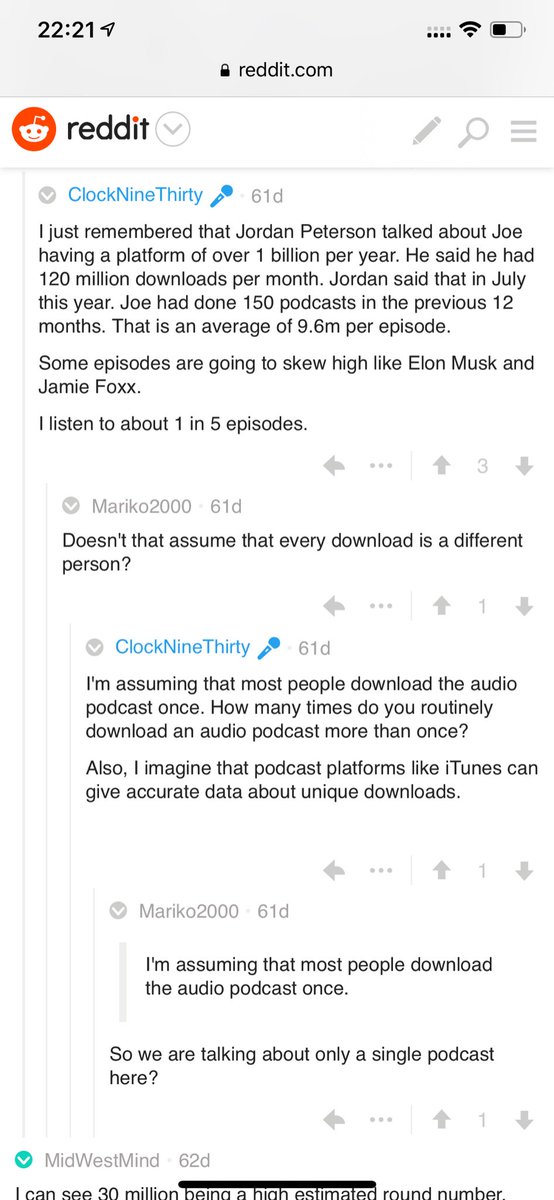
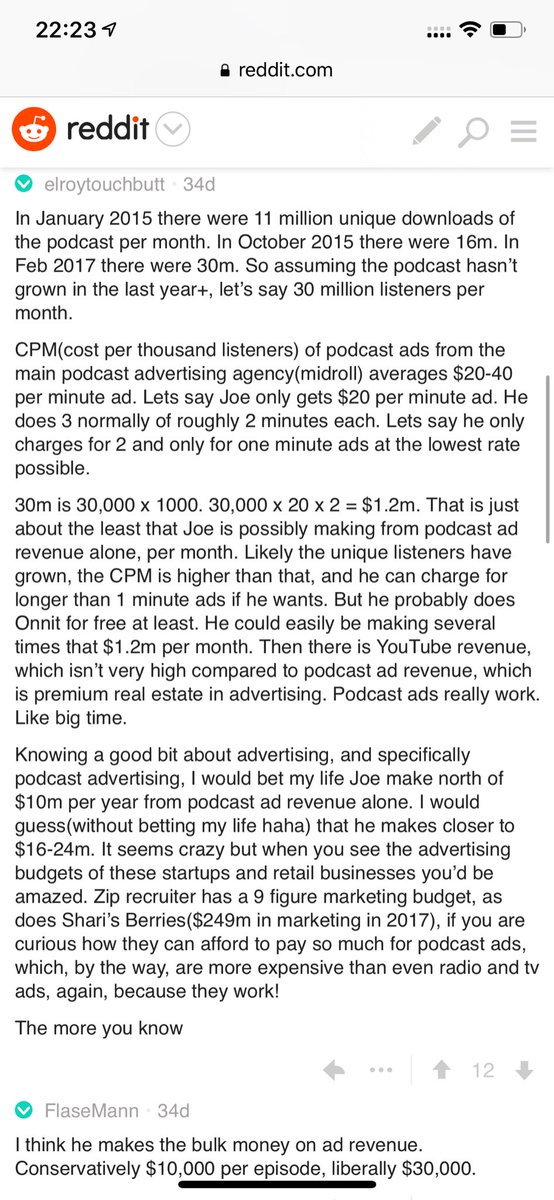
Joe Rogan's podcast is now is listened to 1.5+ billion times per year at around $50-100M/year revenue.
Independent and 100% owned by Joe, no networks, no middle men and a 100M+ people audience.
👏
https://t.co/RywAiBxA3s
Joe is the #1 / #2 podcast (depends per week) of all podcasts
120 million plays per month source https://t.co/k7L1LfDdcM
https://t.co/aGcYnVDpMu
Independent and 100% owned by Joe, no networks, no middle men and a 100M+ people audience.
👏
https://t.co/RywAiBxA3s
Joe is the #1 / #2 podcast (depends per week) of all podcasts
120 million plays per month source https://t.co/k7L1LfDdcM
https://t.co/aGcYnVDpMu