In 2012, my first options trade lost $9,000.

12 months later I was making $1,100 per week trading in my free time.

What changed?

I read 20 books on options and finished a master’s degree.

But what took my game to the next level was Python.

Here’s the code I still use today:

A quick primer on options in case you're not familiar:

• Over $450 billion in notional trades DAILY
• 39 million options contracts trade DAILY
• 25% of total options trading is from retail

So how do we make money?
Trade options with a simple, 3-part framework:

1. Design your risk
2. Value the position
3. Measure and monitor

Now pair this framework with Python and you get a potent combination for making money trading options.

Let's dig in:
To design our risk profile, we need the option payoff.

Let's start by defining the variables we need:

• Stock price
• Strike price
• Time to expiration
• Interest rate
• Volatility

We also define market prices for demonstrating trades.
Remember our payoff functions for calls and puts?

• call = max(S - K, 0)
• put = max(K - S, 0)

We can define them in Python in one line of code each.

And here's where it gets really interesting.
Using NumPy, we define a series of stock prices.

This gives us the payoff at each of these prices.

Then we plot the payoff against the stock prices and we have our famous hockey stick payoff chart for a call option!

We do the same thing for a put option.
We can clearly see that as the stock price decreases in price, the value of our put option increases.

Here's the amazing part of this...
Using this framework, we can construct any complex options position we want.

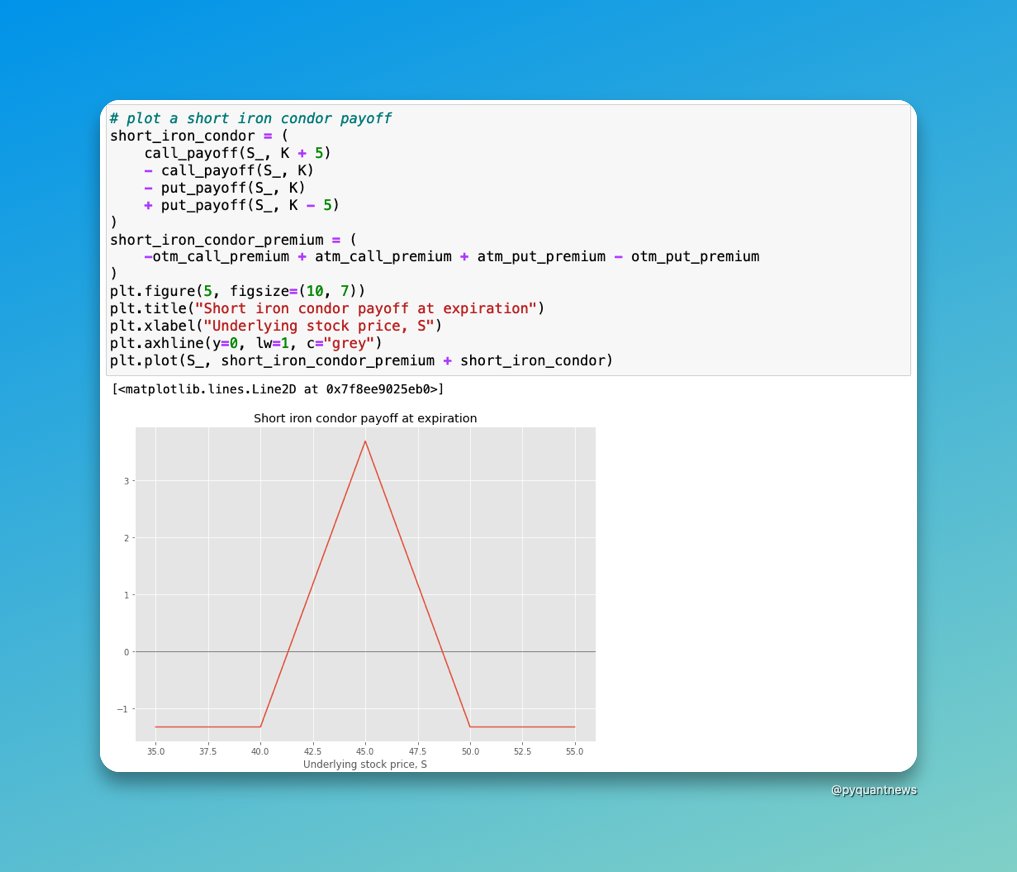
For example, I modeled a short straddle with breakeven points at $38.75 and $51.25 and max profit when the stock price is at $45.

Butterfly spread?
A butterfly spread is similar to a straddle except the loss is capped.

Because you're buying additional options to protect the downside, the premium collected is less than a straddle.

This is clear when you design your risk upfront.
The value in doing this FIRST is to pick the right position for the market.

Bullish?

Buy a call.

Bearish?

Buy a put.

Want to bet on volatility?

Buy a straddle.

Know the breakeven points, max gain and loss - before you put the trade on.

There's one thing missing though.
You'll notice all these payoffs happen when the options expire.

What about before they expire?

The Black-Scholes formula gives us the value of an option at any time before expiration.

In the next thread, we'll see how to build the formula in Python.

Here's a preview:
Now, you can apply this framework to your analysis.

Step 1 is understanding risk before you make the trade.

If you want to learn how to do this with Python, grab my 46-Page Ultimate Guide to Pricing Options and Implied Volatility with Python.

https://t.co/uUXgYrCqgx
PyQuant News writes about resources for using Python for quantitative and data analysis.

• Reply to this thread with any questions
• Follow me @pyquantnews for more of these
• RT the tweet below to share this thread with your audience https://t.co/5BrPwf19lc
A few people asked me about books for options.

Start here:

https://t.co/cF5wUTyjNp
https://t.co/OlMy9zFGL3
More from PyQuant News

More from All

How can we use language supervision to learn better visual representations for robotics?

Introducing Voltron: Language-Driven Representation Learning for Robotics!

Paper: https://t.co/gIsRPtSjKz
Models: https://t.co/NOB3cpATYG
Evaluation: https://t.co/aOzQu95J8z

🧵👇(1 / 12)


Videos of humans performing everyday tasks (Something-Something-v2, Ego4D) offer a rich and diverse resource for learning representations for robotic manipulation.

Yet, an underused part of these datasets are the rich, natural language annotations accompanying each video. (2/12)

The Voltron framework offers a simple way to use language supervision to shape representation learning, building off of prior work in representations for robotics like MVP (
https://t.co/Pb0mk9hb4i) and R3M (https://t.co/o2Fkc3fP0e).

The secret is *balance* (3/12)

Starting with a masked autoencoder over frames from these video clips, make a choice:

1) Condition on language and improve our ability to reconstruct the scene.

2) Generate language given the visual representation and improve our ability to describe what's happening. (4/12)

By trading off *conditioning* and *generation* we show that we can learn 1) better representations than prior methods, and 2) explicitly shape the balance of low and high-level features captured.

Why is the ability to shape this balance important? (5/12)

You May Also Like

IMPORTANCE, ADVANTAGES AND CHARACTERISTICS OF BHAGWAT PURAN

It was Ved Vyas who edited the eighteen thousand shlokas of Bhagwat. This book destroys all your sins. It has twelve parts which are like kalpvraksh.

In the first skandh, the importance of Vedvyas


and characters of Pandavas are described by the dialogues between Suutji and Shaunakji. Then there is the story of Parikshit.
Next there is a Brahm Narad dialogue describing the avtaar of Bhagwan. Then the characteristics of Puraan are mentioned.

It also discusses the evolution of universe.(
https://t.co/2aK1AZSC79 )

Next is the portrayal of Vidur and his dialogue with Maitreyji. Then there is a mention of Creation of universe by Brahma and the preachings of Sankhya by Kapil Muni.


In the next section we find the portrayal of Sati, Dhruv, Pruthu, and the story of ancient King, Bahirshi.
In the next section we find the character of King Priyavrat and his sons, different types of loks in this universe, and description of Narak. ( https://t.co/gmDTkLktKS )


In the sixth part we find the portrayal of Ajaamil ( https://t.co/LdVSSNspa2 ), Daksh and the birth of Marudgans( https://t.co/tecNidVckj )

In the seventh section we find the story of Prahlad and the description of Varnashram dharma. This section is based on karma vaasna.