My master's degree completely failed to teach me how to test trading strategies.

So I spent 40 hours looking for Python backtesting libraries.

Then I started using the best ones.

But unlike my quant finance degree, these won't cost you $90,000.

Here they are for free.

AutoTrader

AutoTrader is Python-based platform intended to help in the development, optimisation and deployment of automated trading systems.

https://t.co/XOiPXFpviA
Zipline

From Quantopian (acquired by Robinhood) the first to democratize quant trading, comes Zipline. It's a robust, fully-featured backtesting library which features slippage models, robust data handing and rich metrics.

https://t.co/qaFcddK9qh
backtrader

backtrader features live data and trading, filters and multiple data feeds at once.

https://t.co/3OhgjbDet0
backtesting .py

backtesting .py features a simple well-documented API, fast execution and a library of built-in base strategies.

https://t.co/UN4GILA8Gd
Vectorbt

Vectorbt helps find your trading edge, using the fastest engine for backtesting, algorithmic trading, and research.

https://t.co/t7k2pfDPrT
OctoBot

OctoBot is a cryptocurrency trading bot for TA, arbitrage and social trading with an advanced web interface

https://t.co/UTtJhWaQ9U
Gemini

Gemini is another cryptocurrency backtesting engine that focuses on simplicity.

https://t.co/tf0CosBqgG
Quantdom

Quantdom is a powerful backtesting framework that let's you focus on modeling financial strategies, portfolio management, and analyzing backtests.

https://t.co/dZV4jJAEQK
alpaca-backtrader-api

alpaca-backtrader-api allows rapid trading algo development easily, with support for the both REST and streaming interfaces.

https://t.co/PCAf3GvECn
Save yourself $90,000.

Use the 9 best (free) Python backtesting libraries to improve your trading:

• Zipline
• Gemini
• OctoBot
• Vectorbt
• Quantdom
• AutoTrader
• backtrader
• backesting .py
• alpaca-backtrader-api
If you're into trading options, check out the Ultimate Guide to Pricing Options and Implied Volatility:

• Compute Black-Scholes, the greeks, and implied volatility
• Includes a Jupyter Notebook with the code
• How to use Python to analyze the results

https://t.co/uUXgYrCqgx
PyQuant News writes about resources for using Python for quantitative and data analysis.

• Reply to this thread with any questions
• Follow me @pyquantnews for more of these
• RT the tweet below to share this thread with your audience https://t.co/dKE57ob8uL

More from PyQuant News

More from All

How can we use language supervision to learn better visual representations for robotics?

Introducing Voltron: Language-Driven Representation Learning for Robotics!

Paper: https://t.co/gIsRPtSjKz
Models: https://t.co/NOB3cpATYG
Evaluation: https://t.co/aOzQu95J8z

🧵👇(1 / 12)


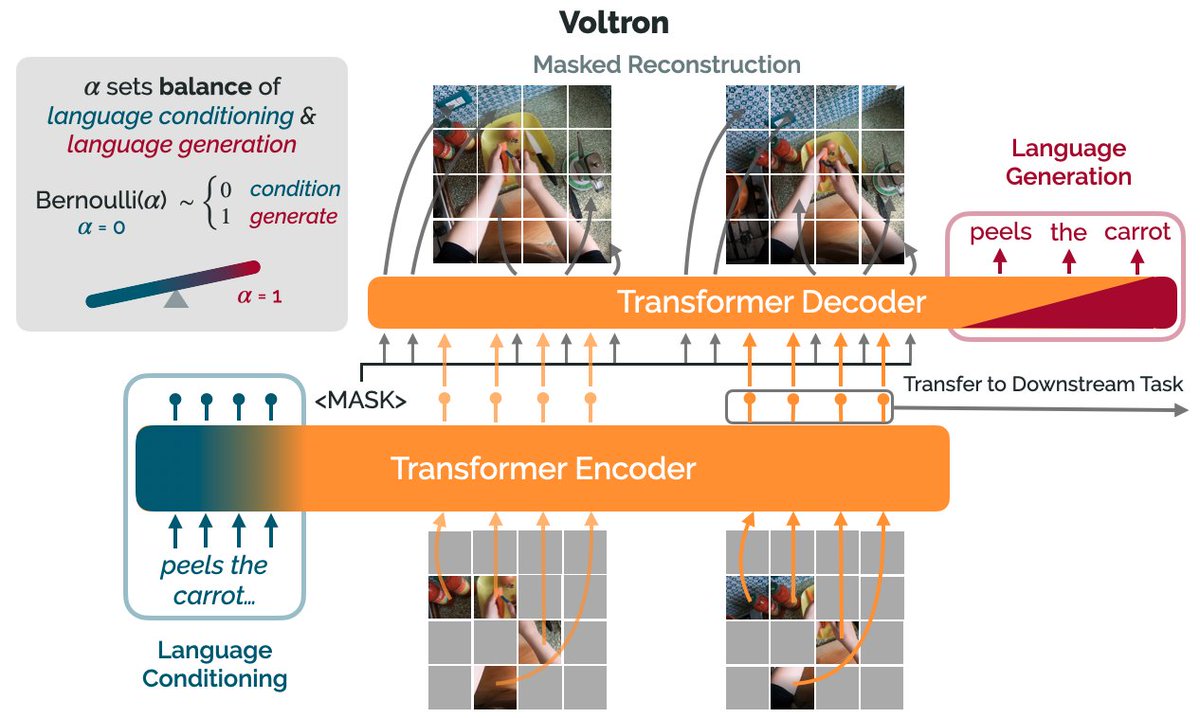
Videos of humans performing everyday tasks (Something-Something-v2, Ego4D) offer a rich and diverse resource for learning representations for robotic manipulation.

Yet, an underused part of these datasets are the rich, natural language annotations accompanying each video. (2/12)

The Voltron framework offers a simple way to use language supervision to shape representation learning, building off of prior work in representations for robotics like MVP (
https://t.co/Pb0mk9hb4i) and R3M (https://t.co/o2Fkc3fP0e).

The secret is *balance* (3/12)

Starting with a masked autoencoder over frames from these video clips, make a choice:

1) Condition on language and improve our ability to reconstruct the scene.

2) Generate language given the visual representation and improve our ability to describe what's happening. (4/12)

By trading off *conditioning* and *generation* we show that we can learn 1) better representations than prior methods, and 2) explicitly shape the balance of low and high-level features captured.

Why is the ability to shape this balance important? (5/12)
The best morning routine?

Starts the night before.

9 evening habits that make all the difference:

1. Write down tomorrow's 3:3:3 plan

• 3 hours on your most important project
• 3 shorter tasks
• 3 maintenance activities

Defining a "productive day" is crucial.

Or else you'll never be at peace (even with excellent output).

Learn more


2. End the workday with a shutdown ritual

Create a short shutdown ritual (hat-tip to Cal Newport). Close your laptop, plug in the charger, spend 2 minutes tidying your desk. Then say, "shutdown."

Separating your life and work is key.

3. Journal 1 beautiful life moment

Delicious tacos, presentation you crushed, a moment of inner peace. Write it down.

Gratitude programs a mindset of abundance.

4. Lay out clothes

Get exercise clothes ready for tomorrow. Upon waking up, jump rope for 2 mins. It will activate your mind + body.

You May Also Like

"I lied about my basic beliefs in order to keep a prestigious job. Now that it will be zero-cost to me, I have a few things to say."


We know that elite institutions like the one Flier was in (partial) charge of rely on irrelevant status markers like private school education, whiteness, legacy, and ability to charm an old white guy at an interview.

Harvard's discriminatory policies are becoming increasingly well known, across the political spectrum (see, e.g., the recent lawsuit on discrimination against East Asian applications.)

It's refreshing to hear a senior administrator admits to personally opposing policies that attempt to remedy these basic flaws. These are flaws that harm his institution's ability to do cutting-edge research and to serve the public.

Harvard is being eclipsed by institutions that have different ideas about how to run a 21st Century institution. Stanford, for one; the UC system; the "public Ivys".