CodyyyGardner Categories Society
7 days
30 days
All time
Recent
Popular









#Thread: Though it's important to shed light on the ongoing humanitarian crisis in #Yemen, you could read this entire @reuters article (and most articles written about Yemen) and not know why this boy is starving or who is responsible for these conditions:
The boy travelled from Al-Jawf to Sana'a because al-Jawf is among "high intensity battlefronts" & is the target of repeated civilian airstrikes. https://t.co/1KlIN5ixTf
Also, roads are "damaged" because they're frequently bombed by US/Saudi airstrikes:
Shockingly, he's one of the lucky ones who managed to make it to a hospital.
Only 51% of health facilities are (barely) functioning: https://t.co/GBgKXM562t
And hospitals have been frequently targeted by airstrikes: For example:
International aid & donations are necessary for Faid & millions to survive because of the Saudi/US/UAE blockade that prevents Yemenis from trade and makes them reliant on aid instead. Before the war, Yemen imported 90% of its food; now, 80% rely on aid.
Famine hasn't been declared because the UN faces immense pressure from its top donors, the US & Saudi, who are also causing the famine in Yemen.
The US went as far as pressuring the UN to restrict aid to Northern Yemen, where 70% of Yemenis live:
The boy travelled from Al-Jawf to Sana'a because al-Jawf is among "high intensity battlefronts" & is the target of repeated civilian airstrikes. https://t.co/1KlIN5ixTf
Also, roads are "damaged" because they're frequently bombed by US/Saudi airstrikes:
Shockingly, he's one of the lucky ones who managed to make it to a hospital.
Only 51% of health facilities are (barely) functioning: https://t.co/GBgKXM562t
And hospitals have been frequently targeted by airstrikes: For example:
International aid & donations are necessary for Faid & millions to survive because of the Saudi/US/UAE blockade that prevents Yemenis from trade and makes them reliant on aid instead. Before the war, Yemen imported 90% of its food; now, 80% rely on aid.
Famine hasn't been declared because the UN faces immense pressure from its top donors, the US & Saudi, who are also causing the famine in Yemen.
The US went as far as pressuring the UN to restrict aid to Northern Yemen, where 70% of Yemenis live:


1/ Some people are looking at this map and saying: "it must have come from Europe". Here are a few reasons why that is unlikely.
2/ Though B.1.1.7 was especially prominent in Kent, the 2nd sequence ever sequenced was found in London, a day after the 1st. Due to superspreading it isn't possible to pinpoint for sure whether it originated in Kent or London. (If London, there's no argument for the continent).
3/ And suppose we did believe the new variant was introduced from abroad. Would we expect it to be introduced by sea or air? Far more arrivals to the UK in August/September occurred by air compared to sea.
4/ Genetic evidence. Suppose this highly transmissible variant had arisen in some other country, and made its way through France to the UK. It would also have left lots of descendants in Europe. We can look at a genetic tree of sequences and see that that is not the case.
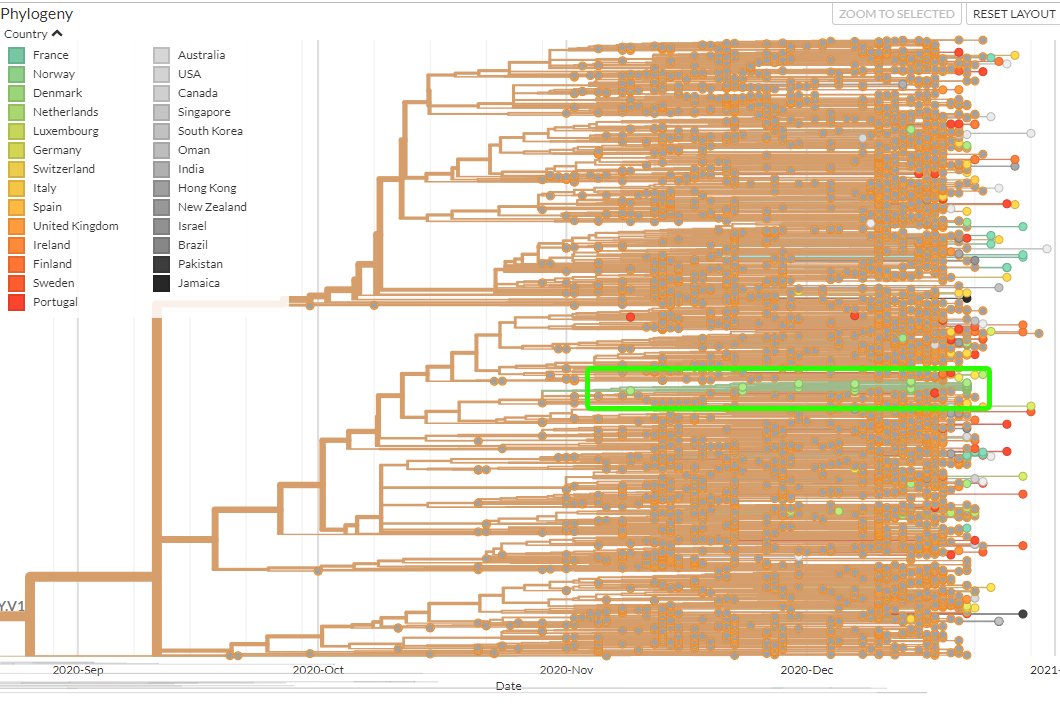
5/ The grey/orange sequences here are UK sequences and the others are from an array of other countries. Specifically I've highlighted a lineage in Denmark which represents spread from a single introduction to Denmark, ultimately from the UK.
The spread of B.1.1.7 through England over November and December, with London inset at top-right. pic.twitter.com/fVfL0xijcx
— Theo Sanderson (@theosanderson) January 8, 2021
2/ Though B.1.1.7 was especially prominent in Kent, the 2nd sequence ever sequenced was found in London, a day after the 1st. Due to superspreading it isn't possible to pinpoint for sure whether it originated in Kent or London. (If London, there's no argument for the continent).
3/ And suppose we did believe the new variant was introduced from abroad. Would we expect it to be introduced by sea or air? Far more arrivals to the UK in August/September occurred by air compared to sea.
4/ Genetic evidence. Suppose this highly transmissible variant had arisen in some other country, and made its way through France to the UK. It would also have left lots of descendants in Europe. We can look at a genetic tree of sequences and see that that is not the case.
5/ The grey/orange sequences here are UK sequences and the others are from an array of other countries. Specifically I've highlighted a lineage in Denmark which represents spread from a single introduction to Denmark, ultimately from the UK.









1/14
Excellent question!
"Risk/reward ratio" is a term used in investing, but it's rarely quantified like one would quantify a debt/assets ratio. Risk/reward ratio is usually used more intuitively.
2/14
Usually people will use all their knowledge to make guesstimates about an investment like:
- 20% chance to go bust
- 20% chance to break-even
- 40% chance to double
- 10% chance to 4x
- 10% chance to 10x
And then state "for me, this is good from a risk/reward standpoint".
3/14
That last statement will be different for each individual though. For some people the investment laid out above may be great from a risk/reward standpoint, because of the high expected ROI. For others, it may be terrible because of the 20% chance to go bust.
4/14
Investing is much more complex than just making money and maximizing returns, and investment strategies should differ from individual to individual. If this is news to you, I strongly suggest you read through the first section of this blog
5/14
The final section of the same blog post goes into depth on $TSLA call options, and how I go about evaluating them. There is even a subsection called "The Risk Reward of Call Options" that should answer a lot of your questions.
Excellent question!
"Risk/reward ratio" is a term used in investing, but it's rarely quantified like one would quantify a debt/assets ratio. Risk/reward ratio is usually used more intuitively.
@FrankPeelen I\u2019m curious what you think is a good risk/reward ratio and how do you generally calculate that to help inform your decision to buy options? Appreciate your insights!
— Dianne Francisco (@dfrancisco910) December 30, 2020
2/14
Usually people will use all their knowledge to make guesstimates about an investment like:
- 20% chance to go bust
- 20% chance to break-even
- 40% chance to double
- 10% chance to 4x
- 10% chance to 10x
And then state "for me, this is good from a risk/reward standpoint".
3/14
That last statement will be different for each individual though. For some people the investment laid out above may be great from a risk/reward standpoint, because of the high expected ROI. For others, it may be terrible because of the 20% chance to go bust.
4/14
Investing is much more complex than just making money and maximizing returns, and investment strategies should differ from individual to individual. If this is news to you, I strongly suggest you read through the first section of this blog
5/14
The final section of the same blog post goes into depth on $TSLA call options, and how I go about evaluating them. There is even a subsection called "The Risk Reward of Call Options" that should answer a lot of your questions.
