CodyyyGardner Categories Health





A well-balanced piece. Bed occupancy rate in NHS is actually lower than usual - even with fewer beds. (Though spare capacity has been created through cancellation of non-urgent operations etc, and higher levels of staff sickness are causing pressures.) https://t.co/CH8hGcFOs9
— Paul Embery (@PaulEmbery) January 8, 2021
Under normal circumstances, most NHS acute hospitals will have several types of inpatient areas
1. Assessment unit
2. Specialty wards
3. Intensive care
As well as outpatients, emergency department, day case surgery etc.
Patients admitted from A&E would go to 1, then move to 2. Some might go directly to 2, sickest ones to 3.
In many hospitals, the assessment unit is vital to flow of patients out of Emergency Department.
With COVID, several blocks have been introduced. Firstly patients have to be treated as "hot" in 2m apart bed spaces until their test results are back. This reduces an average six bedded bay to four.
There are rapid tests that turn around in around an hour or two, but their availability is limited. PCR still takes up to 24 hours to get back (often quicker), and lateral flow in the population admitted to hospital isn't sensitive enough to pick up silent cases.


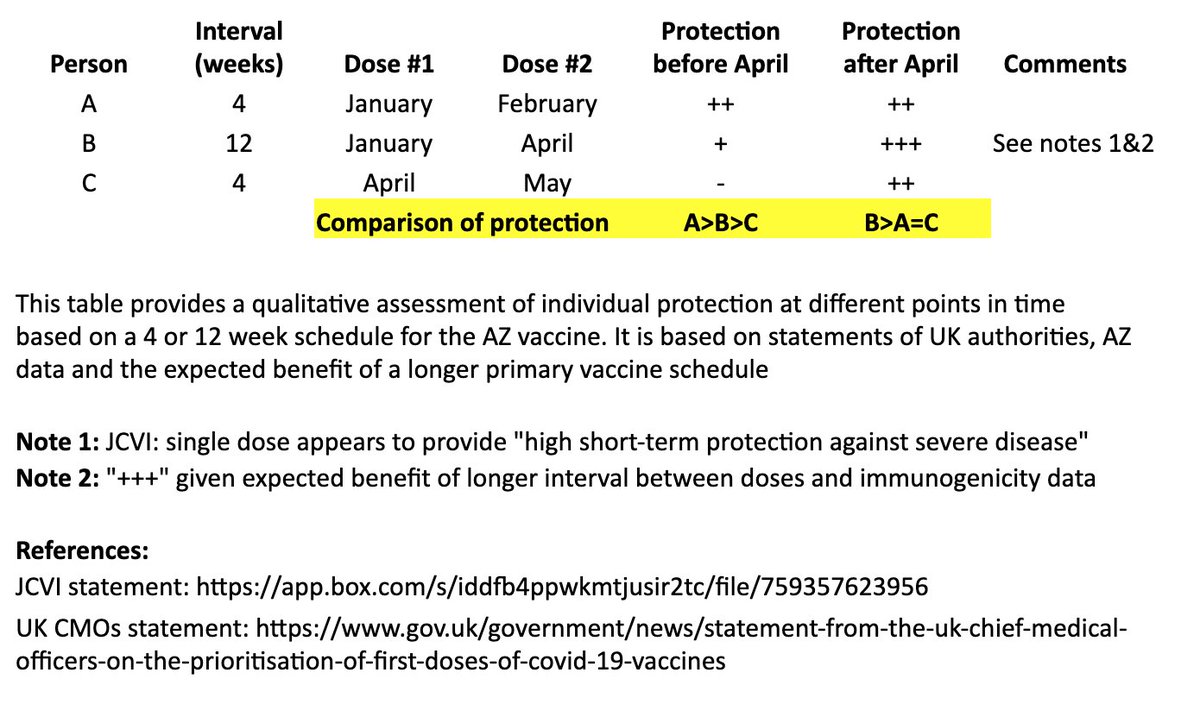
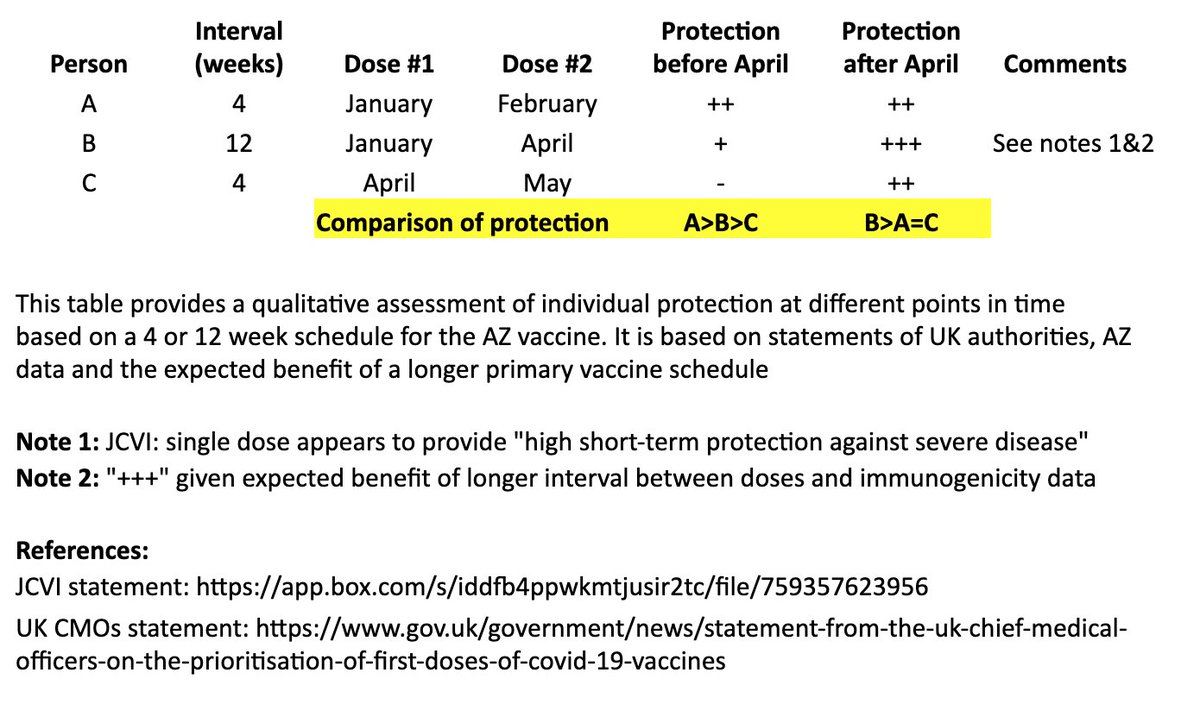
I created a simple table to illustrate the individual impact of the "flexible second dose timing" now recommended in the UK.
Coincidentally, @bob_wachter & @ashishkjha just tackled the US policy question in this important piece. 1/
https://t.co/n5bHkdIo0c
In @washingtonpost, @ashishkjha & I argue for the 2nd-shot-deferred strategy, partly by invoking the Mike Tyson principle. https://t.co/ZxrgVj3TJe We both came to this view because of the slow rollout & the new variant. But it's a tough call and reasonable people will disagree.
— Bob Wachter (@Bob_Wachter) January 3, 2021
I based this on recent statements from the UK chief medical officers, JCVI, and what we know from prior vaccine development. 2/
JCVI: https://t.co/6FQ25d6MFE
UK Chief Medical Officer (CMO) statement: https://t.co/RTpAIqgE1i
CMO letter to the profession:
This table and thread focuses on the AZ vaccine, where more data on a delayed second dose is available than with the Pfizer vaccine. It is not intended to address questions about single-dose regimens or mix & match approaches. 3/
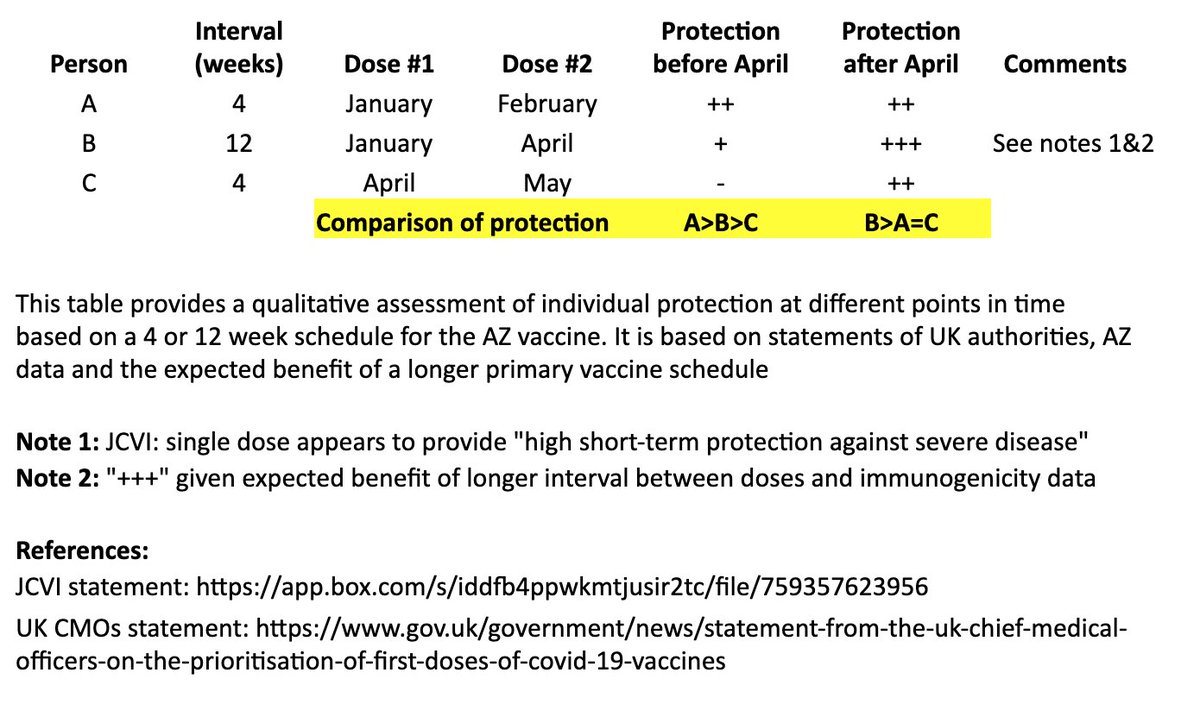
In the table, persons “A” and “B” both receive their first dose in January. “A” receives their second dose in February (4 weeks later), and “B” receives their second dose in April (12 weeks later). “C” receives their first dose in April and second dose in May (4 weeks later). 4/
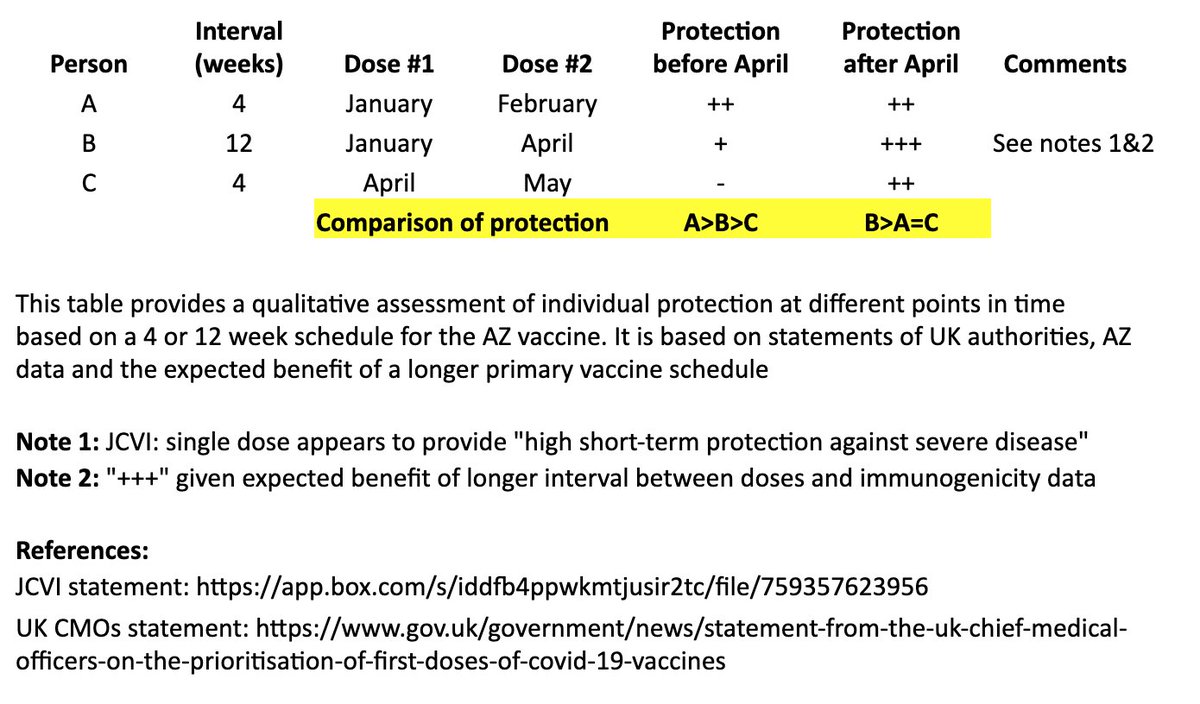
I made a qualitative comparison the potential efficacy during the two months between “A” and “B’s” second dose, as well as the potential longer-term efficacy after “B” receives their second dose. 5/


https://t.co/8amD9PQhfO
So overwhelmed. Filmed in A Cardiff Hospital (disclaimer. Not by me!) . Notice the empty beds also. \U0001f92c\U0001f92c pic.twitter.com/dZcE9cMERy
— Tracy make the world great \U0001f4ab (@TracyICQ) December 30, 2020
https://t.co/pmCsSJ6a1p
Romford Hospital - my man on the ground was there for over an hour. pic.twitter.com/jk0BxtLF5o
— Ministry Of Dissent, #EndTheLockdown #KBF (@MinistryDissent) December 30, 2020
https://t.co/KRPpFVCSgz
Don\u2019t know who this is or when it was filmed, but it raises questions #NightingaleHospitals pic.twitter.com/eyuIZuJGDz
— R Bemath (@RBemath) December 29, 2020
https://t.co/9iyvqPyo9O
Worth noting on hospital occupancy. I\u2019m hearing anecdotal evidence of same from whistleblowers in hospitals including in London. https://t.co/fahC18EbEw
— Richard Tice (@TiceRichard) December 29, 2020