Alex1Powell's Categories
Alex1Powell's Authors


Latest Saves

My first piece on Jill Biden\u2019s dissertation was just me getting warmed up. This gets into the substance and contains lots of direct quotation of her shockingly bad writing. https://t.co/VeA67VVhIf
— Kyle Smith (@rkylesmith) December 17, 2020
The main allegations of his post are that Dr. Biden isn't a great writer and that she didn't do what Smith considers an adequate amount of work to justify her degree. It isn't shocking that he'd avoid substantive critique, as he lacks the expertise to make it.
In the paragraph below 👇, Smith takes Biden's citation pattern – for a potted, perfunctory history of community colleges (which isn't intended to be anything else) – as evidence that she couldn't be bothered to do the reading.

Did he bother to look at the books? At least check their tables of contents? One can find some basic information online. Cohen & Brawer (2003) appears to be a standard textbook on community colleges (cited 5400+ times). The page ranges reflect... relevant parts of the text.

I couldn't find a TOC with pagination for Witt et al., but here's a summary of the contents 👇. Again, given the substance the page ranges aren't terribly surprising, especially since she cites a different source for her *two sentences* on the pre-crash 1920s.


Past Presidents....Zuckerberg, Gates...
All C_A... the Family business.... The company...
BREAKING\u2014 \u201cThis \u2018SHADOW GOVERNMENT\u2019 had a huge hand in running the show on Nov. 3 and you may have not known it\u201d says attorney Phil Kine. @newsmax pic.twitter.com/8ypASTEA1Z
— White Rabbit News \u277c (@WhiteRabbitNN) December 17, 2020
2. Past Presidents....Zuckerberg, Gates...
All C_A... the Family business.... The company...The Farm.... all C_A assets... most of them related by blood, business, or marriage...

3. "The individual is handicapped by coming face-to-face with a conspiracy so monstrous he cannot believe it exists. The American mind simply has not come to a realization of the evil which has been introduced into our midst." - J. Edgar Hoover

4. diff. names & faces.... Monsters that lurk in the Shadows. Swamp, Deep State, Establishment, Globalist Elite Cabal...
Shall we go back...How far back...

5. I know these monsters... it's when I try to explain them to others is when I run into a problem.This is why I'm better at retweeting and compiling. I never know where to start... Everytime I try to thread, i end up w/ a messy monstrous web.I'm better at helping others thread.




Our community - American Jewish parents, schools, synagogues, & org\u2019s - have failed. We & our children are virtually all illiterate. I mean that literally. Most of us don\u2019t understand Hebrew or any Jewish language. We lack basic familiarity w/ our history & the Jewish bookshelf.
— Rabbi Reuvane (@RabbiReuvane) December 16, 2020
He was baffled by his Jewish education topping out at the Babylonian and Roman exiles. He was enthralled with the lives of the early Rabbis, and how Jewish intellectual culture developed over the centuries. There was more than a little bit of anger at what he'd been deprived. 2/
I had the same experience when I did my MA in Hebrew Bible at JTS. I grew up very involved in my synagogue through high school, and went on the Alexander Muss program in Israel. I came out of all that not even knowing what the Mishna or the Talmud were, and I'm a good student. 3/
My honest appraisal is that most of our Progressive synagogues were created to be institutions that helped new Jewish immigrant families integrate into American culture, and we haven't shifted from that. My one quibble with @RabbiReuvane is with the de-assimilation piece. 4/
It's not about de-assimilation, but re-integration. Our institutions broadly accomplished the goal of helping folks like my Ashki great grandparents and their descendants gain access to mainstream acceptance just like other white European immigrant groups in America. 5/


This paper by Abenavoli was actually pub. in 2019, but I didn’t see it til Jan. My view is that improving outcomes for #devlangdis #DLD requires improved early years provision. However, even for the best programmes, positive effects fade out over time.
The paper provides a useful summary of why that might be and what we can do to address this – hint: we can’t just focus on early intervention, but need to know what comes next. 3/
This paper was written by some of my favourite people and SCALES collaborators. I like it because it is a rare paper that attempts to understand how differences in school placement might affect outcomes. https://t.co/qq1cWHwDA4 4/
I often get asked about this WRT #DLD, but it is hard to say b/c school places are not randomly allocated – they are influenced by child and family characteristics. Th paper by Simonoff et al. gives me some ideas of how we might approach similar questions in SCALES. 5/


After all these years... remainers still go "AH HA but fishing is a tiny contribution to the economy".. Well why might that be? Why has it withered? Why has it become a totemic issue in our relationship with Brussels? Yes it is tiny now. But for millions that's the sodding point.
— Harry Cole (@MrHarryCole) December 17, 2020
1. Fishing had been declining for much of the twentieth century. The number of UK fishermen more than halved in mid-century: from nearly 48,000 in 1938 to 21,000 in 1970. By 1970 - the year *before* the UK signed the Treaty of Accession - fishing made up less than 0.1% of UK GDP.
2. That decline had many causes. A century of over-fishing had left stocks dangerously depleted. Younger generations were moving out, in search of safer and better-paid work inland. And the "Cod Wars" with Iceland (1958-76) triggered the collapse of the Atlantic trawler fleet.
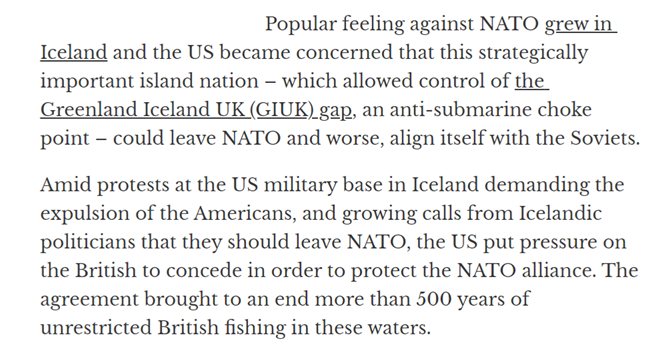
3. The "Cod Wars", in which Iceland expelled GB trawlers from its waters, were a grim reminder (a) that other states have sovereignty too & (b) that power-politics still exist outside the EU. For Cold-War reasons, the US backed Iceland. The UK had to fold. https://t.co/t8wdvtCgMb
4. There were other challenges, too. In the early 1970s, Norway & Iceland were dumping large quantities of frozen fish on the British market, driving down prices for domestic suppliers. The fishing fleet badly needed investment for modernisation but was struggling to raise funds.

