Jay_millerjay Categories Society

1. There is an issue with hostility some academics have faced on some issues
2. Another academic who himself uses threats of legal action to bully colleagues into silence is not a good faith champion of the free speech cause
How about Selina Todd, Kathleen Stock, Jo Phoenix, Rachel Ara, Sarah Honeychurch, Michele Moore, Nina Power, Joanna Williams, Jenny Murray, Julia Gasper ...
— Matt Goodwin (@GoodwinMJ) February 17, 2021
Or is it only Eric you pop at?
Are they all making it up too Rob?
Are they "beyond parody"? https://t.co/drQssTD0OL
I have kept quiet about Matthew's recent outpourings on here but as my estwhile co-author has now seen fit to portray me as an enabler of oppression I think I have a right to reply. So I will.
I consider Matthew to be a colleague and a friend, and we had a longstanding agreement not to engage in disputes on twitter. I disagree with much in the article @UOzkirimli wrote on his research in @openDemocracy but I strongly support his right to express such critical views
I therefore find it outrageous that Matthew saw fit to bully @openDemocracy with legal threats, seeking it seems to stifle criticism of his own work. Such behaviour is simply wrong, and completely inconsistent with an academic commitment to free speech.
I am not embroiling myself in the various other cases Matt lists because, unlike him, I think attention to the detail matters and I don't have time to research each of these cases in detail.


Here again is a summary of the Christian Abolitionists’ arguments against enslavers’ appeals to the Scripture: Thread
Slavery is not a sin. It is never outlawed by the Bible. Manstealing is but not slavery.
— micah (@laborersarefew) February 20, 2021
Murdering babies and sodomy are sins according the the Bible. YOU don't get to make up things as you go Dolly, neither do I or Malachi.

https://t.co/eXLNam2gv4

Good. Fuck Rush Limbaugh, and let the celebration about his death be a reminder to the rest of the racists and bigots that we\u2019ll happily dance on your graves too.
— Chris Kluwe, Irredeemable Pudgy Nobody (@ChrisWarcraft) February 17, 2021

While this will likely to be the case, this should not be an automatic cause for concern. Cases could still remain contained.
Here's how: 🧵
One of @CDCgov's own models has tracked the true decline in cases quite accurately thus far.
Their projection shows that the B.1.1.7 variant will become the dominant variant in March. But interestingly... there's no fourth wave. Cases simply level out:
https://t.co/tDce0MwO61
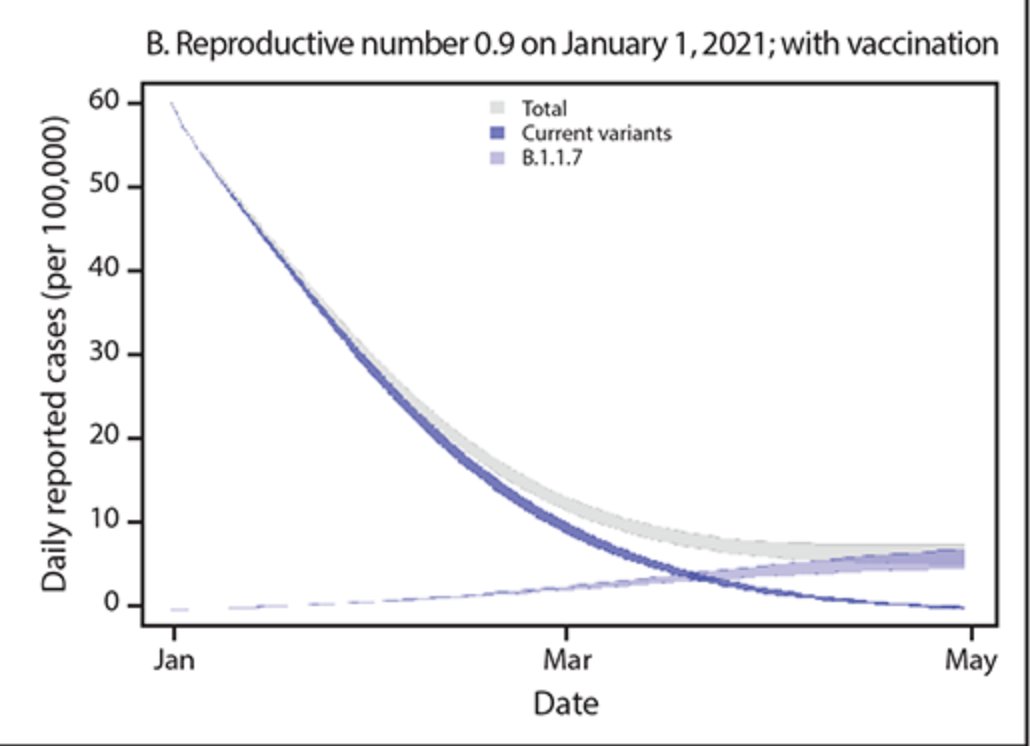
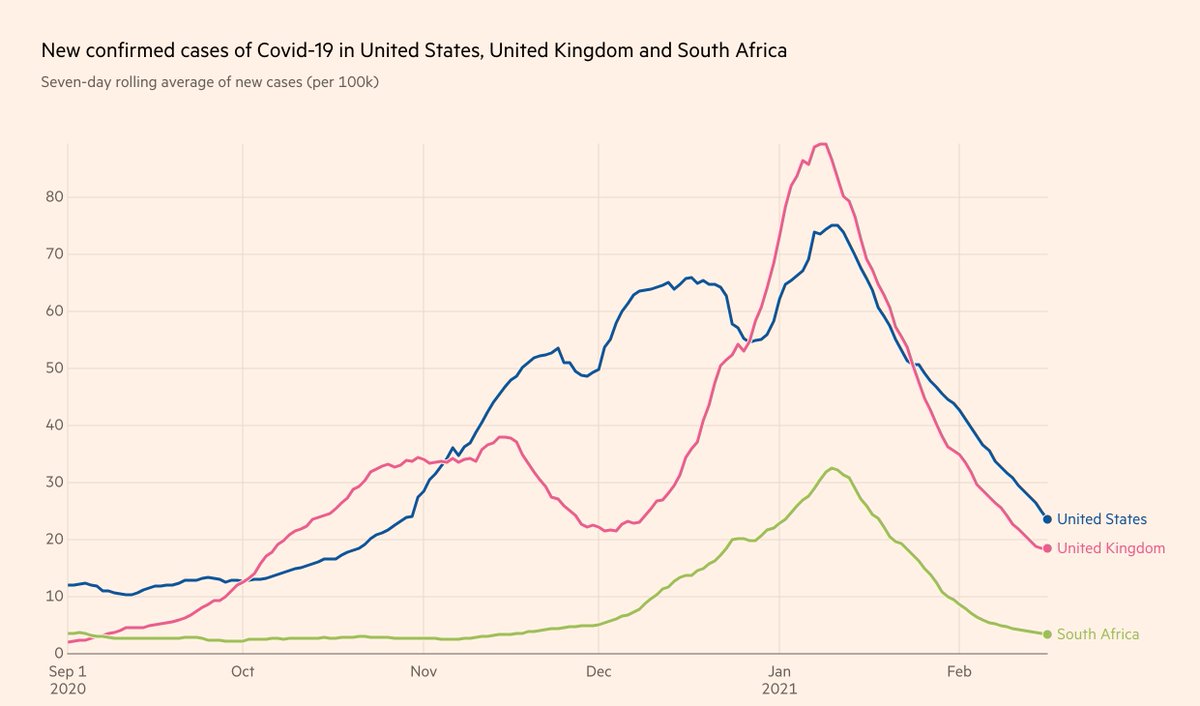
Just because a variant becomes the dominant strain does not automatically mean we will see a repeat of Fall 2020.
Let's look at UK and South Africa, where cases have been falling for the past month, in unison with the US (albeit with tougher restrictions):
Furthermore, the claim that the "variant is doubling every 10 days" is false. It's the *proportion of the variant* that is doubling every 10 days.
If overall prevalence drops during the studied time period, the true doubling time of the variant is actually much longer 10 days.
Simple example:
Day 0: 10 variant / 100 cases -> 10% variant
Day 10: 15 variant / 75 cases -> 20% variant
Day 20: 20 variant / 50 cases -> 40% variant
1) Proportion of variant doubles every 10 days
2) Doubling time of variant is actually 20 days
3) Total cases still drop by 50%


My reporting here convinced me that there's no large effect in either direction on labor force participation from child allowances. Canada has a bigger one than either Romney or Biden are considering, and more labor force participation among women.
But what if that wasn't true?
Forcing parents into low-wage, often exploitative, jobs by threatening them and their children with poverty may be counted as a success by some policymakers, but it’s a sign of a society that doesn’t value the most essential forms of labor.
The problem is in the very language we use. If I left my job as a New York Times columnist to care for my 2-year-old son, I’d be described as leaving the labor force. But as much as I adore him, there is no doubt I’d be working harder. I wouldn't have stopped working!
I tried to render conservative objections here fairly. I appreciate that @swinshi talked with me, and I'm sorry I couldn't include everything he said. I'll say I believe I used his strongest arguments, not more speculative ones, in the piece.
I appreciate his intellectual curiosity and effort. I have quibbles. But my big disappointment is there was no mention of unintended consequences, which we discussed and which are kind of THE core conservative concern on this issue.
— \U0001d682\U0001d68c\U0001d698\U0001d69d\U0001d69d \U0001d686\U0001d692\U0001d697\U0001d69c\U0001d691\U0001d692\U0001d699 (@swinshi) February 18, 2021




Conservatives are using the Texas power chaos to argue against climate policy even as fossil-generated power outages dwarf the amount of renewables knocked offline during the historic deep freeze. President Biden and progressives have been slow to respond.https://t.co/UajKhptEAU
— E&E News (@EENewsUpdates) February 17, 2021
It relied on very little wind energy - that was the plan. It relied on a lot of natural gas - that was the plan. It relied on all of its nuclear energy - that was the plan. 2/x
There was enough natural gas, coal and nuclear capacity installed to survive this event - it was NOT "forced out" by the wind energy expansion. It was there. 3/x
Wind, natural gas, coal and nuclear plants all failed to deliver on their expectations for long periods of time. The biggest gap was in natural gas! The generators were there, but they were not able to deliver. 4/x
It may be fair to ask why there is so much wind energy in ERCOT if we do NOT expect it to deliver during weather events like this, but that is an entirely different question - and one with a lot of great answers!! 5/x

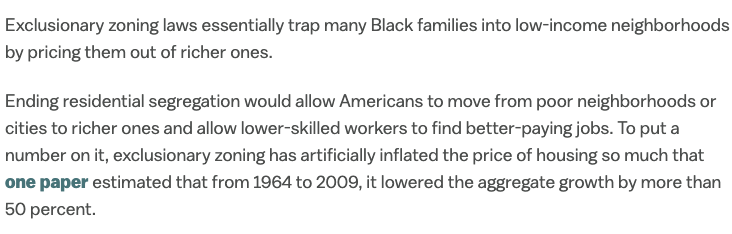









Confidential info from a market participant in ERCOT: As of ~10 AM Eastern time, the system has ~30 GW of capacity offline, ~26 GW of thermal -- mostly natural gas which cant get fuel deliveries which are being priorities for heating loads -- and ~4 GW of wind due to icing. https://t.co/Bfpn0WeRIq
— JesseJenkins (@JesseJenkins) February 15, 2021
1/ As Jesse notes, natural gas is somewhat unique in that it is both a power plant fuel and a home heating fuel. When cold weather comes, regulators bias in favor of heating rather than power generation.
2/ New England - a region that is both cold and has long been more reliant than others on natural gas for power generation - has had to grapple with this for a long time.
3/ In most of the country, the tightest times for power markets are during hot summer days when demand peaks to run all that AC. In New England, the tightest times are often cold winter days when supply gets constrained as the gas is redirected to heat
4/ Texas isn't used to planning for cold snaps, but they are gas-dependent on the power grid. So they are, in essence, acting like New England right now.