https://t.co/zJKWdzOxZA
1 - @EFF revealed today how the LAPD have been requesting Ring doorbell cameras footage of Black Lives Matter protests (https://t.co/FtPoYH3Hn2). Here is a short thread on why this is part of a worrying bigger picture.
https://t.co/zJKWdzOxZA
More from Society


global health policy in 2020 has centered around NPI's (non-pharmaceutical interventions) like distancing, masks, school closures
these have been sold as a way to stop infection as though this were science.
this was never true and that fact was known and knowable.
let's look.
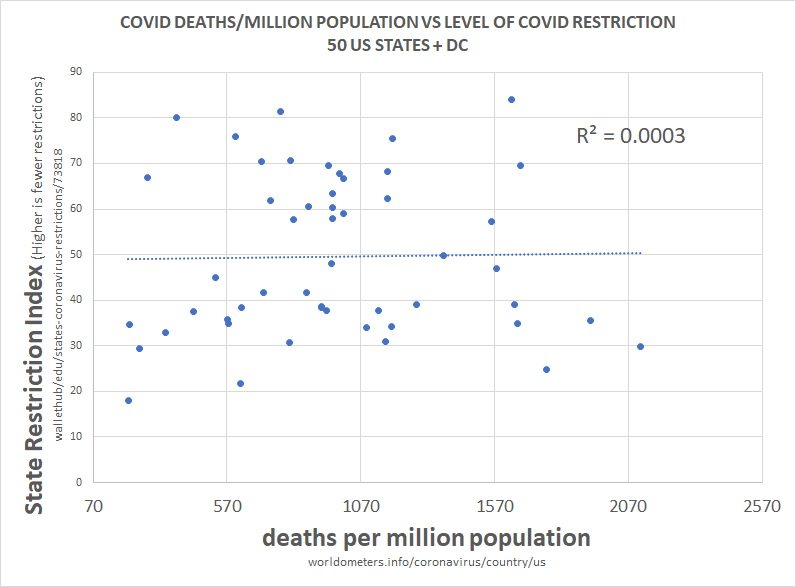
above is the plot of social restriction and NPI vs total death per million. there is 0 R2. this means that the variables play no role in explaining one another.
we can see this same relationship between NPI and all cause deaths.
this is devastating to the case for NPI.
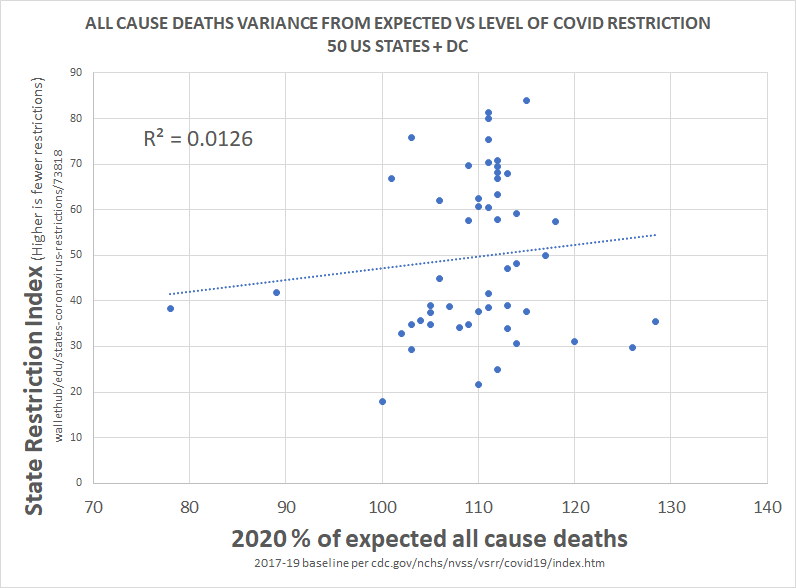
clearly, correlation is not proof of causality, but a total lack of correlation IS proof that there was no material causality.
barring massive and implausible coincidence, it's essentially impossible to cause something and not correlate to it, especially 51 times.
this would seem to pose some very serious questions for those claiming that lockdowns work, those basing policy upon them, and those claiming this is the side of science.
there is no science here nor any data. this is the febrile imaginings of discredited modelers.
this has been clear and obvious from all over the world since the beginning and had been proven so clearly by may that it's hard to imagine anyone who is actually conversant with the data still believing in these responses.
everyone got the same R
these have been sold as a way to stop infection as though this were science.
this was never true and that fact was known and knowable.
let's look.
above is the plot of social restriction and NPI vs total death per million. there is 0 R2. this means that the variables play no role in explaining one another.
we can see this same relationship between NPI and all cause deaths.
this is devastating to the case for NPI.
clearly, correlation is not proof of causality, but a total lack of correlation IS proof that there was no material causality.
barring massive and implausible coincidence, it's essentially impossible to cause something and not correlate to it, especially 51 times.
this would seem to pose some very serious questions for those claiming that lockdowns work, those basing policy upon them, and those claiming this is the side of science.
there is no science here nor any data. this is the febrile imaginings of discredited modelers.
this has been clear and obvious from all over the world since the beginning and had been proven so clearly by may that it's hard to imagine anyone who is actually conversant with the data still believing in these responses.
everyone got the same R
this methodology is a little complex, so let me explain what i did.
— el gato malo (@boriquagato) May 30, 2020
a few EU countries provide real day of death data. this lets us plot meaningful curves to show rate of disease change.
what struck me is how similar all the curves were.
everyone got the same shape. pic.twitter.com/bN0hILzoSl




Patriotism is an interesting concept in that it’s excepted to mean something positive to all of us and certainly seen as a morally marketable trait that can fit into any definition you want for it.+
Tolstoy, found it both stupid and immoral. It is stupid because every patriot holds his own country to be the best, which obviously negates all other countries.+
It is immoral because it enjoins us to promote our country’s interests at the expense of all other countries, employing any means, including war. It is thus at odds with the most basic rule of morality, which tells us not to do to others what we would not want them to do to us+
My sincere belief is that patriotism of a personal nature, which does not impede on personal and physical liberties of any other, is not only welcome but perhaps somewhat needed.
But isn’t adherence to a more humane code of life much better than nationalistic patriotism?+
Göring said, “people can always be brought to the bidding of the leaders. That is easy. All you have to do is tell them they are being attacked, and denounce the peacemakers for lack of patriotism and exposing the country to danger. It works the same in any country.”+
\u0926\u0947\u0936 \u092e\u0947\u0902 \u092a\u0939\u0932\u0940 \u092c\u093e\u0930 \U0001f1ee\U0001f1f3
— AAP (@AamAadmiParty) March 12, 2021
\u0926\u0947\u0936\u092d\u0915\u094d\u0924\u093f \u0915\u0940 \u0938\u094d\u092a\u0947\u0936\u0932 \u0915\u094d\u0932\u093e\u0938 \u0932\u0917\u093e\u090f\u0917\u0940 @ArvindKejriwal \u0938\u0930\u0915\u093e\u0930\u0964
\u090f\u0915 \u092a\u093e\u0920\u094d\u092f\u0915\u094d\u0930\u092e \u092c\u0928\u093e\u092f\u093e \u091c\u093e\u090f\u0917\u093e, \u091c\u093f\u0938\u0938\u0947 \u092c\u091a\u094d\u091a\u094b\u0902 \u092e\u0947\u0902 \u0915\u0942\u091f \u0915\u0942\u091f \u0915\u0930 \u0926\u0947\u0936\u092d\u0915\u094d\u0924\u093f \u092d\u0930\u0940 \u091c\u093e\u090f\u0917\u0940\u0964 pic.twitter.com/iO6WMBh4YG
Tolstoy, found it both stupid and immoral. It is stupid because every patriot holds his own country to be the best, which obviously negates all other countries.+
It is immoral because it enjoins us to promote our country’s interests at the expense of all other countries, employing any means, including war. It is thus at odds with the most basic rule of morality, which tells us not to do to others what we would not want them to do to us+
My sincere belief is that patriotism of a personal nature, which does not impede on personal and physical liberties of any other, is not only welcome but perhaps somewhat needed.
But isn’t adherence to a more humane code of life much better than nationalistic patriotism?+
Göring said, “people can always be brought to the bidding of the leaders. That is easy. All you have to do is tell them they are being attacked, and denounce the peacemakers for lack of patriotism and exposing the country to danger. It works the same in any country.”+
You May Also Like



1/ Some initial thoughts on personal moats:
Like company moats, your personal moat should be a competitive advantage that is not only durable—it should also compound over time.
Characteristics of a personal moat below:
2/ Like a company moat, you want to build career capital while you sleep.
As Andrew Chen noted:
3/ You don’t want to build a competitive advantage that is fleeting or that will get commoditized
Things that might get commoditized over time (some longer than
4/ Before the arrival of recorded music, what used to be scarce was the actual music itself — required an in-person artist.
After recorded music, the music itself became abundant and what became scarce was curation, distribution, and self space.
5/ Similarly, in careers, what used to be (more) scarce were things like ideas, money, and exclusive relationships.
In the internet economy, what has become scarce are things like specific knowledge, rare & valuable skills, and great reputations.
Like company moats, your personal moat should be a competitive advantage that is not only durable—it should also compound over time.
Characteristics of a personal moat below:
I'm increasingly interested in the idea of "personal moats" in the context of careers.
— Erik Torenberg (@eriktorenberg) November 22, 2018
Moats should be:
- Hard to learn and hard to do (but perhaps easier for you)
- Skills that are rare and valuable
- Legible
- Compounding over time
- Unique to your own talents & interests https://t.co/bB3k1YcH5b
2/ Like a company moat, you want to build career capital while you sleep.
As Andrew Chen noted:
People talk about \u201cpassive income\u201d a lot but not about \u201cpassive social capital\u201d or \u201cpassive networking\u201d or \u201cpassive knowledge gaining\u201d but that\u2019s what you can architect if you have a thing and it grows over time without intensive constant effort to sustain it
— Andrew Chen (@andrewchen) November 22, 2018
3/ You don’t want to build a competitive advantage that is fleeting or that will get commoditized
Things that might get commoditized over time (some longer than
Things that look like moats but likely aren\u2019t or may fade:
— Erik Torenberg (@eriktorenberg) November 22, 2018
- Proprietary networks
- Being something other than one of the best at any tournament style-game
- Many "awards"
- Twitter followers or general reach without "respect"
- Anything that depends on information asymmetry https://t.co/abjxesVIh9
4/ Before the arrival of recorded music, what used to be scarce was the actual music itself — required an in-person artist.
After recorded music, the music itself became abundant and what became scarce was curation, distribution, and self space.
5/ Similarly, in careers, what used to be (more) scarce were things like ideas, money, and exclusive relationships.
In the internet economy, what has become scarce are things like specific knowledge, rare & valuable skills, and great reputations.