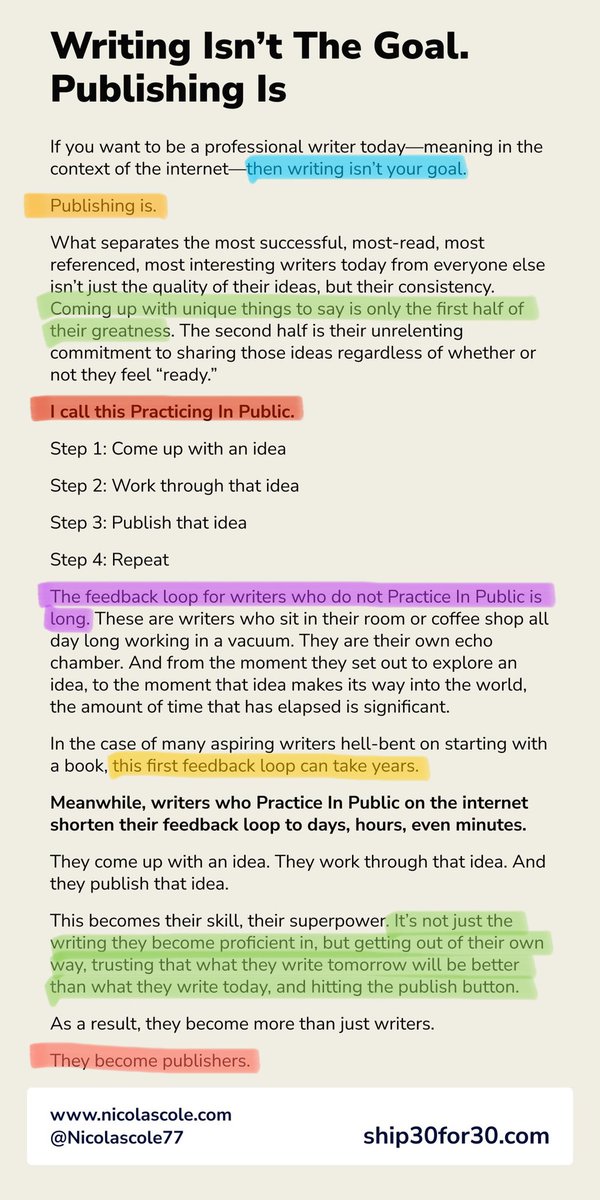
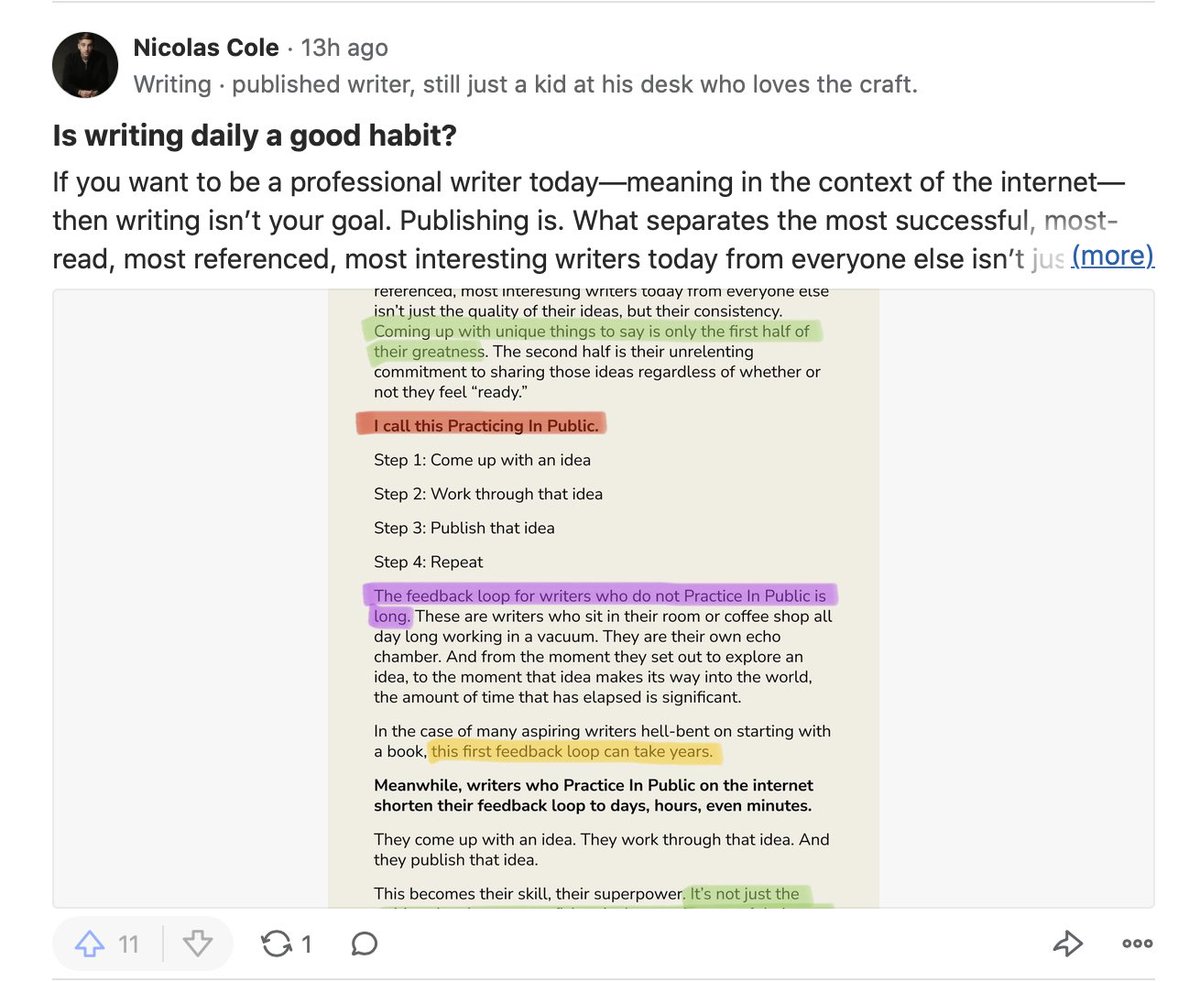
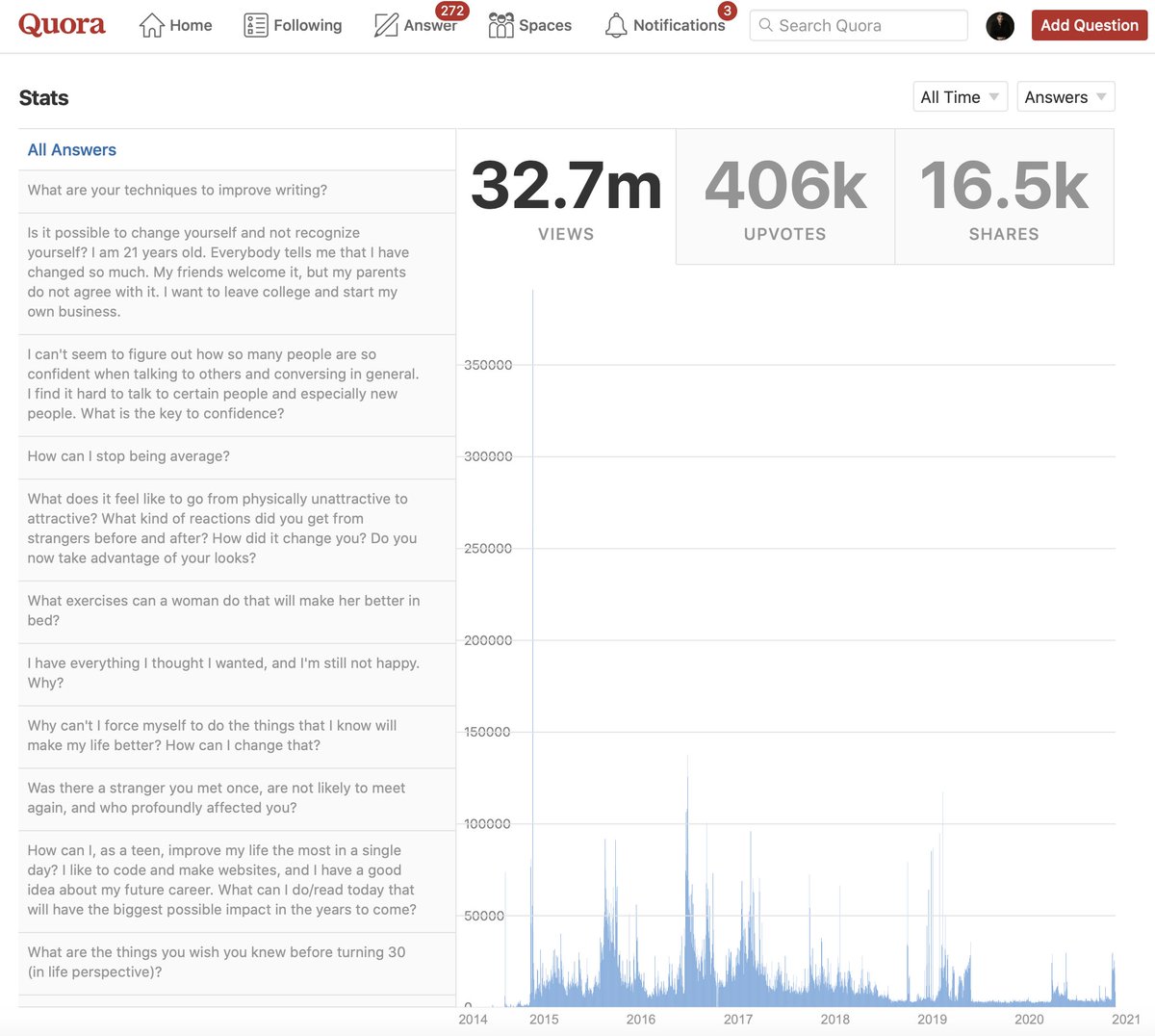
🚢 Atomic Essays Republishing Framework 🚢

1. Write Atomic Essay
2. Post image on Twitter
3. (Bonus) Copy/paste text as thread
4. Find relevant Question on Quora. Copy/paste Atomic Essay + image.
5. Copy/paste again on Medium.
6. Again on LinkedIn
7. Win

Guide below ✍️🚢👇

Step 1: Write Atomic Essay

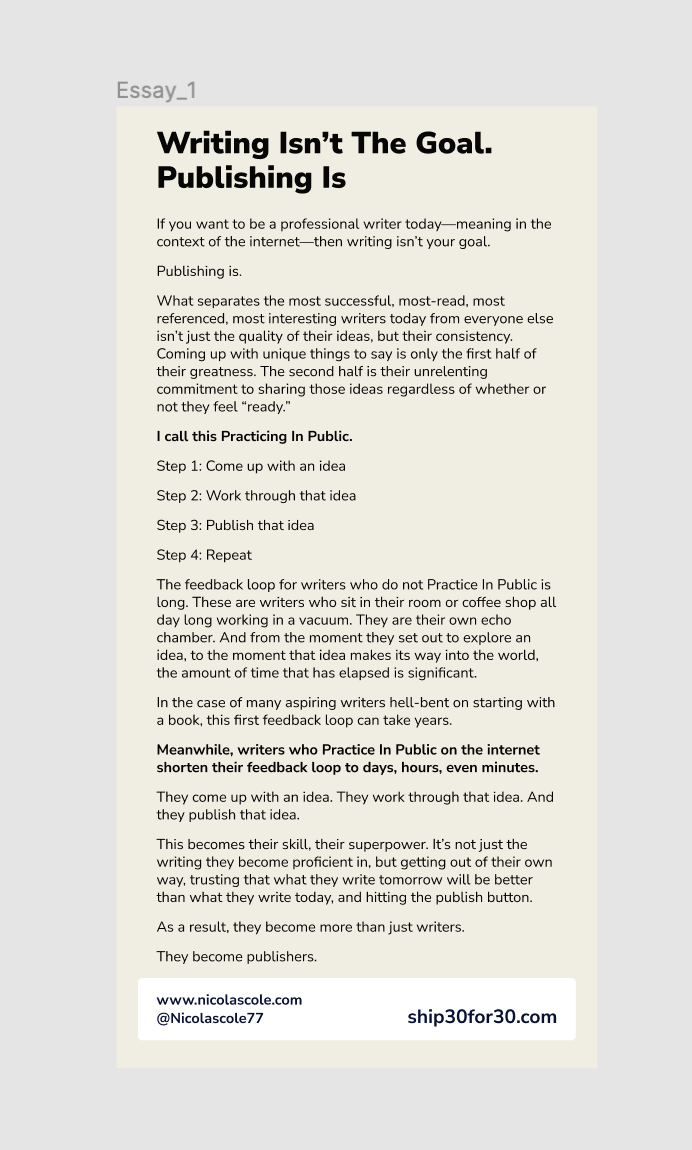
I really enjoy writing right inside the Figma template. It helps give me a good sense of exactly how much "real estate" I have/have left before my time us up and I'm out of space.

Once finished, I export the image and send to my phone on Slack.
Step 2: Post image on Twitter

Before I publish my Atomic Essay on Twitter, I use the Edit/Photo Markup function on the iPhone to highlight standout sentences.

These are usually power-phrases: things the reader skims and thinks, "That's interesting," prompting them to read more.
Step 3: For the Ship 30 for 30 challenge, I only turn Atomic Essays into threads if...

1. The piece is SUPER actionable and lends itself well to the thread format (lots of bullets, quick points, lists, etc.)

or...

2. I'm referencing research and want to link to the pieces.
Step 4: Find relevant Question on Quora. Copy/paste Atomic Essay + image.

Search on Quora around the topic you wrote about. Find a related Question. Copy/paste the whole Atomic Essay as your "answer" (& fix formatting). Then include image so it appears in the thumbnail.
Step 5: Copy/paste again on Medium.

Do the same thing on Medium. Use your same original Atomic Essay title and publish on Medium.

*Bonus points: put behind the paywall & submit to a Medium pub. (Now you're earning $ for republishing)

https://t.co/vx2RLHww5N
Step 6: Copy/paste again on LinkedIn

I like using the first few lines/paragraphs as my lead-in text when I publish the article and LinkedIn prompts me to add text for a status update.

https://t.co/qdnVjgUk8T
Step 7: Copy/paste again anywhere else you'd like.

- Personal website/blog
- NewsBreak
- Another publication that wants to curate your content

You can also turn your Atomic Essays into:

- TikToks
- Instagram Reels
- Tweet 1 sentence. Send to IG as an image.
- Etc.
For more Online Writing tips, tricks, growth hacks, best practices, and more, subscribe to my M-F newsletter, Daily Writing Habits.

https://t.co/aB6kuANb2l

More from Nicolas Cole

I started writing threads on Twitter in 2019.

Since then, I've written more than 200 threads and accumulated over 50,000,000 views on Twitter alone.

Want to know a secret?

I (pretty much) use the same 7 thread templates every time.

🧵👇

Template #1: The Framework Thread

The best frameworks all follow this same recipe:

• To solve X [well-known & difficult] problem
• I do Y [unconventional] thing
• To achieve Z [highly desirable]


Template #2: The Curation Thread

Recipe: "I did all this work—so you don't have to."

But the secret w/ curation threads is to niche down HARD.

"Biz books to read on investing" > "Best biz books" > "Best


Template #3: The "This Just Happened" Thread

Breaking News always has a 24-48 hour hype cycle.

The recipe here is:

• Write about a trending topic
• Provide your own unique take
• Unique take must be relevant to your


Template #4: The "If I Had To Do It Over Again" Thread

Recipe =

• I achieved X
• And made a lot of mistakes along the way
• If I were you, and had to do it all over again, here's what I would do

More from Writing

I can second this observation through personal experience. I was only able to start writing because "it's just dumb weeb fanfiction quests, who cares." 100,000 pages of dumb weeb fanfic later, and I actually got better... but only because I was trying my best with every page.


"It's dumb weeb fanfiction" gave me permission to be bad, to vomit things onto the page that I knew fell far short of what I wanted it to be. To just write and write instead of laboring over six paragraphs for weeks like I'd always done before.

But I still *wanted* to be good.

Writing is HARD. And unfortunately, most people don't appreciate just how hard writing (or communication in general) is, and that cultural attitude infects writers, too.

You must give yourself permission to be bad. And realize that all writing is practice.

IT. COUNTS.

And as the folks in my mentions are pointing


... it's an excellent way to find out what actually resonates with other people - putting work out there. Even your early bad stuff you'll cringe at later.

What resonates is NOT easy to tell, because we all, inherently cringe at ourselves, a lot.
Things we don’t learn in this article: that the author wrote David Cameron’s speeches during the period when they were intentionally underfunding the NHS and other services, directly creating the problem the author is concerned about now.


We also don’t learn that the paper it’s written in stridently supported those measures and attacked junior doctors threatening strike action over NHS cuts and long working hours, accusing them of holding the country to ransom.

We aren’t reminded that NHS funding and the future of health provision was a central part of previous election campaigns, and that attempts to highlight these problems were swiftly stomped on or diverted and then ignored by most of the press, including the Times.

I’d underline here that “corruption” doesn’t just mean money in brown envelopes: it describes a situation where much of an organisation is personally motivated to ignore, downplay or divert from malfeasance for personal reasons - because highlighting them would be bad for careers

Foges was Cameron’s speechwriter at the height of austerity; Forsyth is married to the PM’s spokesman; Danny F is a Tory peer; Parris is a former MP; Gove used to write for them regularly, and that’s before we get to professional mates-with-ministers like Shipman or Montgomerie.

You May Also Like

1/ Some initial thoughts on personal moats:

Like company moats, your personal moat should be a competitive advantage that is not only durable—it should also compound over time.

Characteristics of a personal moat below:


2/ Like a company moat, you want to build career capital while you sleep.

As Andrew Chen noted:


3/ You don’t want to build a competitive advantage that is fleeting or that will get commoditized

Things that might get commoditized over time (some longer than


4/ Before the arrival of recorded music, what used to be scarce was the actual music itself — required an in-person artist.

After recorded music, the music itself became abundant and what became scarce was curation, distribution, and self space.

5/ Similarly, in careers, what used to be (more) scarce were things like ideas, money, and exclusive relationships.

In the internet economy, what has become scarce are things like specific knowledge, rare & valuable skills, and great reputations.
First thread of the year because I have time during MCO. As requested, a thread on the gods and spirits of Malay folk religion. Some are indigenous, some are of Indian origin, some have Islamic


Before I begin, it might be worth explaining the Malay conception of the spirit world. At its deepest level, Malay religious belief is animist. All living beings and even certain objects are said to have a soul. Natural phenomena are either controlled by or personified as spirits

Although these beings had to be respected, not all of them were powerful enough to be considered gods. Offerings would be made to the spirits that had greater influence on human life. Spells and incantations would invoke their


Two known examples of such elemental spirits that had god-like status are Raja Angin (king of the wind) and Mambang Tali Arus (spirit of river currents). There were undoubtedly many more which have been lost to time

Contact with ancient India brought the influence of Hinduism and Buddhism to SEA. What we now call Hinduism similarly developed in India out of native animism and the more formal Vedic tradition. This can be seen in the multitude of sacred animals and location-specific Hindu gods