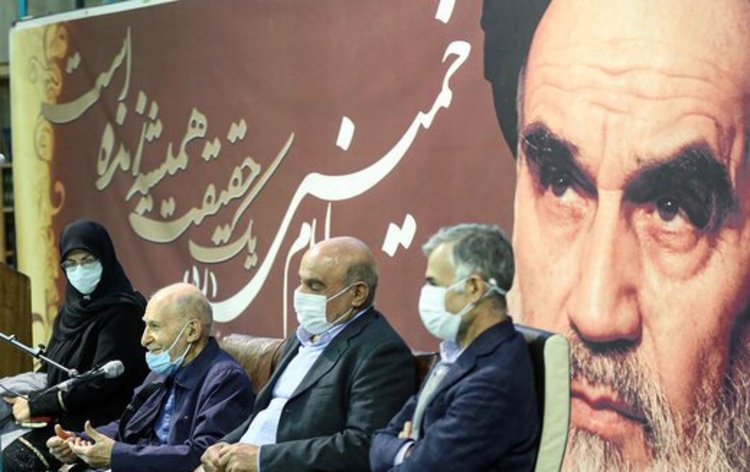
Iranian Reformist Front (Jebheye Eslathalabane Iran) was officially founded yesterday in Jamaran, Khomeini's historic house near Tehran.

The founding meeting elected Behzad Nabavi as an interim head since he is oldest.

And also 5 people as a committee to draft the IRF's by-laws

The five are:

1- Outspoken Tehran MP @mah_sadeghi
2- Faraj Komijani, politician with a base in an official teachers union
3- Ali Bagheri (low-key politician)
4- @MansooriAzar , noted reformist politician
5- Rouhani's ex-VP @mowlaverdi
Some more pictures of the meeting.

The next meeting of the group is on Wednesday and will be held virtually.

The top question remains whether and who (and how many candidates) to run for the coming #IranElections2021
The founding statement says the reformists will run a single candidate agreed by all reformist parties but only if elections are to be "free, legal, competitive, just and constitutional"... which is obviously not what's going to happen!
The founding statement also includes big demands like call for a referendum to revise the constitution. But as usual these big words aren't followed by any actions.
The IRF was formed after the High Policy Council of Reformists (which was formed of about 30 individuals each with one vote) had proved useless. But the IRF is effectively the HPCR that is slightly re-packaged.
The only difference is that now each party in IRF (30 in total) has one vote unlike HPCR where 'personalities' had one vote each and thus too much power. The other main difference is that Rouhani's party had people in HPCR but it's not in the IRF.
But many reformists had much more wide-ranging demands like holding American-style primaries, forming a larger reformist body with rank-and-file, etc. Such demands were especially puhsed by Sadegh Kharazi's @Neda_iranian party.

The old guard resisted all at the end.
The declared goal of the reformists is to not repeat what they did in 2005: i.e. introduce more than one candidate and thus split the vote (which led to Ahmadinejad's first victory)

or what they did in 2013 and 2017, i.e. back a non-reformist candidate like Rouhani.
Of course in 2009, they also introduced more than one candidates and split their own vote... but they faced mass vote-rigging and both their candidates from then are still in house detention after 10 years.
We need to wait and see who will reformists won but perhaps more importantly who will Khamenei's Guardian Council allow to run?

More from World

You May Also Like

I just finished Eric Adler's The Battle of the Classics, and wanted to say something about Joel Christiansen's review linked below. I am not sure what motivates the review (I speculate a bit below), but it gives a very misleading impression of the book. 1/x


The meat of the criticism is that the history Adler gives is insufficiently critical. Adler describes a few figures who had a great influence on how the modern US university was formed. It's certainly critical: it focuses on the social Darwinism of these figures. 2/x

Other insinuations and suggestions in the review seem wildly off the mark, distorted, or inappropriate-- for example, that the book is clickbaity (it is scholarly) or conservative (hardly) or connected to the events at the Capitol (give me a break). 3/x

The core question: in what sense is classics inherently racist? Classics is old. On Adler's account, it begins in ancient Rome and is revived in the Renaissance. Slavery (Christiansen's primary concern) is also very old. Let's say classics is an education for slaveowners. 4/x

It's worth remembering that literacy itself is elite throughout most of this history. Literacy is, then, also the education of slaveowners. We can honor oral and musical traditions without denying that literacy is, generally, good. 5/x