
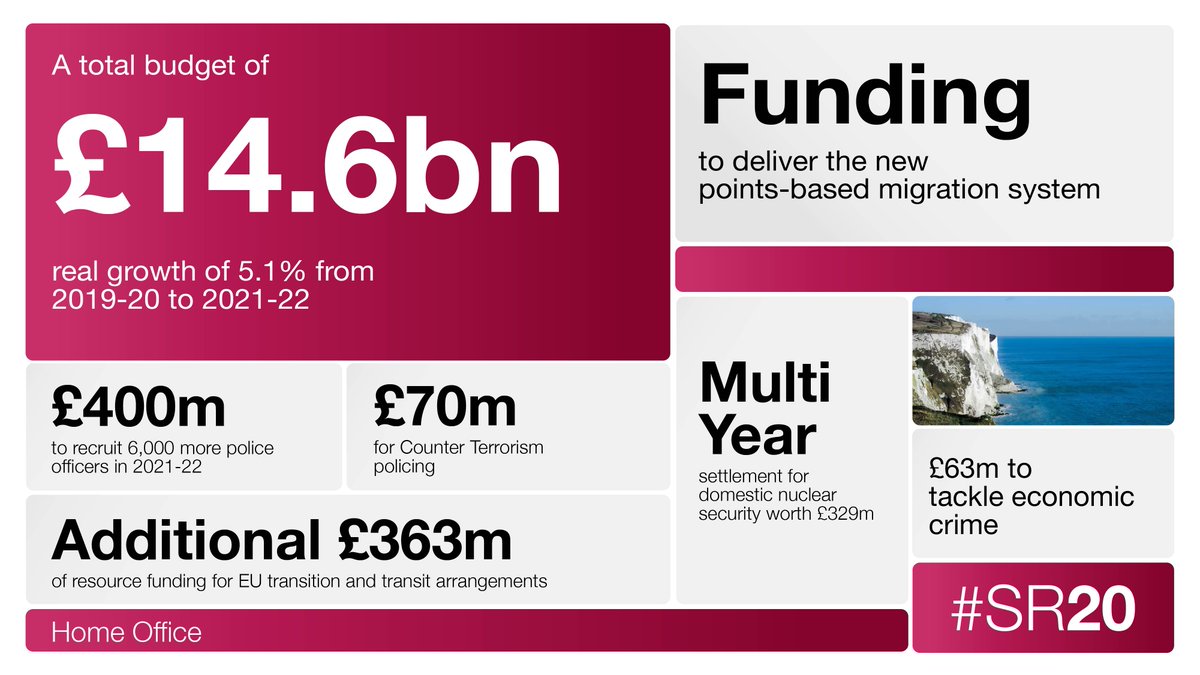
1/ Today’s Spending Review delivers on the priorities of the British people.
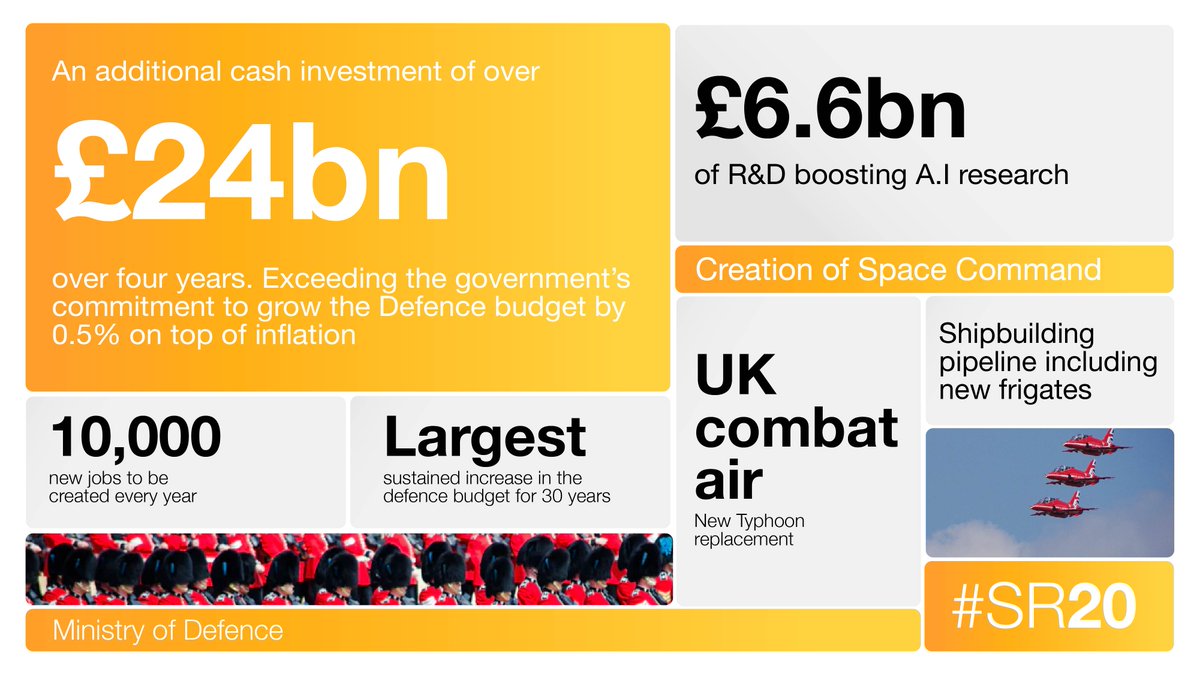
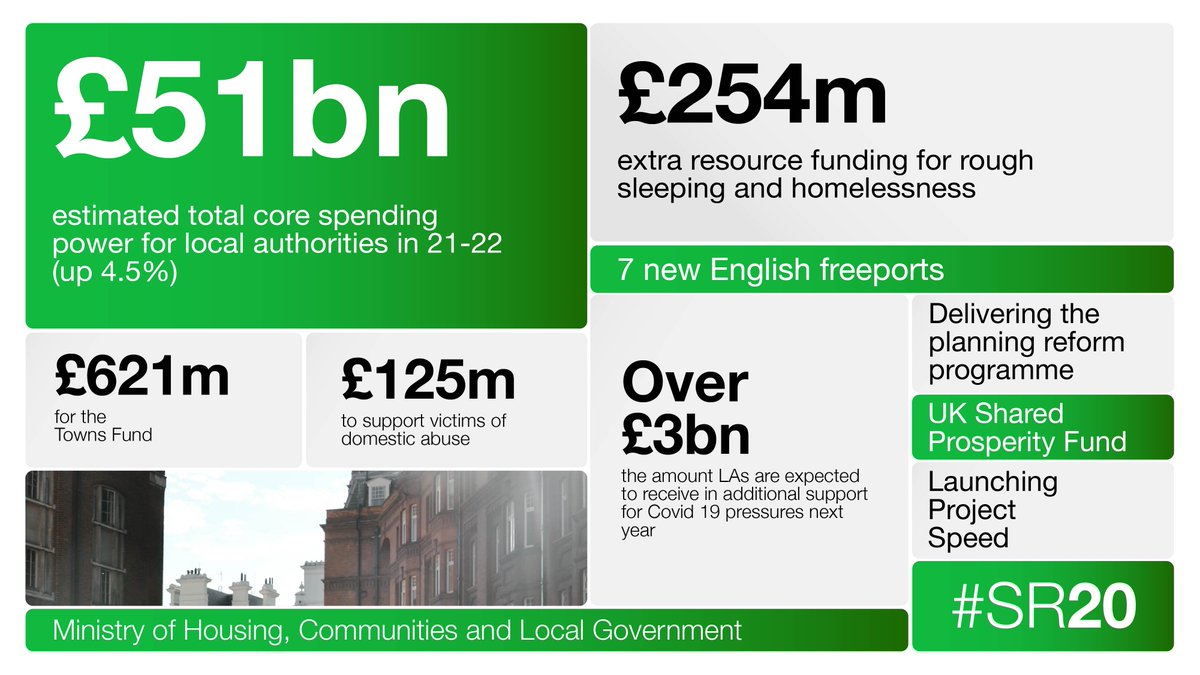
This thread covers 𝘀𝗼𝗺𝗲 𝗼𝗳 𝘁𝗵𝗲 𝗸𝗲𝘆 𝗮𝗻𝗻𝗼𝘂𝗻𝗰𝗲𝗺𝗲𝗻𝘁𝘀 from Departments across Government. #SR20
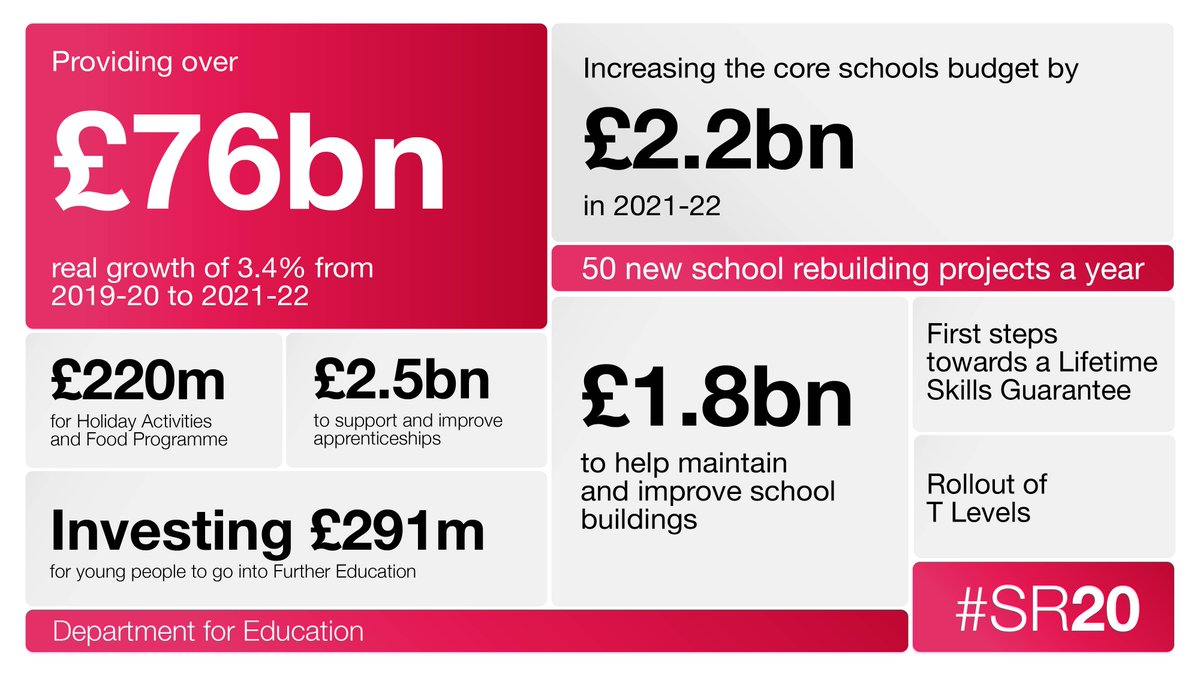
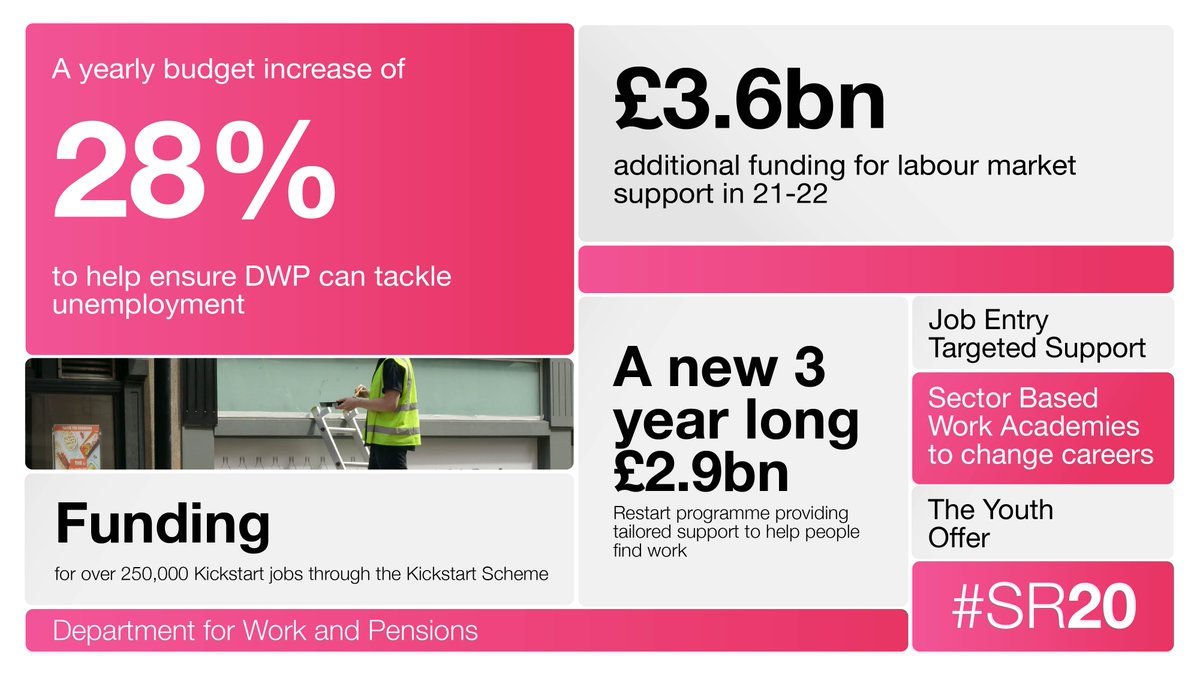
The new 3-year long £2.9 billion Restart programme will provide intensive, tailored support to over 1million unemployed people and help them find work #SR20
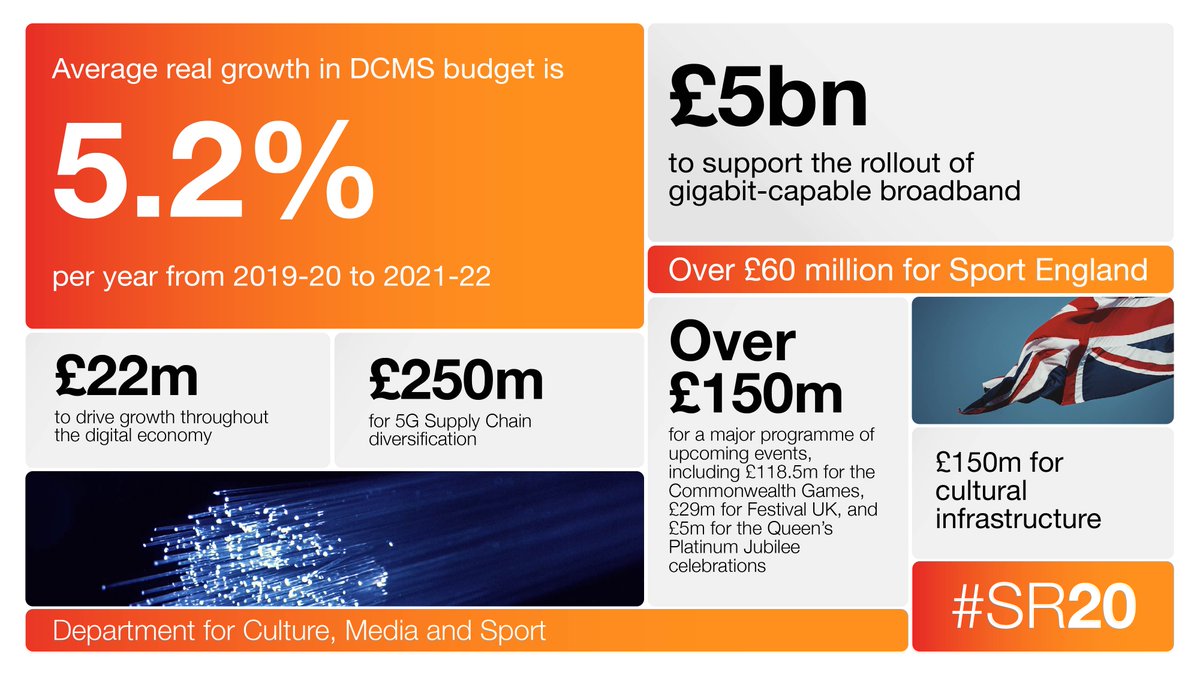
We'll grow and evolve our sectors particularly those most affected by Covid-19 which include culture, sport, civil society and the creative industries. #SR20
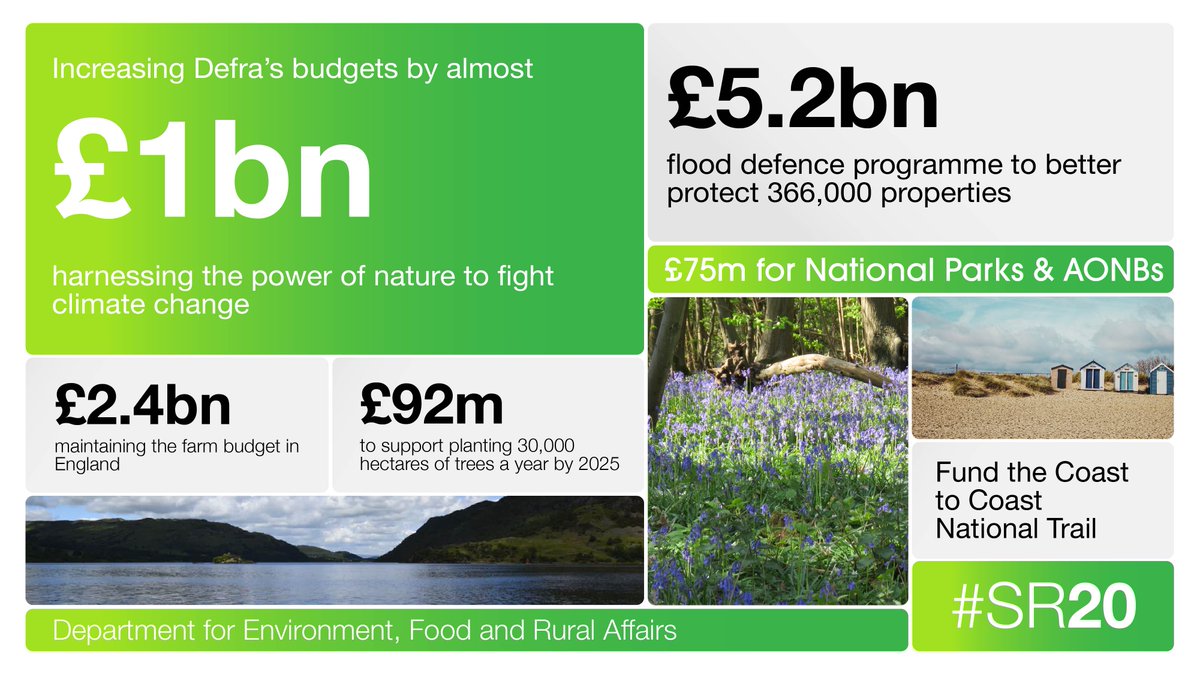
This will allow them to do more to fight against climate change - and connect people with green spaces - by planting trees, restoring peatland, creating habitats, and investing in National Parks. #SR20
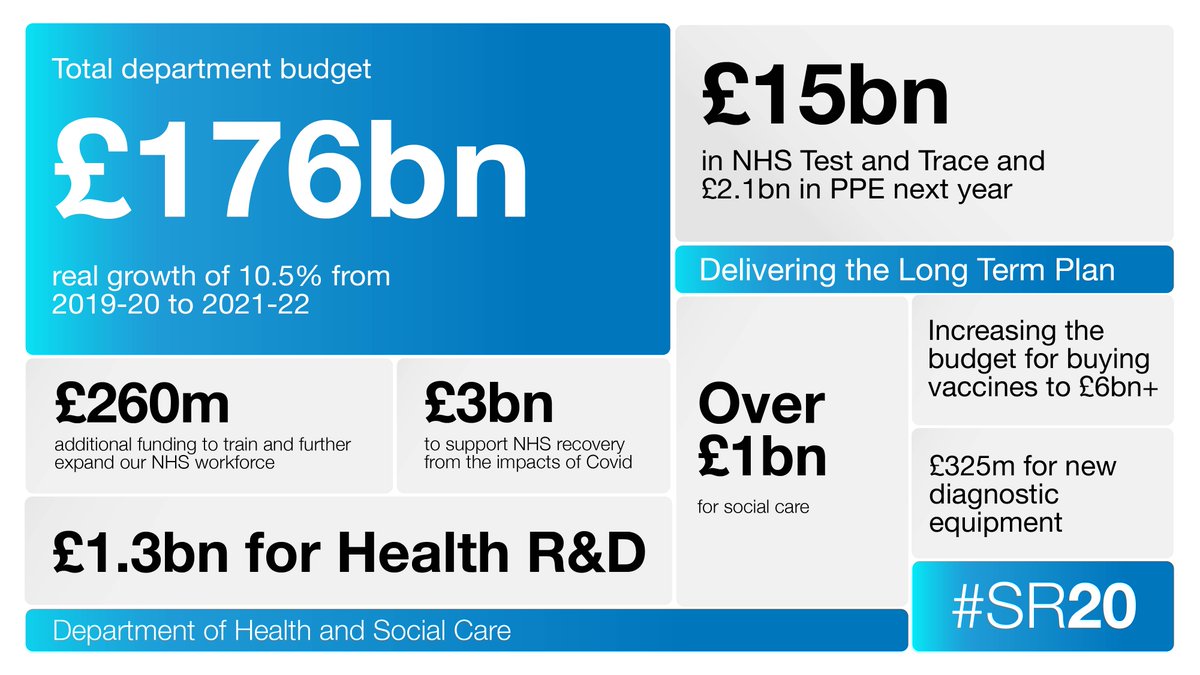
Next year, the core @DHSCgovuk budget will grow by £6.6bn, allowing us to deliver 50,000 more nurses and 50 million more general practice appointments. #SR20
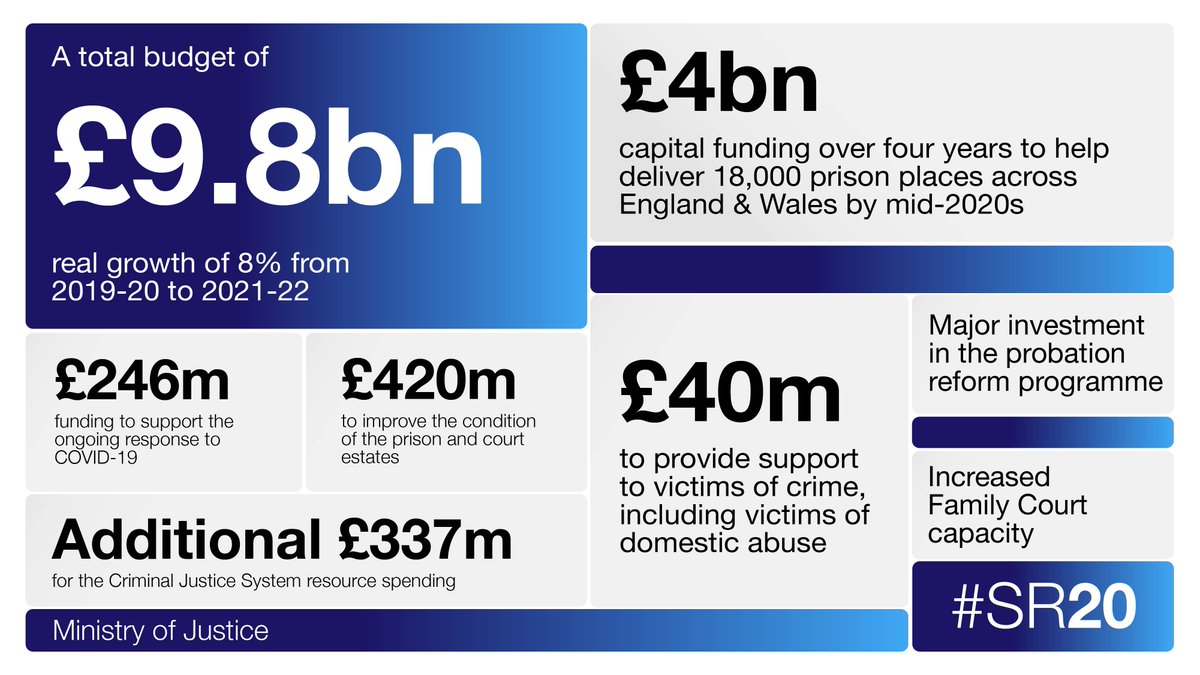
This includes the largest prison building programme in over a century and an over 50% increase in maintenance funding to improve prisons and courts. #SR20
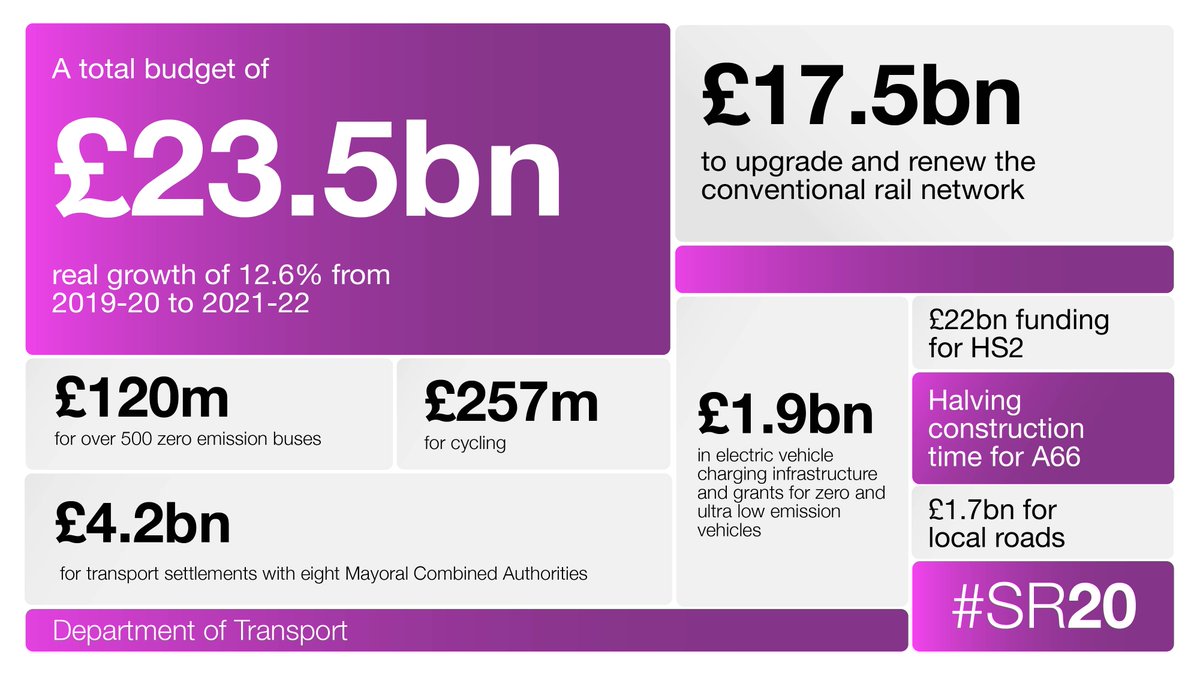
We are decarbonising transport through record investment in electric vehicle charging and maintaining transport services to support the economy as we recover from Covid. #SR20
More from Uk


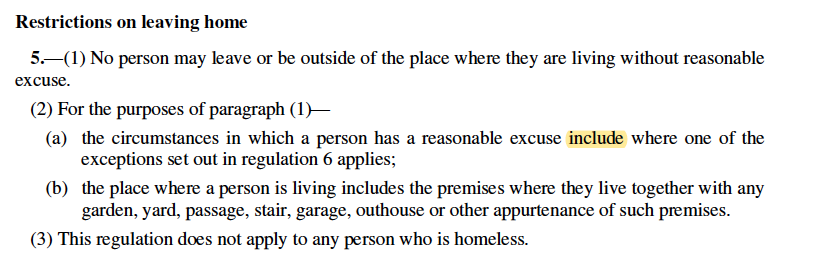


A short thread on why I am dubious that the government can lawfully impose charges on travellers entering the UK for quarantine and testing (proposed at £1,750 and £210)
1/
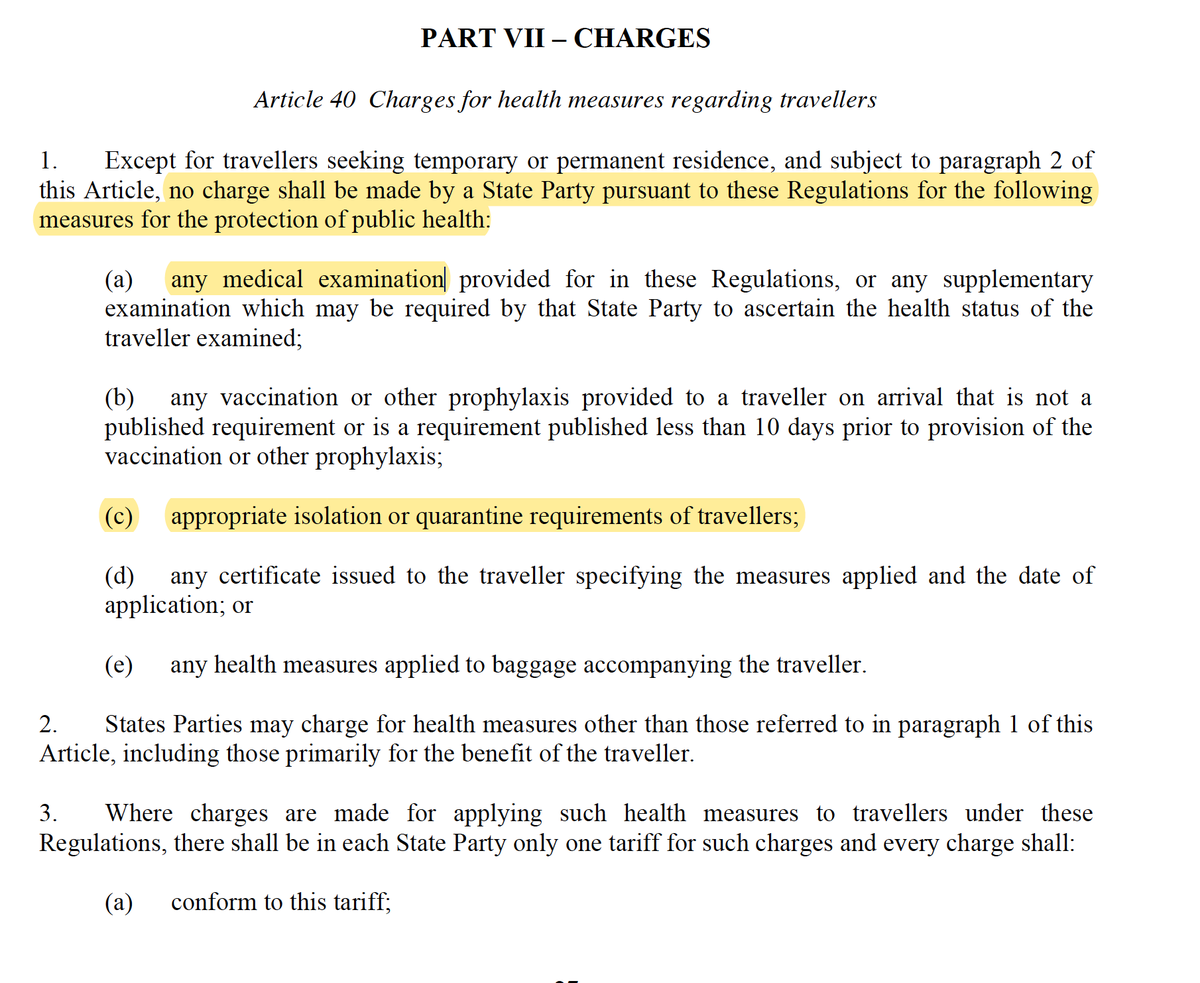
The UK has signed up to the International Health Regulations (IHA) 2005. These therefore create binding international legal obligations on the UK.
The IHA explicitly prevent charging for travellers' quarantine or medical examinations.
https://t.co/n4oWE8x5Vg /2
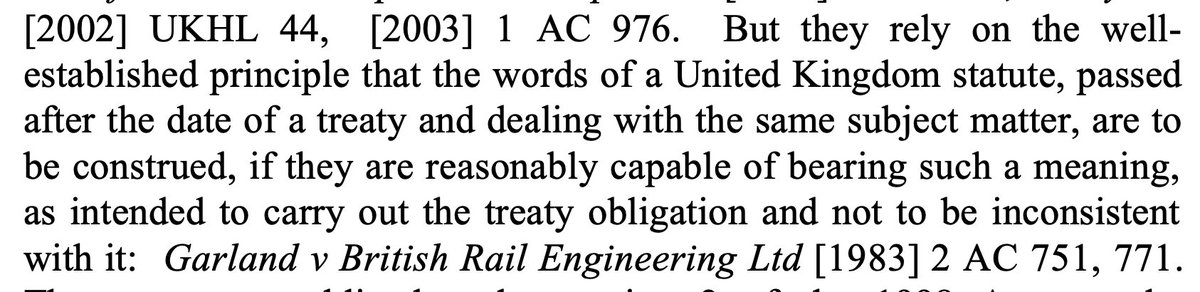
International law is not actionable in a UK court unless it has been implemented in law.
But it can be used as an aide to interpretation where a statute isn't clear as to what powers it grants.
See e.g. Lord Bingham in A v SSHD https://t.co/RXmib1qGYD
/3
The Quarantine regulations will, I assume, be made under section 45B of the Public Health (Control of Disease) Act 1984
https://t.co/54L4lHGMEr
/4
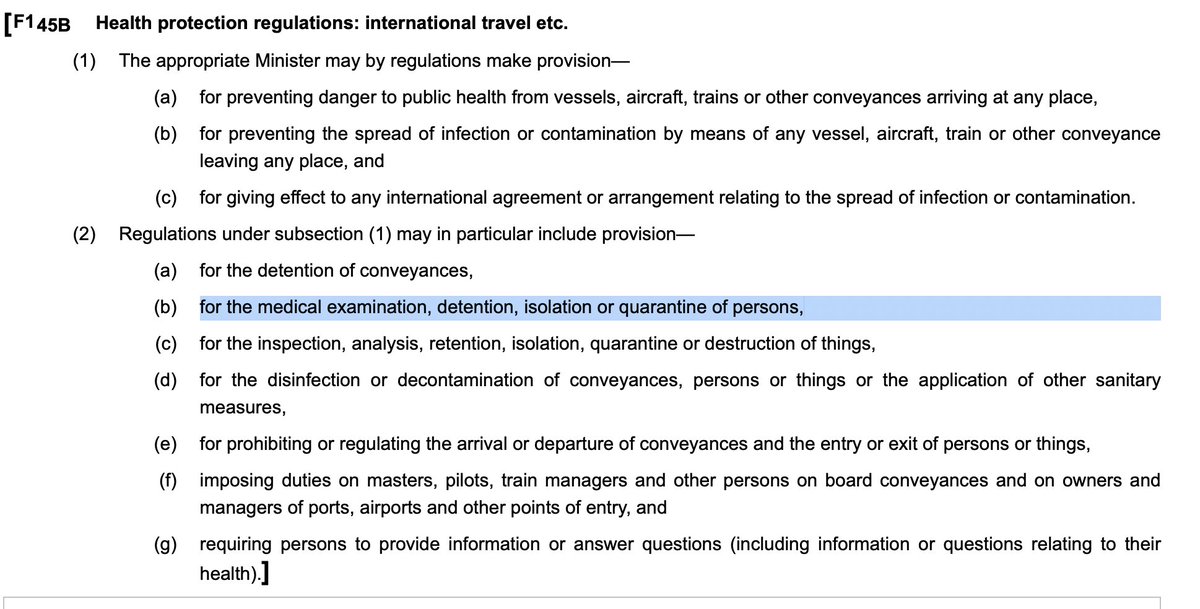
That gives pretty broad powers but I can't see any power to charge for quarantine. Perhaps it will be inferred from somewhere else in Part 2A?
But...
1/
The UK has signed up to the International Health Regulations (IHA) 2005. These therefore create binding international legal obligations on the UK.
The IHA explicitly prevent charging for travellers' quarantine or medical examinations.
https://t.co/n4oWE8x5Vg /2
International law is not actionable in a UK court unless it has been implemented in law.
But it can be used as an aide to interpretation where a statute isn't clear as to what powers it grants.
See e.g. Lord Bingham in A v SSHD https://t.co/RXmib1qGYD
/3
The Quarantine regulations will, I assume, be made under section 45B of the Public Health (Control of Disease) Act 1984
https://t.co/54L4lHGMEr
/4
That gives pretty broad powers but I can't see any power to charge for quarantine. Perhaps it will be inferred from somewhere else in Part 2A?
But...


Yesterday, of course, Jeremy Corbyn launched his Peace and Justice Project, to much excitement on here. Laudable goals too:
Take on Murdoch ✅
Green New Deal ✅
Support for food banks ✅
Speed up vaccine delivery in developing countries ✅
That's all excellent.
I'm not sure if anyone can argue with those four aims: they're irrefutable and all massively important. You bet I'd like to see Labour doing likewise; you bet I'm frustrated that it's so quiet on all of it.
HOWEVER...
Contained within the announcement was exactly the same selective blindness which makes the entire thing all too easy to shoot down - and again, means Corbyn is pretty unlikely to persuade anyone who's not already persuaded.
The sort of blindness which makes me tear my hair out.
Peace and Justice - sounds great, doesn't it? So why did the Peace and Justice project proudly announce the support of a corrupt criminal not remotely interested in either of those
Rafael Correa, former President of Ecuador. Let's run through his record, starting with the positives.
Slashed poverty from 36.7% to 22.5% ✅
Reduced inequality from 0.55 to 0.47 on the Gini index ✅
So far, so good. Except, um...
Take on Murdoch ✅
Green New Deal ✅
Support for food banks ✅
Speed up vaccine delivery in developing countries ✅
That's all excellent.
I'm not sure if anyone can argue with those four aims: they're irrefutable and all massively important. You bet I'd like to see Labour doing likewise; you bet I'm frustrated that it's so quiet on all of it.
HOWEVER...
Contained within the announcement was exactly the same selective blindness which makes the entire thing all too easy to shoot down - and again, means Corbyn is pretty unlikely to persuade anyone who's not already persuaded.
The sort of blindness which makes me tear my hair out.
Peace and Justice - sounds great, doesn't it? So why did the Peace and Justice project proudly announce the support of a corrupt criminal not remotely interested in either of those
We\u2019re delighted to have the backing of Rafael Correa, who cut poverty and inequality by record levels as president of Ecuador.
— Peace and Justice Project (@corbyn_project) January 8, 2021
There is no limit to what we can achieve when we bring people together to take on injustice.
Join us https://t.co/w6QOdSqkeC pic.twitter.com/aT8atxSYvy
Rafael Correa, former President of Ecuador. Let's run through his record, starting with the positives.
Slashed poverty from 36.7% to 22.5% ✅
Reduced inequality from 0.55 to 0.47 on the Gini index ✅
So far, so good. Except, um...
You May Also Like






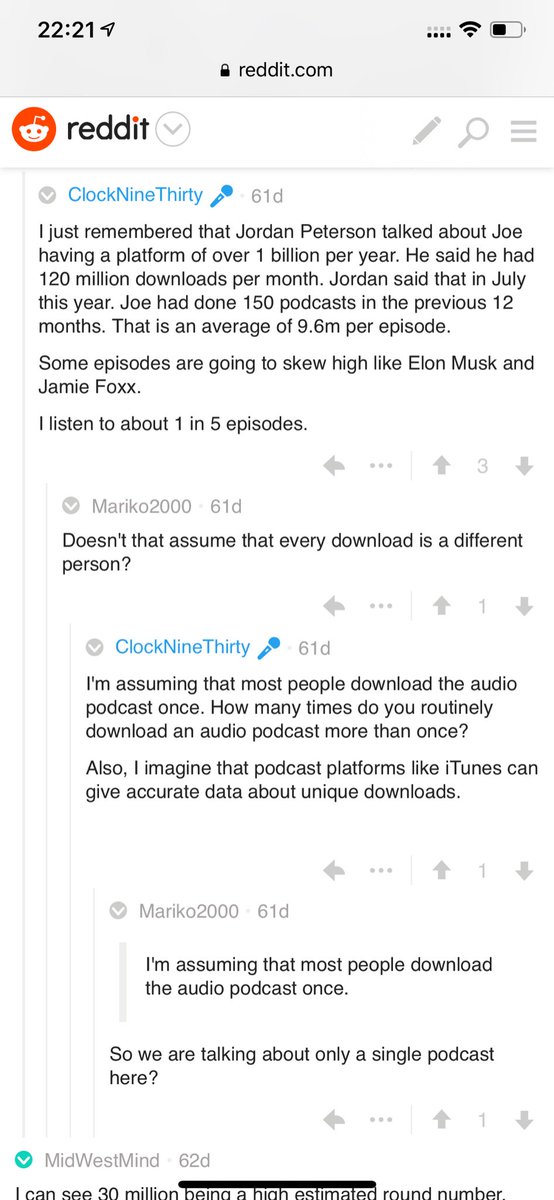
Joe Rogan's podcast is now is listened to 1.5+ billion times per year at around $50-100M/year revenue.
Independent and 100% owned by Joe, no networks, no middle men and a 100M+ people audience.
👏
https://t.co/RywAiBxA3s
Joe is the #1 / #2 podcast (depends per week) of all podcasts
120 million plays per month source https://t.co/k7L1LfDdcM
https://t.co/aGcYnVDpMu
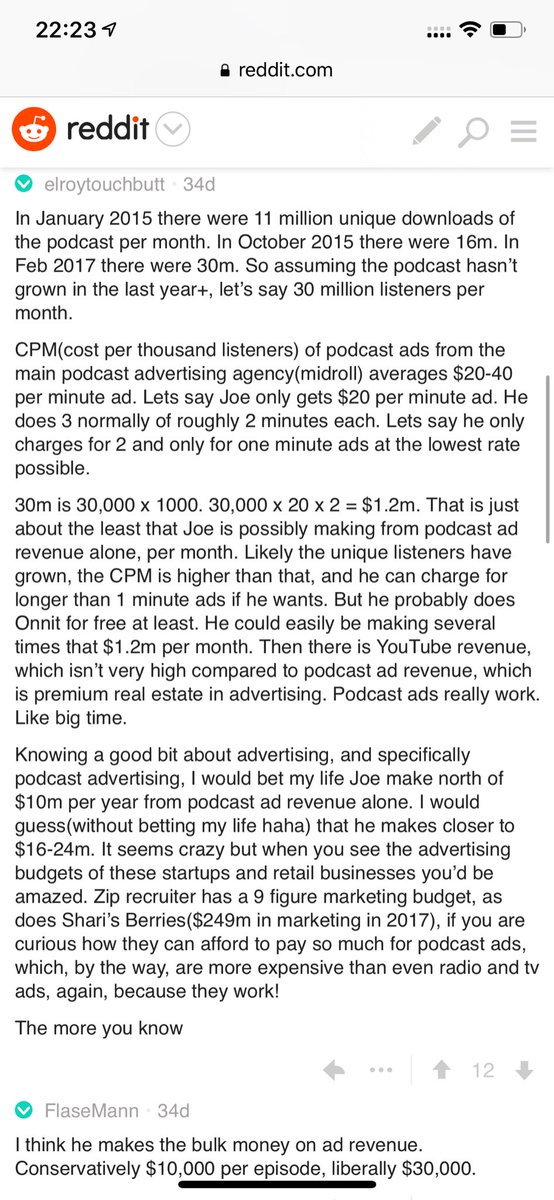
Independent and 100% owned by Joe, no networks, no middle men and a 100M+ people audience.
👏
https://t.co/RywAiBxA3s
Joe is the #1 / #2 podcast (depends per week) of all podcasts
120 million plays per month source https://t.co/k7L1LfDdcM
https://t.co/aGcYnVDpMu
