This is what ultimately separates the good from the great.
A Guide to Position Sizing
--- Thread 🧵 ---
This is what ultimately separates the good from the great.
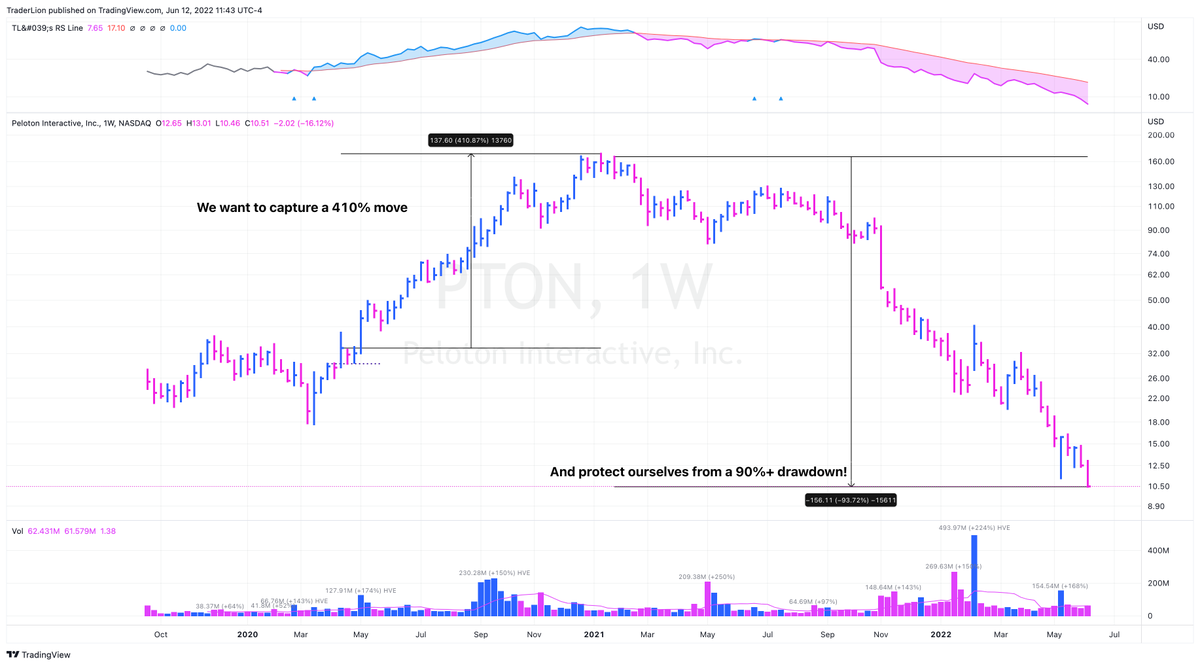
It will make a huge difference on your account if you have a 100% gain in a name with 20%+ of your equity.
1️⃣ Position Size Based on Risk
2️⃣ Position Size Based on Number of Edges
Before you take a position in a stock, you must know how much you are willing to lose on a trade.
We recommend never risking more than 1% of your overall account equity on any single trade, especially if you are in the consistency phase.
▪️ Buy Point: $100
▪️ Stop Loss: $99
▪️ Total Risk: 1%
If your max risk per position is 1% of your overall equity, this setup would allow you to take a 100% equity position and still be within your rules if the trade goes against you.
▪️ Buy Point: $50.50
▪️ Stop Loss: $49.00
▪️ Total Risk: 3%
If your max risk per position is 1% of your overall equity, this setup would allow you to take a 33% equity position and still be within your rules if the trade goes against you.
To position size based on # edges, you must have a great grasp as to what your edges are in the market.
🔸Strongest edges = biggest size
🔸Weakest edges = lowest size
▪️ Highest Volume Ever: Up to 25% of equity
▪️ Volatility Contraction Pattern (VCP): Up to 20% of equity
▪️ IPO Base Breakout: Up to 15% of equity
You must still trade with a risk first mindset though, knowing where you will exit the trade and how much of your account you are risking if the trade goes against you.
▪️ Conviction drives Position Sizing
▪️ $STUDY of your edges is the only way to build conviction
▪️ Whatever style you choose, you must do it consistently
You can find that here 👇
https://t.co/hcAKEG8WX1
If you want more similar content, please follow us
@TraderLion_
Let us know how you position size in the comments below 🔽
More from TraderLion 🦁


More from Traderlion



You May Also Like

1/12
RT-PCR corona (test) scam
Symptomatic people are tested for one and only one respiratory virus. This means that other acute respiratory infections are reclassified as
2/12
It is tested exquisitely with a hypersensitive non-specific RT-PCR test / Ct >35 (>30 is nonsense, >35 is madness), without considering Ct and clinical context. This means that more acute respiratory infections are reclassified as
3/12
The Drosten RT-PCR test is fabricated in a way that each country and laboratory perform it differently at too high Ct and that the high rate of false positives increases massively due to cross-reaction with other (corona) viruses in the "flu
4/12
Even asymptomatic, previously called healthy, people are tested (en masse) in this way, although there is no epidemiologically relevant asymptomatic transmission. This means that even healthy people are declared as COVID
5/12
Deaths within 28 days after a positive RT-PCR test from whatever cause are designated as deaths WITH COVID. This means that other causes of death are reclassified as
RT-PCR corona (test) scam
Symptomatic people are tested for one and only one respiratory virus. This means that other acute respiratory infections are reclassified as
4/10
— Dr. Thomas Binder, MD (@Thomas_Binder) October 22, 2020
...indication, first of all that testing for a (single) respiratory virus is done outside of surveillance systems or need for specific therapy, but even so the lack of consideration of Ct, symptoms and clinical findings when interpreting its result. https://t.co/gHH6kwRdZG
2/12
It is tested exquisitely with a hypersensitive non-specific RT-PCR test / Ct >35 (>30 is nonsense, >35 is madness), without considering Ct and clinical context. This means that more acute respiratory infections are reclassified as
6/10
— Dr. Thomas Binder, MD (@Thomas_Binder) October 22, 2020
The neither validated nor standardised hypersensitive RT-PCR test / Ct 35-45 for SARS-CoV-2 is abused to mislabel (also) other diseases, especially influenza, as COVID-19.https://t.co/AkFIfTCTkS
3/12
The Drosten RT-PCR test is fabricated in a way that each country and laboratory perform it differently at too high Ct and that the high rate of false positives increases massively due to cross-reaction with other (corona) viruses in the "flu
External peer review of the RTPCR test to detect SARS-CoV-2 reveals 10 major scientific flaws at the molecular and methodological level: consequences for false positive results.https://t.co/mbNY8bdw1p pic.twitter.com/OQBD4grMth
— Dr. Thomas Binder, MD (@Thomas_Binder) November 29, 2020
4/12
Even asymptomatic, previously called healthy, people are tested (en masse) in this way, although there is no epidemiologically relevant asymptomatic transmission. This means that even healthy people are declared as COVID
Thread web\u2b06\ufe0f\u2b07\ufe0f
— Dr. Thomas Binder, MD (@Thomas_Binder) December 16, 2020
The fabrication of the "asymptomatic (super) spreader" is the coronation of the total nons(ci)ense in the belief system of #CoronasWitnesses.
Asymptomatic transmission 0.7%; 95% CI 0%-4.9% - could well be 0%!https://t.co/VeZTzxXfvT
5/12
Deaths within 28 days after a positive RT-PCR test from whatever cause are designated as deaths WITH COVID. This means that other causes of death are reclassified as
8/8
— Dr. Thomas Binder, MD (@Thomas_Binder) March 24, 2020
By the way, who the f*** created this obviously (almost) worldwide definition of #CoronaDeath?
This is not only medical malpractice, this is utterly insane!https://t.co/FFsTx4L2mw