The idea that advertisers will walk away from platforms that don't provide personalized targeting simply doesn't hold up. Advertisers buy posters and billboards and TV ads and lots of other things that don't promise the accuracy of web advertising...
Further, the promise of that accuracy has mostly been false. Year after year after year we see that ad products that promise perfect accuracy and tracking don't work, are giving false results, are proving entirely ineffective, or have unexpected negative brand impact...
Also, the one thing we've learned for sure about advertising on the web is that advertisers will try all sorts of things and look towards outcomes. This includes bad things that fail...
https://t.co/MYkZtfdqQQ
This includes things that don't work at all, but still end up costing millions of dollars.
https://t.co/5KPc4fJNcm
And it includes a ton of ad tech that makes claims to personalization that simply don't hold up in reality.
https://t.co/rndP1drQYk
Everyone in advertising should know by now that many of the promises of advertising vendors don't hold up...
https://t.co/FcUbmQTqb0
But the pricing mechanisms of the status quo makes no room for an alternative version of the web. We've no basis to understand what the market could like like in a web where intrusive user tracking becomes impossible on a technical level.
https://t.co/1sWrpeV33Y
And putting all of these questions aside brings an even bigger one forward: do publishers benefit from a web that, through invasive tracking and targeting, generates societies that distrust journalism and make it hard to separate fact from fiction? I think not.
Perhaps that's too esoteric a future to consider. Perhaps we can only see the future in dollars and cents. That's the way Facebook sees it. That's the way the people who have shaped the face of web advertising up to now see it.
https://t.co/WeAudmCpFw
But I don't think the future of the web has to be, or should be, defined on dollars and cents alone. I think a healthier web--one that respects what users want & how they seek to interact w/it, publishers, & advertisers--will create a better environment for publishers to thrive.
$1.3 bil was spent on influencer marketing in 2018. It's hard to believe that publishers can't remake themselves in a private web to change from delivering individual humans to be something else to advertisers. Especially if the ground shifts to make the web force that change.
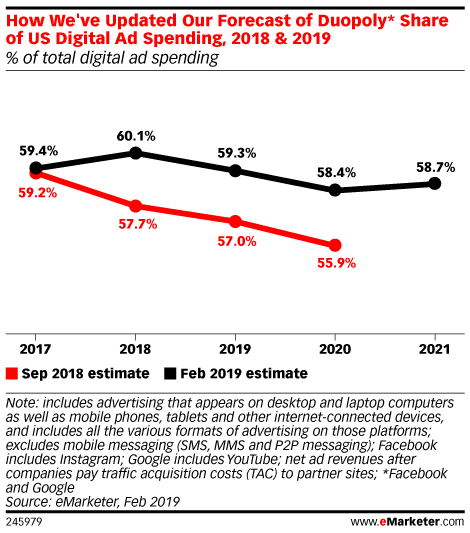
I can't imagine a world where advertisers decide their only venue for digital advertising is FB and Google. That they're just going to leave the rest of the web up for grabs. I wouldn't be here if I didn't think the rest of the web was valuable for advertisers, users & publishers
And if it has value, then it can be priced competitively. And if it can be priced competitively than I have to believe the parts of the web where users can regain control over their personal data can present a competitive argument for advertisers to Facebook and Google.
Beyond that, it is hard to imagine the situation for Publishers in regard to trust and monetization could become more dire by respecting users' interest in a more private web.
https://t.co/jbVGYMnjWx
Finally, I think the difference between publishers & other businesses is they have an ideological core to work on behalf of readers, to do journalism, to make the world more clear & honest. It's hard to see how the current regime of individual user tracking aligns w/that mission.
At the end of the day it is hard to imagine surveillance capitalism as compatible w/journalism. The future of ad tech is entwined with the future of journalism. If that's the case, how can we deliver journalism into the future on a system w/which it is incompatible?
Perhaps there's an immediate financial disadvantage to the privacy-first web. But I think on a longer timeline, a more private web as the baseline standard will not eliminate advertising or chase advertising dollars away. And it will make it easier to be a successful journalist.
At the end of the day, a more private world lets publishers have more control over their own data & be better advocates on behalf of their readers to advertisers & ad tech systems. More control means more opportunity to figure out new approaches and new models. Sounds fun to me!