help

More from Casey Neistat


More from Tech


A common misunderstanding about Agile and “Big Design Up Front”:
There’s nothing in the Agile Manifesto or Principles that states you should never have any idea what you’re trying to build.
You’re allowed to think about a desired outcome from the beginning.
It’s not Big Design Up Front if you do in-depth research to understand the user’s problem.
It’s not BDUF if you spend detailed time learning who needs this thing and why they need it.
It’s not BDUF if you help every team member know what success looks like.
Agile is about reducing risk.
It’s not Agile if you increase risk by starting your sprints with complete ignorance.
It’s not Agile if you don’t research.
Don’t make the mistake of shutting down critical understanding by labeling it Bg Design Up Front.
It would be a mistake to assume this research should only be done by designers and researchers.
Product management and developers also need to be out with the team, conducting the research.
Shared Understanding is the key objective
Big Design Up Front is a thing to avoid.
Defining all the functionality before coding is BDUF.
Drawing every screen and every pixel is BDUF.
Promising functionality (or delivery dates) to customers before development starts is BDUF.
These things shouldn’t happen in Agile.
There’s nothing in the Agile Manifesto or Principles that states you should never have any idea what you’re trying to build.
You’re allowed to think about a desired outcome from the beginning.
It’s not Big Design Up Front if you do in-depth research to understand the user’s problem.
It’s not BDUF if you spend detailed time learning who needs this thing and why they need it.
It’s not BDUF if you help every team member know what success looks like.
Agile is about reducing risk.
It’s not Agile if you increase risk by starting your sprints with complete ignorance.
It’s not Agile if you don’t research.
Don’t make the mistake of shutting down critical understanding by labeling it Bg Design Up Front.
It would be a mistake to assume this research should only be done by designers and researchers.
Product management and developers also need to be out with the team, conducting the research.
Shared Understanding is the key objective
I\u2019d recommend that the devs participate directly in the research.
— Jared Spool (@jmspool) November 18, 2018
If the devs go into the first sprint with a thorough understanding of the user\u2019s problems, they are far more likely to solve it well.
Big Design Up Front is a thing to avoid.
Defining all the functionality before coding is BDUF.
Drawing every screen and every pixel is BDUF.
Promising functionality (or delivery dates) to customers before development starts is BDUF.
These things shouldn’t happen in Agile.







There has been a lot of discussion about negative emissions technologies (NETs) lately. While we need to be skeptical of assumed planetary-scale engineering and wary of moral hazard, we also need much greater RD&D funding to keep our options open. A quick thread: 1/10
Energy system models love NETs, particularly for very rapid mitigation scenarios like 1.5C (where the alternative is zero global emissions by 2040)! More problematically, they also like tons of NETs in 2C scenarios where NETs are less essential. https://t.co/M3ACyD4cv7 2/10
In model world the math is simple: very rapid mitigation is expensive today, particularly once you get outside the power sector, and technological advancement may make later NETs cheaper than near-term mitigation after a point. 3/10
This is, of course, problematic if the aim is to ensure that particular targets (such as well-below 2C) are met; betting that a "backstop" technology that does not exist today at any meaningful scale will save the day is a hell of a moral hazard. 4/10
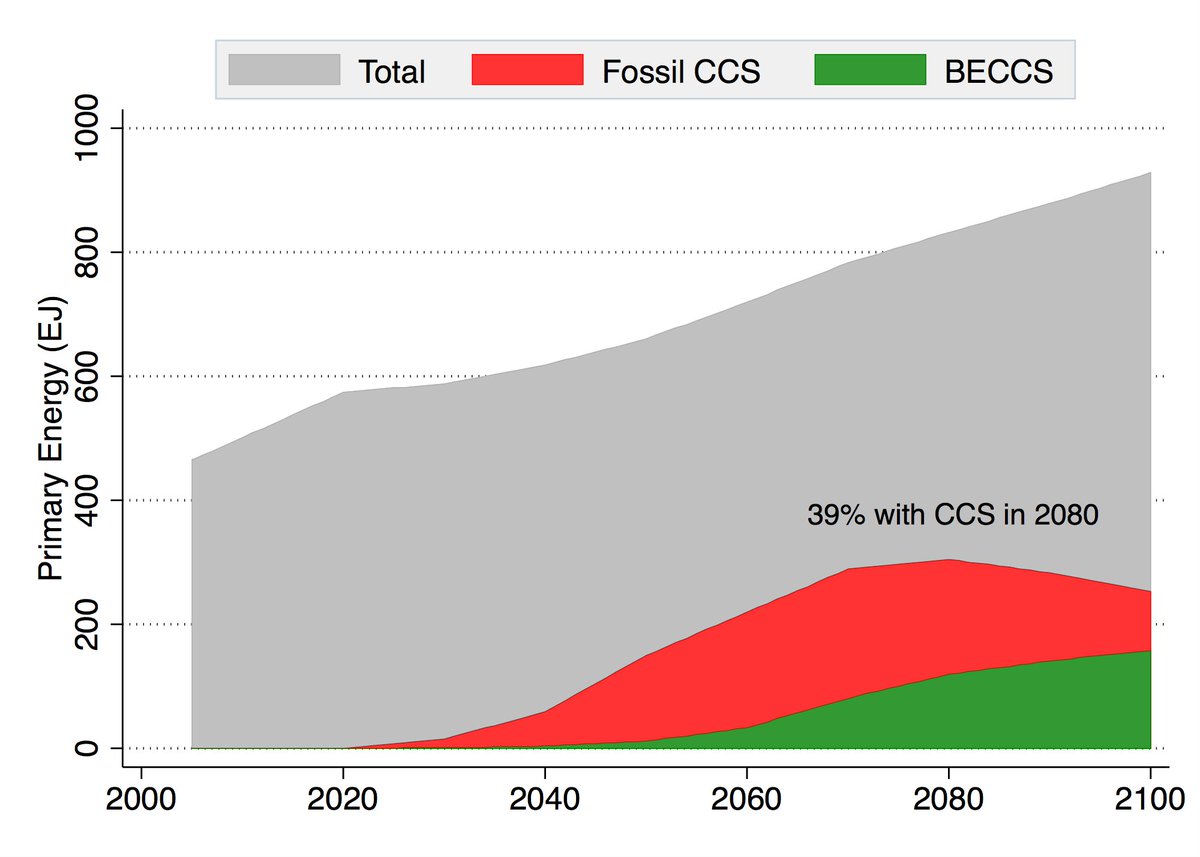
Many models go completely overboard with CCS, seeing a future resurgence of coal and a large part of global primary energy occurring with carbon capture. For example, here is what the MESSAGE SSP2-1.9 scenario shows: 5/10
Energy system models love NETs, particularly for very rapid mitigation scenarios like 1.5C (where the alternative is zero global emissions by 2040)! More problematically, they also like tons of NETs in 2C scenarios where NETs are less essential. https://t.co/M3ACyD4cv7 2/10
There is a lot of confusion about carbon budgets and how quickly emissions need to fall to zero to meet various warming targets. To cut through some of this morass, we can use some very simple emission pathways to explore what various targets would entail. 1/11 pic.twitter.com/Kriedtf0Ec
— Zeke Hausfather (@hausfath) September 24, 2020
In model world the math is simple: very rapid mitigation is expensive today, particularly once you get outside the power sector, and technological advancement may make later NETs cheaper than near-term mitigation after a point. 3/10
This is, of course, problematic if the aim is to ensure that particular targets (such as well-below 2C) are met; betting that a "backstop" technology that does not exist today at any meaningful scale will save the day is a hell of a moral hazard. 4/10
Many models go completely overboard with CCS, seeing a future resurgence of coal and a large part of global primary energy occurring with carbon capture. For example, here is what the MESSAGE SSP2-1.9 scenario shows: 5/10
You May Also Like


Facebook originally a CIA program called "LifeLog".
LifeLog, via DARPA, terminated on Feb 4th, 2004.
Facebook was launched on Feb 4th, 2004.
Many of the LifeLog team became execs at FB.
Zuckerberg is a figurehead.
CIA allowed Cambridge to help Trump win
https://t.co/enzOXDCogV

Pentagon Kills LifeLog
LifeLog, via DARPA, terminated on Feb 4th, 2004.
Facebook was launched on Feb 4th, 2004.
Many of the LifeLog team became execs at FB.
Zuckerberg is a figurehead.
CIA allowed Cambridge to help Trump win
https://t.co/enzOXDCogV
Project: Lifelog
— Robert Horan (@Robby12692) December 13, 2018
Started by DARPA in 1999, the goal of Lifelog was to create a database on civilians without their knowledge, and track everything they do.
The project "ended" on Feb 4th, 2004.
Facebook began the exact same day.
The CIA funneled tens of millions into Facebook. pic.twitter.com/r7hwF0v9kh
Pentagon Kills LifeLog