PAKISTAN-INDIA WATER ISSUES – HOW INDIA STOPPED WATER IN PAKISTAN's CANALS IN 1948

Thread

After partition in 1947, the water system was also bifurcated between Pakistan n India.

India cheated Pakistan when on April 1, 1948, India suddenly n without warning stopped...
1/n

...the supply of waters flowing into Pakistan's Central Bari Doab and Dipalpur Canals.

The boundary award on the partition of the sub-continent had left the headworks of these canals in Indian territory, and in accepting it India had implied her willingness to leave...

2/n
...the historic distribution of common waters undisturbed.

India's action was therefore in flagrant disregard not only of international law n morality, but of her solemn commitments with Pakistan and a gross violation of this country's historical rights over common waters.

3/n
Faced with a threat of utter desolation of millions of acres of fertile land, Pakistan had perforce to sign a document with India in which she agreed to "India's progressively diminishing water supplies to these canals and to the West Punjab government's tapping...

4/n
...alternative resources".

A specific reservation was made in the document with regard to India's claim that she had full property rights over waters flowing into her territory, and could therefore use them as she liked.

The issue was, however, to be examined...

5/n
... separately, but Pakistan's repeated efforts to induce India to submit it either to the International Court of Justice or to any other impartial tribunal met with failure.

So a deadlock ensued.

It was in 1951 that the World Bank offered its good offices to solve...

6/n
...the impasse.

It tried to find a practical solution on the basis of a joint exploitation of the waters of the Indus basin. But after exhaustive negotiations with India and Pakistan it came to the conclusion that the divergence of views between the two countries...

7/n
...was such that a solution of the dispute on these lines was impossible.

The Bank, therefore, directed its efforts to finding a solution.

Accordingly in 1954 the Bank made a broad proposal which stipulated that the waters of the eastern rivers—Sutlej, Beas and Ravi—...

8/n
... should be available to India and those of the western rivers—Chenab, Indus and Jhelum —be assigned to Pakistan.

Both Pakistan and India accepted the proposals in 1956.

In the meanwhile, however, India was going ahead with the construction of engineering works...

9/n
... that could enable her to divert the supplies of the eastern rivers.

In fact in 1957 she gave notice that she would stop water supplies from the eastern rivers to Pakistan in 1962.

However things changed as President Ayub Khan assumed power in Pakistan as he pushed...

10/n
... forward the negotiations towards conclusions before India could act.

After many sessions of of talks, finally Indian Prime Minister Nehru and Pakistani President Ayub Khan signed
the Indus Waters Treaty on 19 Sep 1960 in Karachi.

#WaterIsAHumanRight #Indus #WaterDispute

More from India

In his letters describing the India Mission, Carey has given us an insight into how the society functioned then, of how the minds of the people worked and what methods the missionaries used to approach and brainwash the common people.


It is entirely possible that,Carey in his arrogance of being the white man and hence more civilized,his inability to under the Hindu scriptures and his natural disdain for the learned community coupled with his inherent hatred for the idolaters may have exaggerated the incidents.

In fact, considering the venom with which he has spoken about Hinduism and it's practices, it's likely that he has exaggerated these incidents. But it cannot be denied that these incidents did happen even if they may not have been on scale at which Carey has described.

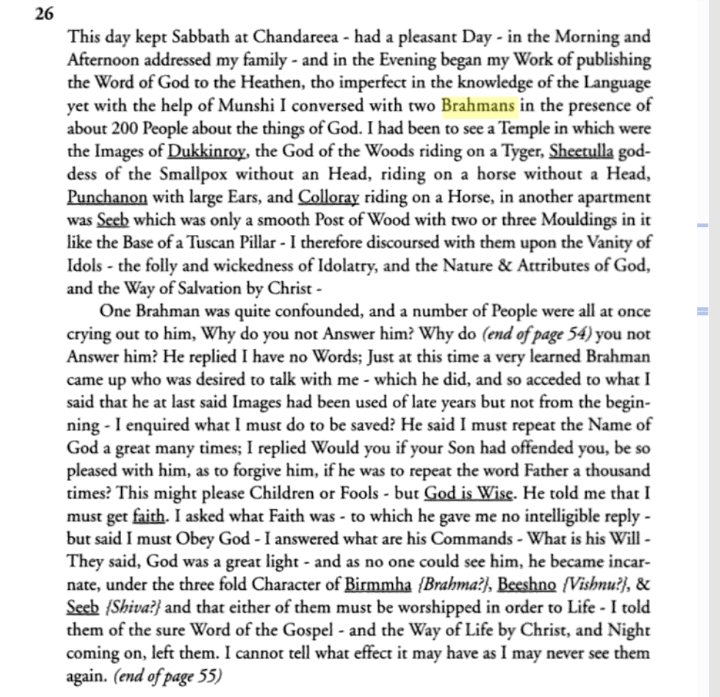
One of his journal entry mentions a debate which happened in a temple in front of around 200 people. Carey describes having debated with two learned men and goes on to say when both learned men failed to answer his questions, he went on to preach the gospel to the assembled crowd


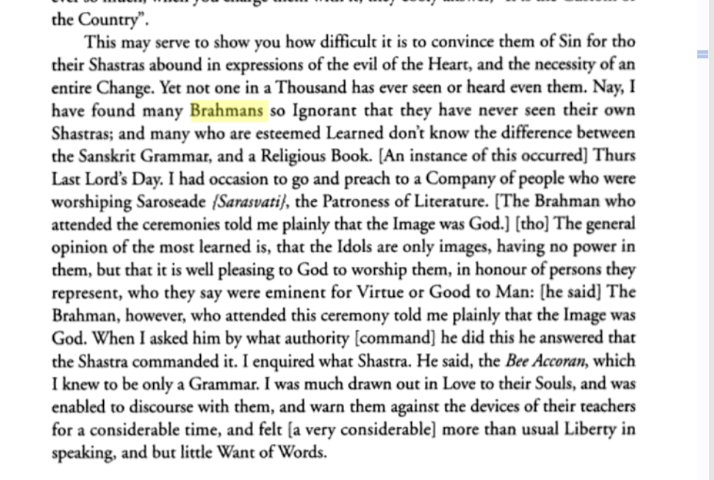
In a letter dated 30th June,1795 he goes on to gleefully narate how Hindus were unaware of their own scriptures and how an supposed expert named a grammar book when he was questioned as which scripture said that the Murti is God.

You May Also Like

1/ Some initial thoughts on personal moats:

Like company moats, your personal moat should be a competitive advantage that is not only durable—it should also compound over time.

Characteristics of a personal moat below:


2/ Like a company moat, you want to build career capital while you sleep.

As Andrew Chen noted:


3/ You don’t want to build a competitive advantage that is fleeting or that will get commoditized

Things that might get commoditized over time (some longer than


4/ Before the arrival of recorded music, what used to be scarce was the actual music itself — required an in-person artist.

After recorded music, the music itself became abundant and what became scarce was curation, distribution, and self space.

5/ Similarly, in careers, what used to be (more) scarce were things like ideas, money, and exclusive relationships.

In the internet economy, what has become scarce are things like specific knowledge, rare & valuable skills, and great reputations.
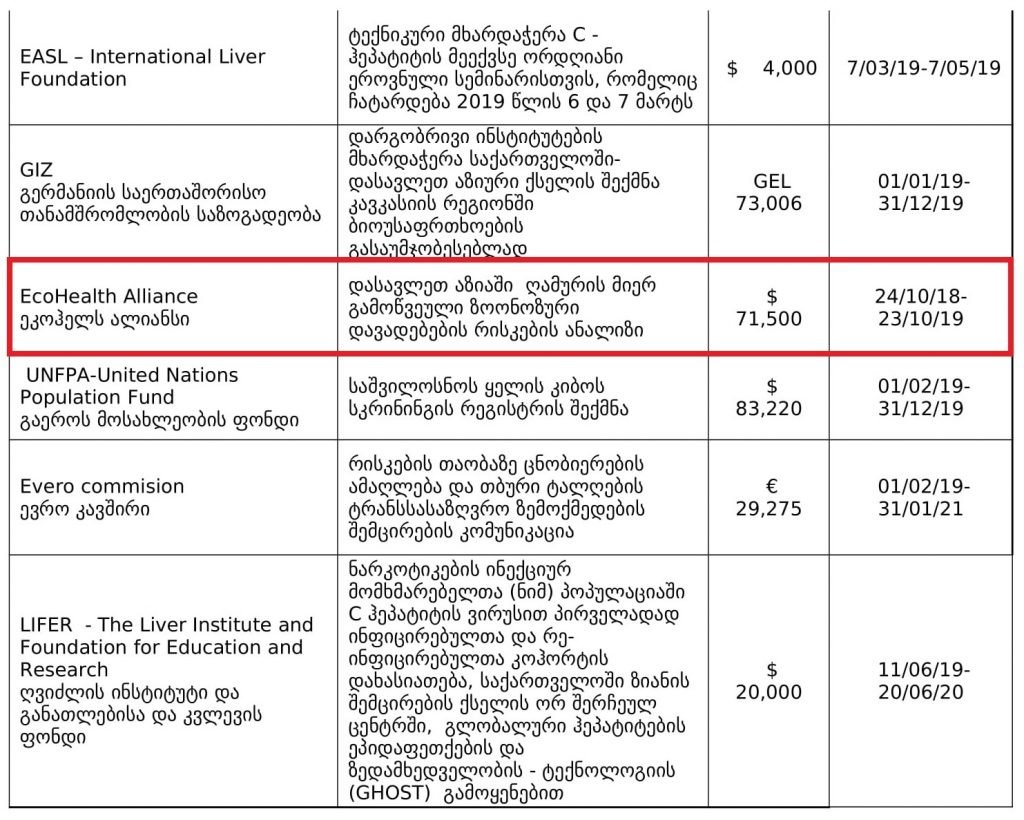
1. Project 1742 (EcoHealth/DTRA)
Risks of bat-borne zoonotic diseases in Western Asia

Duration: 24/10/2018-23 /10/2019

Funding: $71,500
@dgaytandzhieva
https://t.co/680CdD8uug


2. Bat Virus Database
Access to the database is limited only to those scientists participating in our ‘Bats and Coronaviruses’ project
Our intention is to eventually open up this database to the larger scientific community
https://t.co/mPn7b9HM48


3. EcoHealth Alliance & DTRA Asking for Trouble
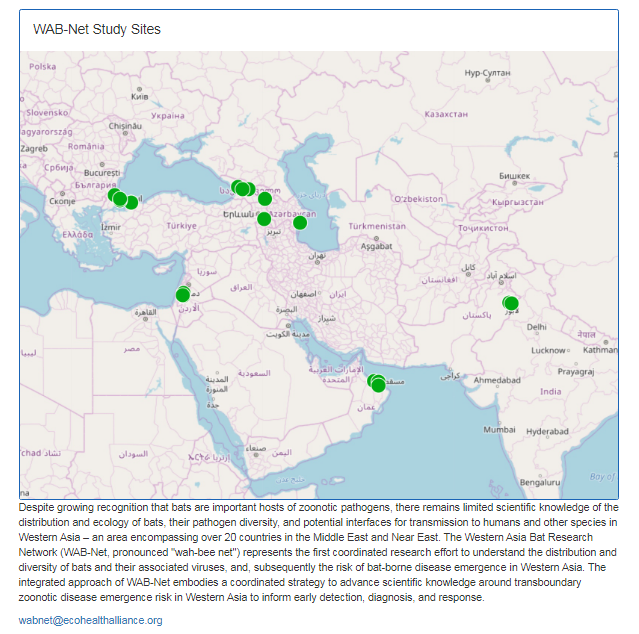
One Health research project focused on characterizing bat diversity, bat coronavirus diversity and the risk of bat-borne zoonotic disease emergence in the region.
https://t.co/u6aUeWBGEN


4. Phelps, Olival, Epstein, Karesh - EcoHealth/DTRA


5, Methods and Expected Outcomes
(Unexpected Outcome = New Coronavirus Pandemic)