[1/4] Ok this is really funny, check this out.
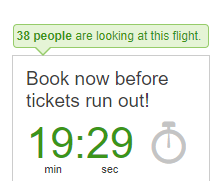
I was in the process of booking a flight via @OneTravel. Trying to make me book ASAP, they claimed: "38 people are looking at this flight".
Whoa, 38 is a lot, I have to hurry up. But first I have to check how they came up with 38 >>

[2/4] Right click and a quick "inspect" on the number, I found out the element's class name is "view_notification_random".
Awesome variable naming guys.
So you're _randomly_ trying to freak me out. Alright >>
[3/4] So what's your sophisticated pseudo-random algorithm?
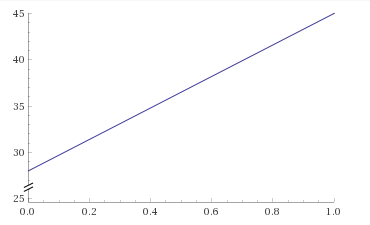
Apparently, OneTravel are choosing a number between 28 and 45.
Because as you all know, based on serious psychological research, these numbers tend to make people book their flights fast #sarcasm #not42 >>
[4/4] Here's a bonus graph.
Thanks @IddoYadlin and #WolframAlpha.

More from Tech

THREAD: How is it possible to train a well-performing, advanced Computer Vision model 𝗼𝗻 𝘁𝗵𝗲 𝗖𝗣𝗨? 🤔

At the heart of this lies the most important technique in modern deep learning - transfer learning.

Let's analyze how it


2/ For starters, let's look at what a neural network (NN for short) does.

An NN is like a stack of pancakes, with computation flowing up when we make predictions.

How does it all work?


3/ We show an image to our model.

An image is a collection of pixels. Each pixel is just a bunch of numbers describing its color.

Here is what it might look like for a black and white image


4/ The picture goes into the layer at the bottom.

Each layer performs computation on the image, transforming it and passing it upwards.


5/ By the time the image reaches the uppermost layer, it has been transformed to the point that it now consists of two numbers only.

The outputs of a layer are called activations, and the outputs of the last layer have a special meaning... they are the predictions!

You May Also Like