14 mental models that helped me build 10 startups and sell (a bunch of them) for millions.

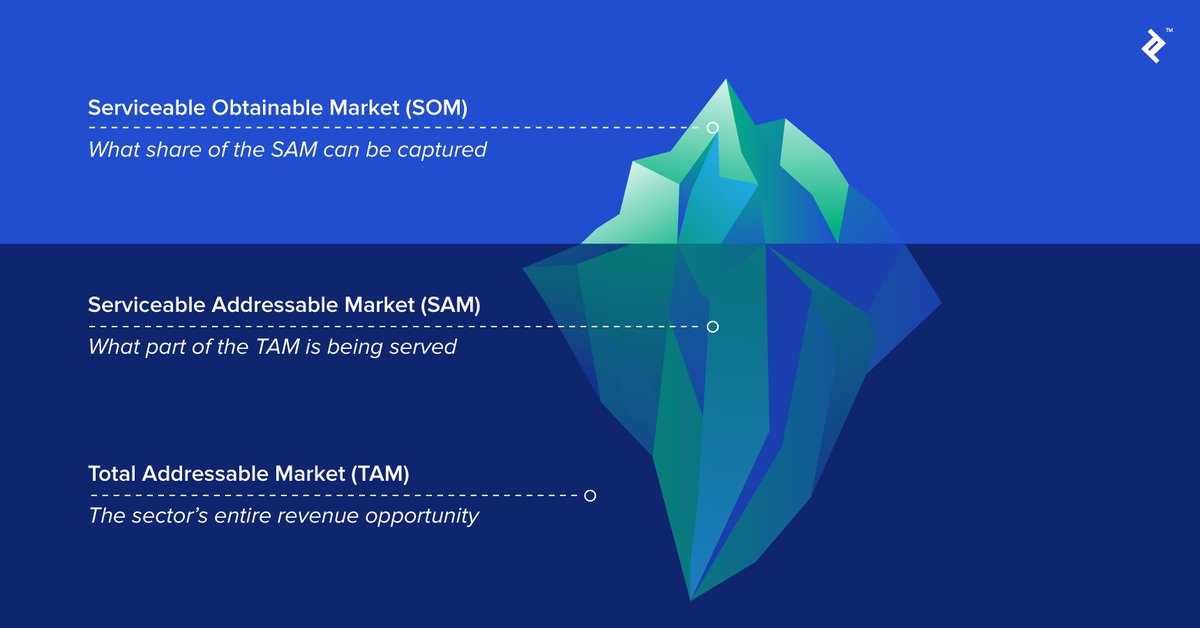
1) Serviceable Obtainable Market (SOM)

Everyone focuses on the Total Addressable Market (TAM), which gives an unrealistic expectation of your market size.

Instead SOM gives you a more practical estimate.
2) Viral Coefficient

Is the number of new users an average customer generates and a strong indicator of how highly your users like your product.

The higher your viral coefficient, the cheaper your acquisition costs.
3) Beta Testing

The process of exposing your users to different versions of the product/ messaging to determine the most effective one.

All top companies do this on a regular basis.
4) Conversion Funnel

The different stages that a buyer goes through before making a purchase.

Understanding what stage they're in helps you strategize your marketing accordingly.
5) Go-To-Market (GTM) Strategy

A comprehensive step-by-step plan that companies deploy to bring a new product/ service into the market.
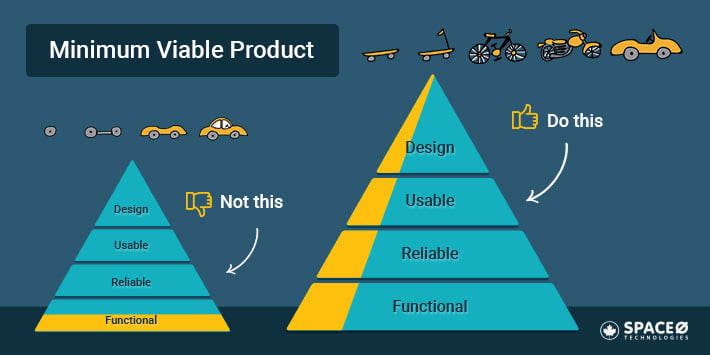
6) Minimum Viable Product (MVP)

The basic version of your product with core functionality that's just enough to launch and gather feedback.
7) Market Penetration

A measure of how much your product/ service is being used relative to the total market.

Eg: Netflix has a 21% share in the streaming services market in the US.
8) Engagement Loop

The activities that a user performs repeatedly while engaging with your app, reinforcing them to use it again, and again.
9) Customer Journey Map

It comprises the different touchpoints that take a person from a complete stranger into a happy customer.
10) LTV:CAC Ratio

It measures how much a customer is worth relative to the cost of acquisition.

If it's less than 1, you're burning your cash by bringing in more customers.
11) Churn Rate

The percentage of customers who cancel/quit your product relative to the total number of customers.

To increase LTV, you need to have a lower churn rate.
12) Value Gap Canvas

The gap that exists between a user's problem and the value delivered by the solution.

The higher the gap, the more you can charge.
13) Moment of Truth

Refers to the interaction that makes the users realize the value of the product or causes them to change their impression of the brand.
14) Exit Strategy

A plan designed to help owners/ shareholders sell their ownership partially/ completely.
Please RT the first tweet if you've found this helpful :) https://t.co/Af3aghLGW5

More from Startup

The dirty inside secret most first-time entrepreneurs don't know.

14 tools I use to steal from competitors, and build million-dollar businesses.

Housekeeping note:
Don't do anything that destroys your reputation. Copying what works is a simple & practical strategy, but don't cross any boundaries.

In this thread, I'll show you how to steal your competitors' traffic, product ideas, and customers in a 100% fair way.

1. Steal their social media traffic

Drop your competitors' url in
https://t.co/n4squ8fjHh

It will tell you what % of their web traffic comes from which social media platform

Looks like this


Generally, this traffic will be from ads and not content. To steal their social traffic, you'll need to steal their ad strategy.

If they're getting their traffic from Facebook...

2. Steal their Facebook ads

Go to Facebook Ad Library and find ads that your competitor has been running for 6+ months.

All of these ads are likely profitable https://t.co/bgqtSOvAe2

You May Also Like

THREAD: 12 Things Everyone Should Know About IQ

1. IQ is one of the most heritable psychological traits – that is, individual differences in IQ are strongly associated with individual differences in genes (at least in fairly typical modern environments). https://t.co/3XxzW9bxLE


2. The heritability of IQ *increases* from childhood to adulthood. Meanwhile, the effect of the shared environment largely fades away. In other words, when it comes to IQ, nature becomes more important as we get older, nurture less.
https://t.co/UqtS1lpw3n


3. IQ scores have been increasing for the last century or so, a phenomenon known as the Flynn effect. https://t.co/sCZvCst3hw (N ≈ 4 million)

(Note that the Flynn effect shows that IQ isn't 100% genetic; it doesn't show that it's 100% environmental.)


4. IQ predicts many important real world outcomes.

For example, though far from perfect, IQ is the single-best predictor of job performance we have – much better than Emotional Intelligence, the Big Five, Grit, etc. https://t.co/rKUgKDAAVx https://t.co/DWbVI8QSU3


5. Higher IQ is associated with a lower risk of death from most causes, including cardiovascular disease, respiratory disease, most forms of cancer, homicide, suicide, and accident. https://t.co/PJjGNyeQRA (N = 728,160)
https://t.co/6cRR2B3jBE
Viruses and other pathogens are often studied as stand-alone entities, despite that, in nature, they mostly live in multispecies associations called biofilms—both externally and within the host.

https://t.co/FBfXhUrH5d


Microorganisms in biofilms are enclosed by an extracellular matrix that confers protection and improves survival. Previous studies have shown that viruses can secondarily colonize preexisting biofilms, and viral biofilms have also been described.


...we raise the perspective that CoVs can persistently infect bats due to their association with biofilm structures. This phenomenon potentially provides an optimal environment for nonpathogenic & well-adapted viruses to interact with the host, as well as for viral recombination.


Biofilms can also enhance virion viability in extracellular environments, such as on fomites and in aquatic sediments, allowing viral persistence and dissemination.