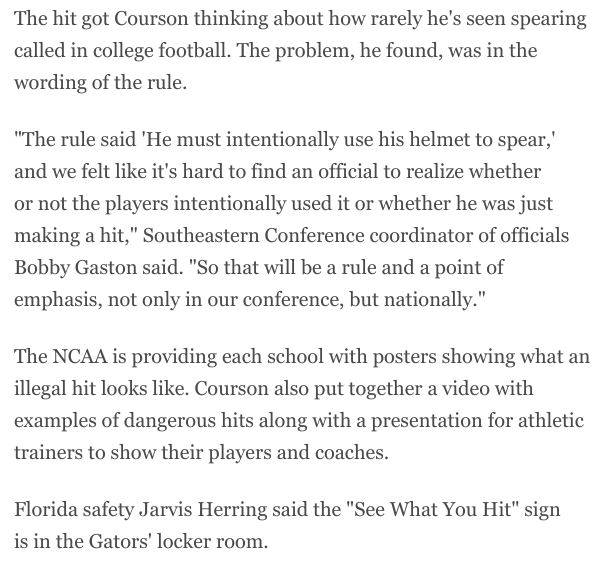
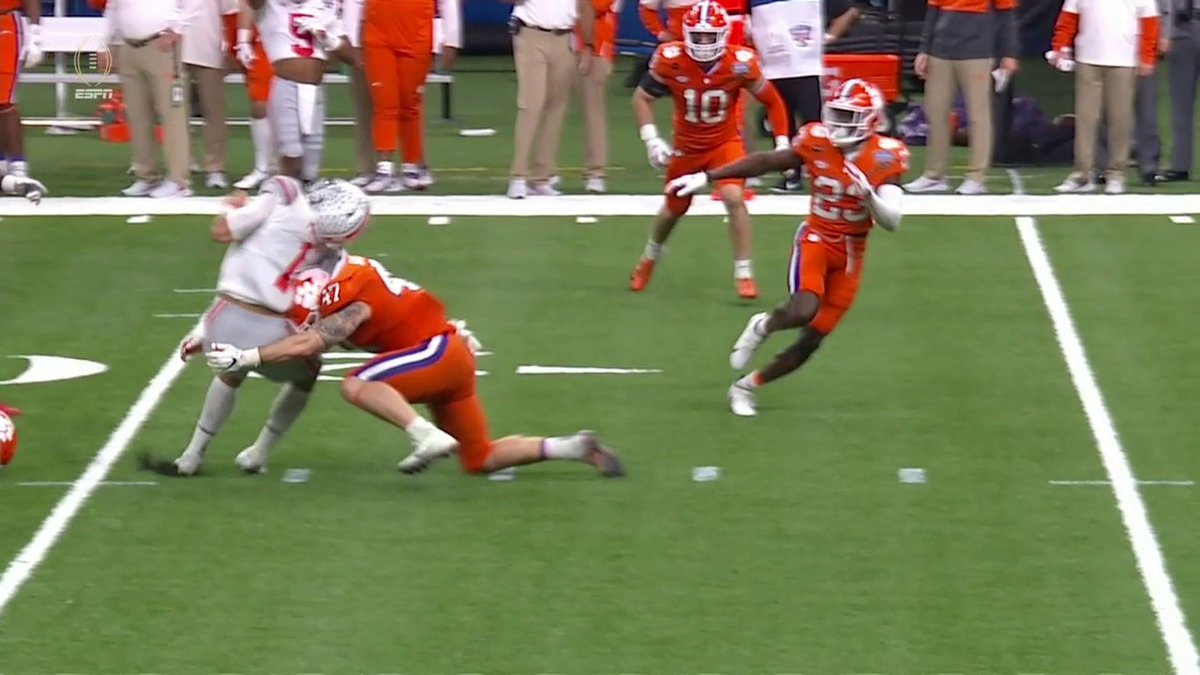
It's time we have a discussion about targeting. Let's set aside with the ejection aspect, for a moment, as I believe that needs changed. But undeniably, undoubtedly and unequivocally this was not only not a "textbook" form tackle, it was textbook targeting (formerly spearing).

1
The version of this targeting rule predates targeting itself. The rule began in 1975 as what was called "spearing" as the "deliberate use of the head and helmet" to punish an opponent. No player should use helmet "butt" or "ram" an opponent.

2
Anyone that played pee wee football in the 80s, 90s or beyond should know this as common sense. Every little leaguer football player was taught on day one not to look down when form tackling and not use the top of your helmet. This was a spear. Kids know this.

3
In 1976, the rule was modified more adding the indicator "(N)o player shall intentionally strike a runner with the crown or top of his helmet," to the rule.

This revision brought more clarity to what you could and could not do with the crown of your helmet.

4
Again the rule was modified, slightly, in 1990 to include the facemask. Although leading with the facemask WAS actually a good form tackle, you couldn't do it maliciously. This version of the rule continued on until 2005. Then...

5
The rule was again changed there in 2005. See a snippet of an ESPN/AP wire article as they removed "intentional" from the definition as it had always been difficult to enforce trying to judge intent of a malicious or otherwise reckless hit...

6
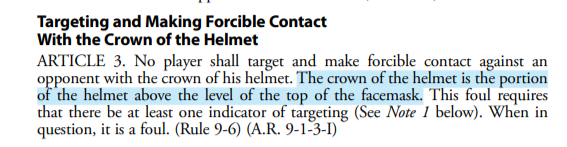
Two years later, the spearing rule was modified and put into an overarching targeting initiative that people now know. It now reads you cannot "target and make forcible contact" with the crown of the helmet. Targeting requires one indicator...

7
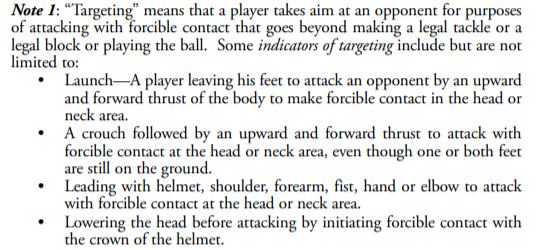
In the case of the old version of spearing, striking a player with the crown of the helmet, here are the indicators. Take your pick on the Skalski tackle, as both of the last two indicators are a perfect description of what he did...

8
Remember that targeting requires only one indicator. A player does not need to be defenseless; a tackler does not need to launch or thrust. There need not be intent. If you strike with the crown of your helmet, it's counter to how you're taught to tackle and it's a penalty.

9
So going back to the original hit it does not matter if Fields "spun into" the tackle or that it wasn't a launch. It was targeting. Period. But I do believe that targeting should not be an ejection unless it's malicious or it's like the yellow card/soccer system of multiple.

End

More from Sport

What a year it's been. It hasn't been easy for anyone in 2020, but we've seen @spfl clubs and community trusts across Scotland step up to support those in need.

Let's have a little thread to celebrate 12 months of extraordinary commitment.

❤️🧡💛💚💙💜🤎🖤🤍

/1


We kicked off the year with Football Fans in Training.

#BeYourOwnHero


Alison wasn't actually a @PartickThistle fan (albeit she kinda fell for the Jags with help from her partner). This was her story... 💪🏽

#BeYourOwnHero


Also in January we revealed that @JamTarts would join our @JoyofMovingUK programme, becoming the third club in Scotland to deliver the project to primary schools, across Edinburgh.

In Feb, we revealed @CashBackScot is to fund a new SPFL Trust project with five @spfl clubs / communities trusts to tackle anti-social behaviour.

Off the Bench will feature:

⚪️ @DundeeFCCT
⚪️ @falkirkfcf
⚪️ @bighearts
⚪️@community_mfcct
⚪️

You May Also Like

THREAD: 12 Things Everyone Should Know About IQ

1. IQ is one of the most heritable psychological traits – that is, individual differences in IQ are strongly associated with individual differences in genes (at least in fairly typical modern environments). https://t.co/3XxzW9bxLE


2. The heritability of IQ *increases* from childhood to adulthood. Meanwhile, the effect of the shared environment largely fades away. In other words, when it comes to IQ, nature becomes more important as we get older, nurture less.
https://t.co/UqtS1lpw3n


3. IQ scores have been increasing for the last century or so, a phenomenon known as the Flynn effect. https://t.co/sCZvCst3hw (N ≈ 4 million)

(Note that the Flynn effect shows that IQ isn't 100% genetic; it doesn't show that it's 100% environmental.)


4. IQ predicts many important real world outcomes.

For example, though far from perfect, IQ is the single-best predictor of job performance we have – much better than Emotional Intelligence, the Big Five, Grit, etc. https://t.co/rKUgKDAAVx https://t.co/DWbVI8QSU3


5. Higher IQ is associated with a lower risk of death from most causes, including cardiovascular disease, respiratory disease, most forms of cancer, homicide, suicide, and accident. https://t.co/PJjGNyeQRA (N = 728,160)