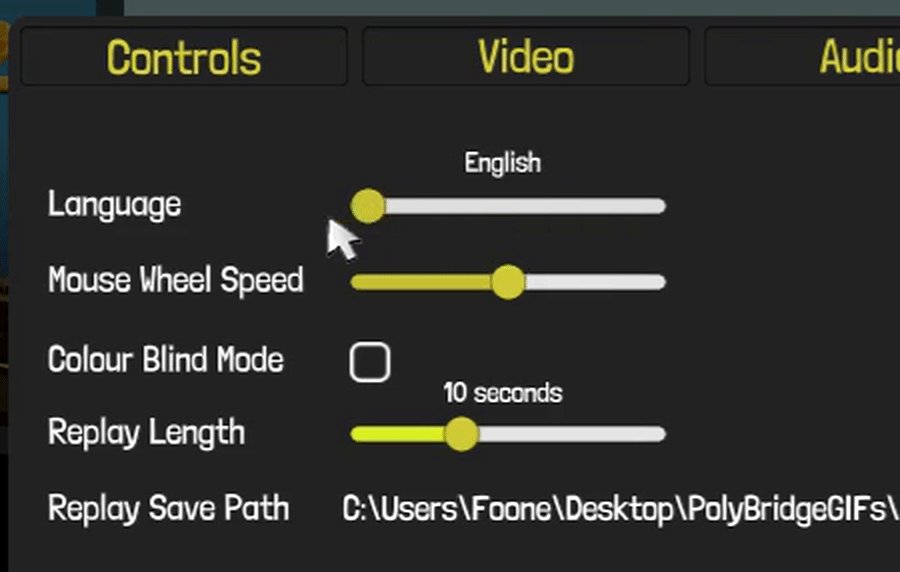
I'm pretty sure whoever designed this control usually makes gender selectors for websites...
Poly Bridge has a language SLIDER.
so they won without placing any bridge pieces? that sounds hard.
Sadly, no: they've moved to a much more sensible drop-down
name length: [slider 1-10]
letter 1: [slider a-z]
letter 2: [slider a-z]
letter 3: [slider a-z]
1. the leaderboard contains videos. these are just mp4 files of the game being played
2. the leaderboard contains the data for the bridge designs, and it's being rendered in-game
and even though people aren't hacking 0$ wins into the leaderboard now doesn't mean they aren't cheating. They just do it with physics, not RAM hacking
They made a "bridge" which is a bit of dense road that falls and crushes the car, but since cars can't "crush", the physics engine ends up squirting them out like a watermelon seed
1. it's talking to cloudflare
2. it's using TLS
3. it's probably about 750 kilobytes for one playback
and #1 and #3 mean it's probably just videos. tiny videos.
does it compress the videos in the client and upload them to the server?
or does it upload the solution to the server and let it render them?
More from foone
A fun fact on the wikipedia page for the metal–oxide–semiconductor field-effect transistor:
it is the most frequently manufactured device in history, and the total number manufactured from 1960-2018 is 13 sextillion.
That's 13,000,000,000,000,000,000,000.
Though this picture is a bit misleading.
Even with devices this small, we couldn't make 13 sextillion of them in 60 years.
So imagine a chip like this. It's the 555 timer, which is one of the most popular integrated circuits ever made.
In 2017, it was estimated a billion are made every year.
And at the heart of it is the die, which looks like this:
(from Ken Shirriff's blog)
https://t.co/mz5PQDjYqF
And that's fundamentally a bunch of CMOS transistors (along with some diodes and resistors), which are a type of MOSFET. How many of them are on a 555?
about 25. Not many, but it's a very simple chip.
it is the most frequently manufactured device in history, and the total number manufactured from 1960-2018 is 13 sextillion.
That's 13,000,000,000,000,000,000,000.
Though this picture is a bit misleading.
Even with devices this small, we couldn't make 13 sextillion of them in 60 years.
So imagine a chip like this. It's the 555 timer, which is one of the most popular integrated circuits ever made.
In 2017, it was estimated a billion are made every year.
And at the heart of it is the die, which looks like this:
(from Ken Shirriff's blog)
https://t.co/mz5PQDjYqF
And that's fundamentally a bunch of CMOS transistors (along with some diodes and resistors), which are a type of MOSFET. How many of them are on a 555?
about 25. Not many, but it's a very simple chip.
More from Software

Are you a Designer or a Developer?👨💻
Here are some Google Chrome extensions that can make you better in 2021. 🔥🍀
(Thread) 🧵👇
1. https://t.co/zGir5E5U0J: https://t.co/PVx1wlX0Se is the easiest way to stay updated on the latest programming news. Get the hottest dev news from the best tech blogs on any topic you can think of.
2. CSS Peeper: CSS Peeper is a CSS viewer tailored for Designers. Get access to useful styles with our Chrome extension. Its mission is to let Designers focus on design, and spend as little time as possible digging in a
3. UX Check: UX Check makes heuristic evaluations quick and easy. The extension will open up Nielsen's Ten Heuristics in a side pane next to your website.
4. Checkbot: Checkbot finds critical SEO, speed & security problems before your website visitors do
Tests 100s of pages at once for broken links, duplicate titles, invalid HTML, insecure pages, and 50+ other
Here are some Google Chrome extensions that can make you better in 2021. 🔥🍀
(Thread) 🧵👇
1. https://t.co/zGir5E5U0J: https://t.co/PVx1wlX0Se is the easiest way to stay updated on the latest programming news. Get the hottest dev news from the best tech blogs on any topic you can think of.
2. CSS Peeper: CSS Peeper is a CSS viewer tailored for Designers. Get access to useful styles with our Chrome extension. Its mission is to let Designers focus on design, and spend as little time as possible digging in a
3. UX Check: UX Check makes heuristic evaluations quick and easy. The extension will open up Nielsen's Ten Heuristics in a side pane next to your website.
4. Checkbot: Checkbot finds critical SEO, speed & security problems before your website visitors do
Tests 100s of pages at once for broken links, duplicate titles, invalid HTML, insecure pages, and 50+ other
@JuliaLMarcus @Iplaywithgerms This paper gives documentation on software (with causal reasoning, assumptions reviewed in appendix) for a parametric approach to estimating either "total effects" or "controlled direct effects" with competing events and time-varying
@Iplaywithgerms Total effects capture paths by which treatment affects competing event (e.g. protective total effect of lifesaving treatment on dementia may be wholly/partially due to effect on survival). Controlled direct effects do not capture these paths
@Iplaywithgerms More detailed reasoning on the difference and tradeoffs between total and controlled direct effects and causal reasoning in the point treatment context provided here along with description of some estimators and
@Iplaywithgerms If you are familiar with more robust approaches like IPW or even better TMLE for time-varying treatment, these are trivially adapted to go after the controlled direct effect by simply treating competing events like loss to follow-up (censoring). e.g.
@Iplaywithgerms Examples of IPW estimation of the total effect of a time-varying treatment described in Appendix D of this paper:
https://t.co/RNhcgTBMkb
And here
https://t.co/rMWmwFBWwV
Others in reference lists of above papers.
@Iplaywithgerms Total effects capture paths by which treatment affects competing event (e.g. protective total effect of lifesaving treatment on dementia may be wholly/partially due to effect on survival). Controlled direct effects do not capture these paths
@Iplaywithgerms More detailed reasoning on the difference and tradeoffs between total and controlled direct effects and causal reasoning in the point treatment context provided here along with description of some estimators and
@Iplaywithgerms If you are familiar with more robust approaches like IPW or even better TMLE for time-varying treatment, these are trivially adapted to go after the controlled direct effect by simply treating competing events like loss to follow-up (censoring). e.g.
@Iplaywithgerms Examples of IPW estimation of the total effect of a time-varying treatment described in Appendix D of this paper:
https://t.co/RNhcgTBMkb
And here
https://t.co/rMWmwFBWwV
Others in reference lists of above papers.