https://t.co/24HOcHIEDl
Here are some resources you need as a designer/developer to work on your level of productivity.👨💻🍀
(Thread) 🧵👇
https://t.co/24HOcHIEDl
https://t.co/KNBH3i21vD
https://t.co/gPmFoPUtxq
https://t.co/UWTXzVYUaB
https://t.co/ETww1mxBOY
https://t.co/MUEyNSFa9r
https://t.co/RH5aHAIN15
https://t.co/S8Hsy9BVlK
https://t.co/fqrUCrSeAW
https://t.co/1FaUonu8XV
More from Software

Developer productivity, y'all. It is a three TRILLION dollar opportunity, per the stripe report.
Eng managers and directors, we have got to stop asking for "more headcount" and start treating this like the systems problem that it is. https://t.co/XJ0CkFdgiO
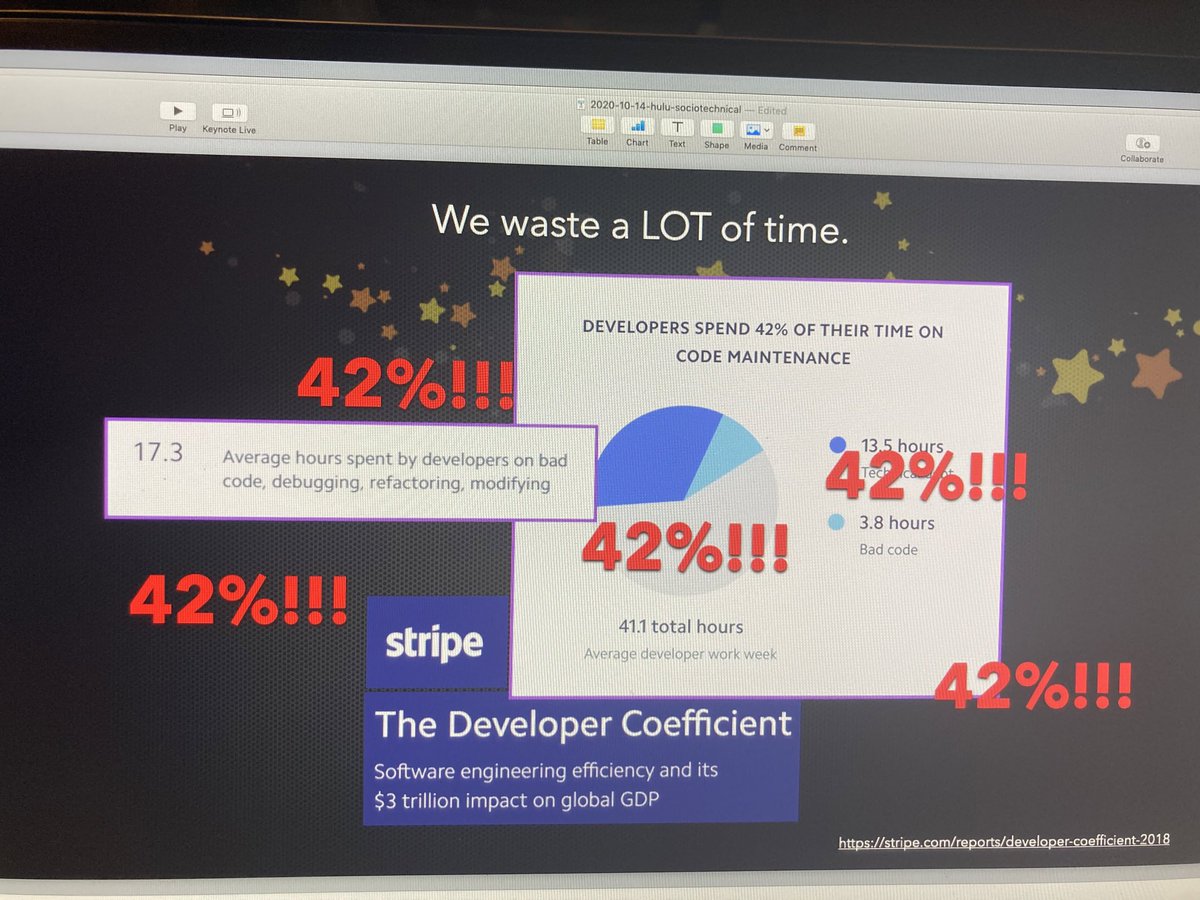
If you are getting barely more than 50% productivity out of your very expensive engineers, I can pretty much guarantee you cannot hire your way out of this resourcing issue. 😐
(the stripe report is here:
Say you've got a strategic initiative that 3 engineers to build and support it. Well, they're going to be swimming in the same muddy pipeline as everyone else at ~50%, so you're actually gotta source, hire and train 6, er make that 7 (gonna need another manager too now)...
...which actually understates the problem, because each person you add also adds friction and overhead to the system. Communication, coordination all get harder and processes get more complex and elaborate, etc.
So we could hire 7 people, or we could patch up our sociotechnical system to lose say only 25% productivity to tech debt, instead of 42%? 🤔
By my calculations, that would reclaim 3 engineers worth of capacity given a team of just 17-18 people.
Eng managers and directors, we have got to stop asking for "more headcount" and start treating this like the systems problem that it is. https://t.co/XJ0CkFdgiO
When people often have to spend weeks just to get a local development environment up, there is a lot to improve. \U0001f641
— Daniel Schildt (@autiomaa) December 20, 2020
If you are getting barely more than 50% productivity out of your very expensive engineers, I can pretty much guarantee you cannot hire your way out of this resourcing issue. 😐
(the stripe report is here:
Say you've got a strategic initiative that 3 engineers to build and support it. Well, they're going to be swimming in the same muddy pipeline as everyone else at ~50%, so you're actually gotta source, hire and train 6, er make that 7 (gonna need another manager too now)...
...which actually understates the problem, because each person you add also adds friction and overhead to the system. Communication, coordination all get harder and processes get more complex and elaborate, etc.
So we could hire 7 people, or we could patch up our sociotechnical system to lose say only 25% productivity to tech debt, instead of 42%? 🤔
By my calculations, that would reclaim 3 engineers worth of capacity given a team of just 17-18 people.


The Great Software Stagnation is real, but we have to understand it to fight it. The CAUSE of the TGSS is not "teh interwebs". The cause is the "direct manipulation" paradigm : the "worst idea in computer science" \1
Progress in CS comes from discovering ever more abstract and expressive languages to tell the computer to do something. But replacing "tell the computer to do something in language" with "do it yourself using these gestures" halts that progress. \2
Stagnation started in the 1970s after the first GUIs were invented. Every genre of software that gives users a "friendly" GUI interface, effectively freezes progress at that level of abstraction / expressivity. Because we can never abandon old direct manipulation metaphors \3
The 1990s were simply the point when most people in the world finally got access to a personal computer with a GUI. So that's where we see most of the ideas frozen. \4
It's no surprise that the improvements @jonathoda cites, that are still taking place are improvements in textual representation : \5
The Great Software\xa0Stagnation https://t.co/A6peSPERaU
— Jonathan Edwards (@jonathoda) January 1, 2021
Progress in CS comes from discovering ever more abstract and expressive languages to tell the computer to do something. But replacing "tell the computer to do something in language" with "do it yourself using these gestures" halts that progress. \2
Stagnation started in the 1970s after the first GUIs were invented. Every genre of software that gives users a "friendly" GUI interface, effectively freezes progress at that level of abstraction / expressivity. Because we can never abandon old direct manipulation metaphors \3
The 1990s were simply the point when most people in the world finally got access to a personal computer with a GUI. So that's where we see most of the ideas frozen. \4
It's no surprise that the improvements @jonathoda cites, that are still taking place are improvements in textual representation : \5