
A: no, it lives side-by-side with the existing Aurora Serverless, which will still be available to you as "v1".
I've gotten a few questions about Aurora Serverless v2 preview, so here's what I've learnt so far. Please feel free to chime in if I've missed anything important or got any of the facts wrong.
Alright, here goes the 🧵...
A: no, it lives side-by-side with the existing Aurora Serverless, which will still be available to you as "v1".
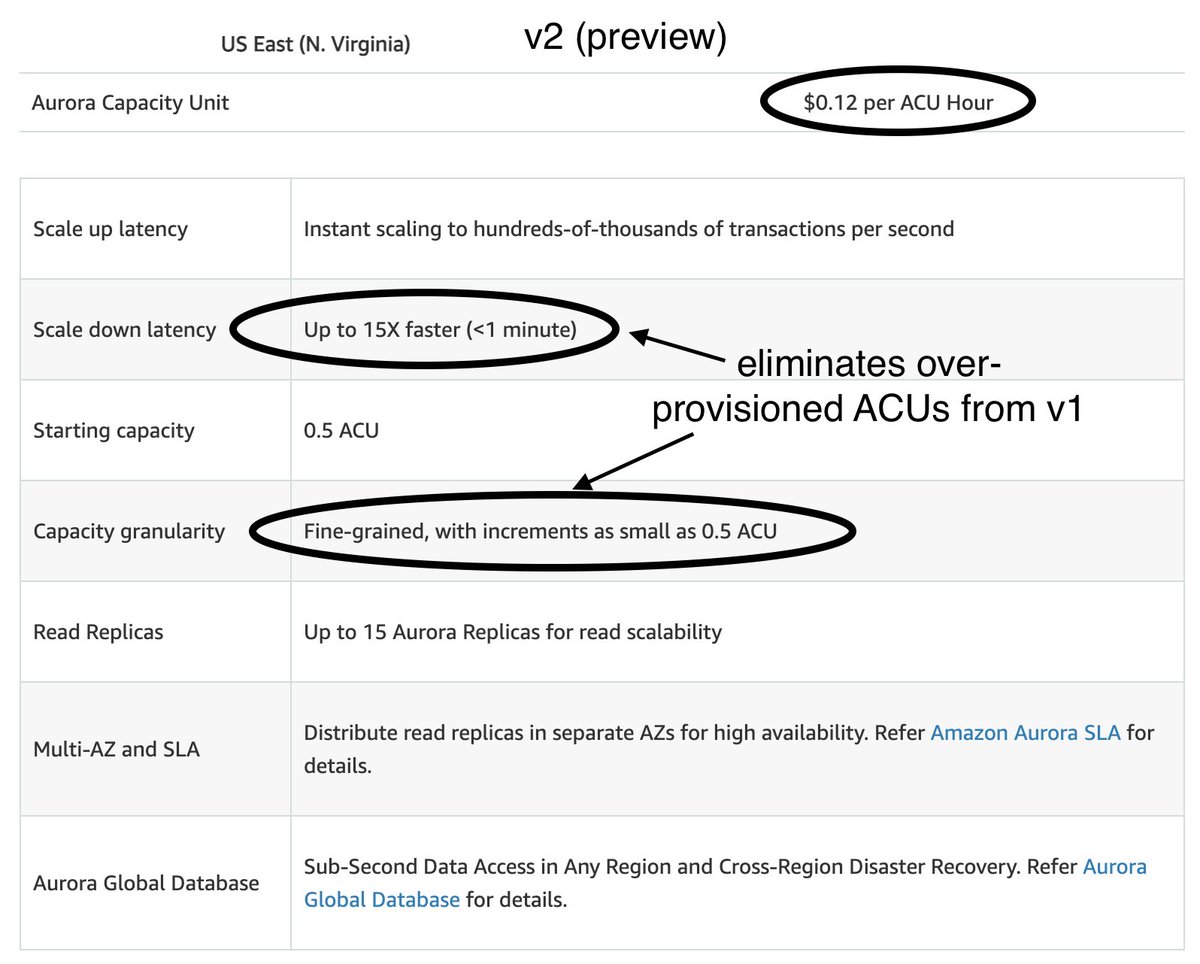
A: no, v2 scales up in milliseconds, during preview the max ACU is only 32 though
A: yes, unfortunately...
Q: so if you want to avoid cold starts, what's the minimum ACU you have to run?
A: minimum ACU with v2 is 0.5
A: no, it scales up in increments of 0.5 ACUs, so it's a much tighter fit for your workload, so you'll waste less money on over-provisioned ACUs
A: yes, v2 supports all the Aurora features, including those that v1 is missing, such as global database, IAM auth and Lambda triggers
A: yes, but v1 requires a lot of over-provisioning because it doubles ACU each time and takes 15 mins to scale down. v2 scales in 0.5 ACU increments and scales down in < 1 min. AND you get all the Aurora features!
A: yes you can! cool, right!?
A: yes, you probably should, until data API is enabled on v2, otherwise, more connections = more ACUs, it can run you into trouble
@jeremy_daly has written a nice summary post on this too, with a nice experiment on the scaling behaviour of v2, so check it out if you haven't already https://t.co/DIGylN0HFX
More from Software


Software architecture is in crisis, and the way to fix it is a hefty dose of anarchy.
Some lay the blame for this on @boicy with the whole microservices thing.
(Admittedly, @nicolefv, @jezhumble and @realgenekim didn’t help when they statistically proved that he might have been onto something with all that de-coupling and team-alignment…)
However I don’t blame him at all.
I think he saved us; bringing us back to the path of value-delivery and independent services, but now with added independent teams.

But one thing is clear. Microservices need more architecture, not less (as do other forms of #Accelerate-style software organisation).
(See https://t.co/B2hWmXhIqe if you need convincing)
I mean, all those pesky slices we need to carve up our monoliths (or were they big balls of mud?) That’s a significant amount of work right there…

Some lay the blame for this on @boicy with the whole microservices thing.
(Admittedly, @nicolefv, @jezhumble and @realgenekim didn’t help when they statistically proved that he might have been onto something with all that de-coupling and team-alignment…)
However I don’t blame him at all.
I think he saved us; bringing us back to the path of value-delivery and independent services, but now with added independent teams.
But one thing is clear. Microservices need more architecture, not less (as do other forms of #Accelerate-style software organisation).
(See https://t.co/B2hWmXhIqe if you need convincing)
I mean, all those pesky slices we need to carve up our monoliths (or were they big balls of mud?) That’s a significant amount of work right there…


@JuliaLMarcus @Iplaywithgerms This paper gives documentation on software (with causal reasoning, assumptions reviewed in appendix) for a parametric approach to estimating either "total effects" or "controlled direct effects" with competing events and time-varying
@Iplaywithgerms Total effects capture paths by which treatment affects competing event (e.g. protective total effect of lifesaving treatment on dementia may be wholly/partially due to effect on survival). Controlled direct effects do not capture these paths
@Iplaywithgerms More detailed reasoning on the difference and tradeoffs between total and controlled direct effects and causal reasoning in the point treatment context provided here along with description of some estimators and
@Iplaywithgerms If you are familiar with more robust approaches like IPW or even better TMLE for time-varying treatment, these are trivially adapted to go after the controlled direct effect by simply treating competing events like loss to follow-up (censoring). e.g.
@Iplaywithgerms Examples of IPW estimation of the total effect of a time-varying treatment described in Appendix D of this paper:
https://t.co/RNhcgTBMkb
And here
https://t.co/rMWmwFBWwV
Others in reference lists of above papers.
@Iplaywithgerms Total effects capture paths by which treatment affects competing event (e.g. protective total effect of lifesaving treatment on dementia may be wholly/partially due to effect on survival). Controlled direct effects do not capture these paths
@Iplaywithgerms More detailed reasoning on the difference and tradeoffs between total and controlled direct effects and causal reasoning in the point treatment context provided here along with description of some estimators and
@Iplaywithgerms If you are familiar with more robust approaches like IPW or even better TMLE for time-varying treatment, these are trivially adapted to go after the controlled direct effect by simply treating competing events like loss to follow-up (censoring). e.g.
@Iplaywithgerms Examples of IPW estimation of the total effect of a time-varying treatment described in Appendix D of this paper:
https://t.co/RNhcgTBMkb
And here
https://t.co/rMWmwFBWwV
Others in reference lists of above papers.

You May Also Like






So it's now October 10, 2018 and....Rod Rosenstein is STILL not fired.
He's STILL in charge of the Mueller investigation.
He's STILL refusing to hand over the McCabe memos.
He's STILL holding up the declassification of the #SpyGate documents & their release to the public.
I love a good cover story.......
The guy had a face-to-face with El Grande Trumpo himself on Air Force One just 2 days ago. Inside just about the most secure SCIF in the world.
And Trump came out of AF1 and gave ol' Rod a big thumbs up!
And so we're right back to 'that dirty rat Rosenstein!' 2 days later.
At this point it's clear some members of Congress are either in on this and helping the cover story or they haven't got a clue and are out in the cold.
Note the conflicting stories about 'Rosenstein cancelled meeting with Congress on Oct 11!"
First, rumors surfaced of a scheduled meeting on Oct. 11 between Rosenstein & members of Congress, and Rosenstein just cancelled it.
He's STILL in charge of the Mueller investigation.
He's STILL refusing to hand over the McCabe memos.
He's STILL holding up the declassification of the #SpyGate documents & their release to the public.
I love a good cover story.......
The guy had a face-to-face with El Grande Trumpo himself on Air Force One just 2 days ago. Inside just about the most secure SCIF in the world.
And Trump came out of AF1 and gave ol' Rod a big thumbs up!
And so we're right back to 'that dirty rat Rosenstein!' 2 days later.
At this point it's clear some members of Congress are either in on this and helping the cover story or they haven't got a clue and are out in the cold.
Note the conflicting stories about 'Rosenstein cancelled meeting with Congress on Oct 11!"
First, rumors surfaced of a scheduled meeting on Oct. 11 between Rosenstein & members of Congress, and Rosenstein just cancelled it.
Rep. Andy Biggs and Rep. Matt Gaetz say DAG Rod Rosenstein cancelled an Oct. 11 appearance before the judiciary and oversight committees. They are now calling for a subpoena. pic.twitter.com/TknVHKjXtd
— Ivan Pentchoukov \U0001f1fa\U0001f1f8 (@IvanPentchoukov) October 10, 2018