Twitter is like a free workshop.

But 98.8% of the people miss out on the best tweets.

Here are our best threads from February & what they can help you with:

Collaborated with @niki_poojary

1) How to use Tradingview paid features in the free plan?

This will save you a lot of money each year. Also a huge help with multi-timeframe analysis.

https://t.co/qrhGZqhmhP
2) After constantly working with @niki_poojary I finally learned how to make my own trading plan.

I listed down her simple 8 step process to create a plan:

https://t.co/by0IpJg5UA
3) Extended moves help you to book profits and play reversals.

Here are 8 examples of extended moves to learn from @niki_poojary

https://t.co/yjQhQm4APx
4) 10 concepts I wish I learned quicker post my three-year experience in the stock market.

Knowing these and working on them will save you a lot of time & money. If I did it all again, I'd focus on these concepts first before learning something else.

https://t.co/3CTAy9dT5o
5) We'd all love to lower our trading costs significantly. That's where "synthetics" help us.

These are must-know concepts to help you build a strong foundation. Once you master them, you'll always pick the right strategy from a cost & and returns point.

https://t.co/CG6pPscDnk
6) We can do some cool things with Zerodha's charting platform for free.

@niki_poojary has listed out 7 ways we can use the charting software to save money and enhance our experience on Zeordha.

https://t.co/HcNxnBA0vg
7) In case you're interested in our threads from January here they are:

We've covered strategies to use for option sellers and also noted down 15 learnings from Power of Stocks Subhasish Pani.

https://t.co/rMAGMmpWgI

More from Aditya Todmal

More from Screeners

Time for a new thread on the possibilities I am looking for.
Do read it completely to understand the stance and the plan.


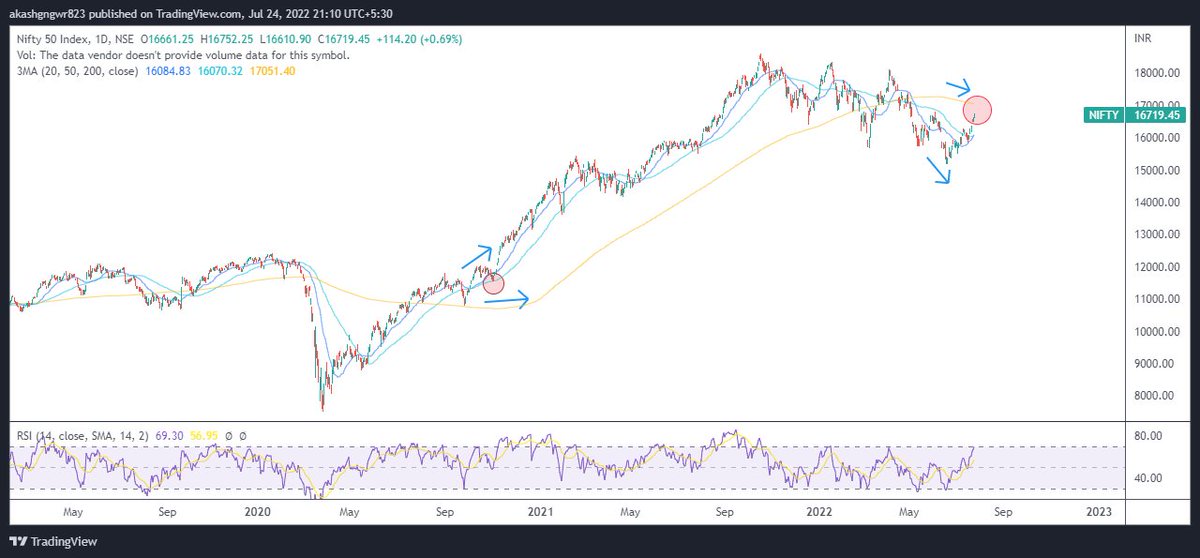
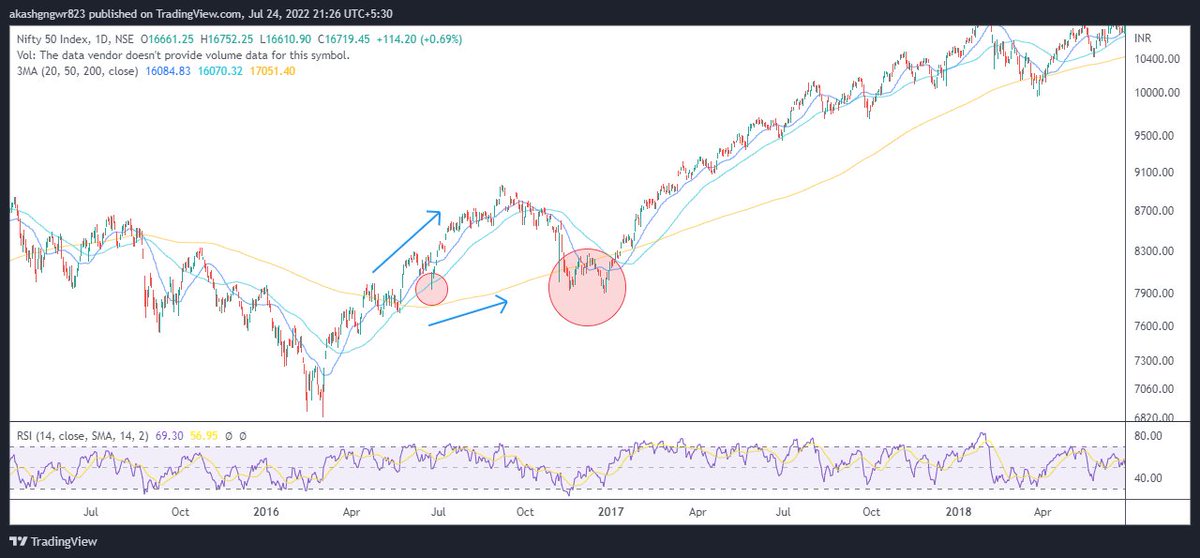
1. The moving average structure - Many traders just look at the 200 ma test or closing above/below it regardless of its slope. Let's look at all the interactions with 200 ma where price met it for the first time after the trend change but with 200 ma slope against it


One can clearly sense that currently it is one of those scenarios only. I understand that I might get trolled for this, but an unbiased mind suggests that odds are highly against the bulls for making fresh investments.

But markets are good at giving surprises. What should be our stance if price kept on rising? Let's understand that through charts. The concept is still the same. Divergent 200 ma and price move results in 200 ma test atleast once which gives good investment opportunities.


2. Zig-Zag bear market- There are two types of fall in a bear market, the first one is vertical fall which usually ends with ending diagonals (falling wedges) and the second one is zig zag one which usually ends with parabolic down moves.

You May Also Like

THREAD: 12 Things Everyone Should Know About IQ

1. IQ is one of the most heritable psychological traits – that is, individual differences in IQ are strongly associated with individual differences in genes (at least in fairly typical modern environments). https://t.co/3XxzW9bxLE


2. The heritability of IQ *increases* from childhood to adulthood. Meanwhile, the effect of the shared environment largely fades away. In other words, when it comes to IQ, nature becomes more important as we get older, nurture less.
https://t.co/UqtS1lpw3n


3. IQ scores have been increasing for the last century or so, a phenomenon known as the Flynn effect. https://t.co/sCZvCst3hw (N ≈ 4 million)

(Note that the Flynn effect shows that IQ isn't 100% genetic; it doesn't show that it's 100% environmental.)


4. IQ predicts many important real world outcomes.

For example, though far from perfect, IQ is the single-best predictor of job performance we have – much better than Emotional Intelligence, the Big Five, Grit, etc. https://t.co/rKUgKDAAVx https://t.co/DWbVI8QSU3


5. Higher IQ is associated with a lower risk of death from most causes, including cardiovascular disease, respiratory disease, most forms of cancer, homicide, suicide, and accident. https://t.co/PJjGNyeQRA (N = 728,160)
“We don’t negotiate salaries” is a negotiation tactic.

Always. No, your company is not an exception.

A tactic I don’t appreciate at all because of how unfairly it penalizes low-leverage, junior employees, and those loyal enough not to question it, but that’s negotiation for you after all. Weaponized information asymmetry.

Listen to Aditya


And by the way, you should never be worried that an offer would be withdrawn if you politely negotiate.

I have seen this happen *extremely* rarely, mostly to women, and anyway is a giant red flag. It suggests you probably didn’t want to work there.

You wish there was no negotiating so it would all be more fair? I feel you, but it’s not happening.

Instead, negotiate hard, use your privilege, and then go and share numbers with your underrepresented and underpaid colleagues. […]