
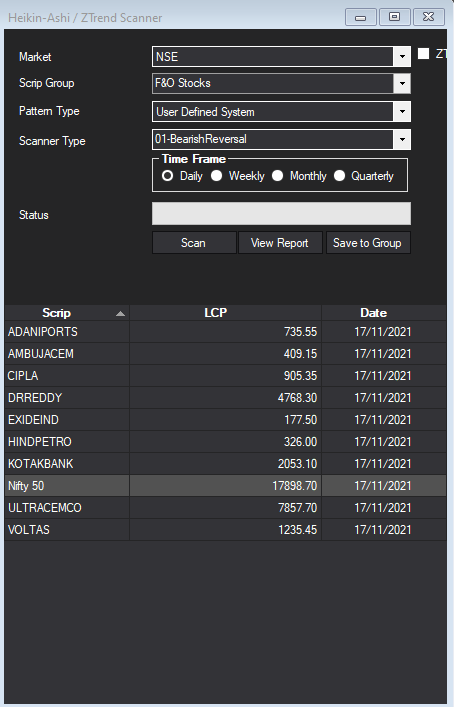
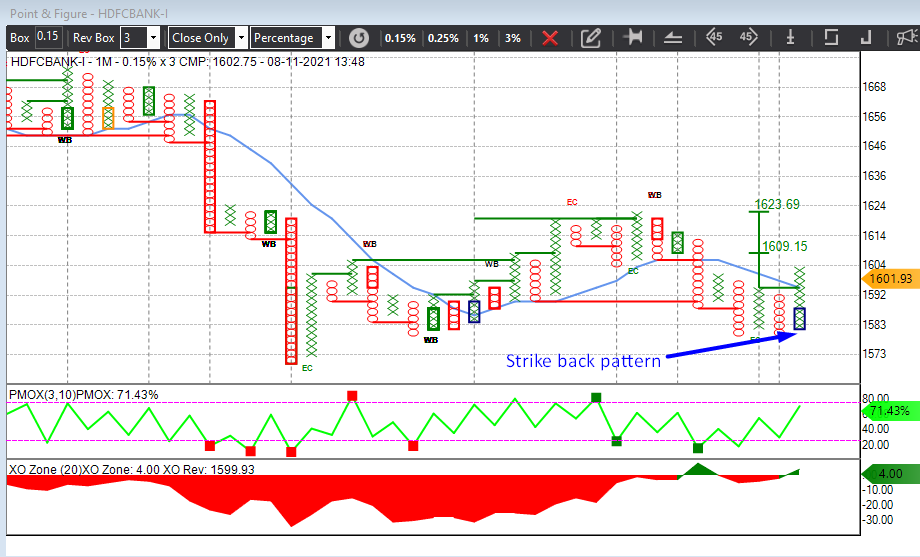
Developed a Heikin-Ashi scanner for bearish reversals. Today's outputs and two charts attached.
2 conditions for reversal -
a) HA doji at prev candle and open=high at current candle
b) Open=Low at prev candle and Open=high at current candle
Filter added - disparity indx on 21 EMA
More from DTBhat
#BearishMomentumScanner
Conditions -
1) EMA 8 below ema 34 and falling
2) bar close below prev 5 bars
3) RSI below 30
4) volume above prev 5 bars
5) ADX above 30
6) +DMI below -DMI
All conditions should be true
Conditions -
1) EMA 8 below ema 34 and falling
2) bar close below prev 5 bars
3) RSI below 30
4) volume above prev 5 bars
5) ADX above 30
6) +DMI below -DMI
All conditions should be true
The thread explains my momentum scanner and how to build it in #TradePoint software. @Definedge
— DTBhat (@dtbhat) August 29, 2021
Conditions :
1)EMA 8 above EMA 34 and rising
2)Candle close above previous 5 candle high
3) RSI above 60
4) Volume above previous 5 candles
5) ADX above 30
1/n



More from Screeners


You May Also Like




A brief analysis and comparison of the CSS for Twitter's PWA vs Twitter's legacy desktop website. The difference is dramatic and I'll touch on some reasons why.
Legacy site *downloads* ~630 KB CSS per theme and writing direction.
6,769 rules
9,252 selectors
16.7k declarations
3,370 unique declarations
44 media queries
36 unique colors
50 unique background colors
46 unique font sizes
39 unique z-indices
https://t.co/qyl4Bt1i5x

PWA *incrementally generates* ~30 KB CSS that handles all themes and writing directions.
735 rules
740 selectors
757 declarations
730 unique declarations
0 media queries
11 unique colors
32 unique background colors
15 unique font sizes
7 unique z-indices
https://t.co/w7oNG5KUkJ

The legacy site's CSS is what happens when hundreds of people directly write CSS over many years. Specificity wars, redundancy, a house of cards that can't be fixed. The result is extremely inefficient and error-prone styling that punishes users and developers.
The PWA's CSS is generated on-demand by a JS framework that manages styles and outputs "atomic CSS". The framework can enforce strict constraints and perform optimisations, which is why the CSS is so much smaller and safer. Style conflicts and unbounded CSS growth are avoided.
Legacy site *downloads* ~630 KB CSS per theme and writing direction.
6,769 rules
9,252 selectors
16.7k declarations
3,370 unique declarations
44 media queries
36 unique colors
50 unique background colors
46 unique font sizes
39 unique z-indices
https://t.co/qyl4Bt1i5x
PWA *incrementally generates* ~30 KB CSS that handles all themes and writing directions.
735 rules
740 selectors
757 declarations
730 unique declarations
0 media queries
11 unique colors
32 unique background colors
15 unique font sizes
7 unique z-indices
https://t.co/w7oNG5KUkJ
The legacy site's CSS is what happens when hundreds of people directly write CSS over many years. Specificity wars, redundancy, a house of cards that can't be fixed. The result is extremely inefficient and error-prone styling that punishes users and developers.
The PWA's CSS is generated on-demand by a JS framework that manages styles and outputs "atomic CSS". The framework can enforce strict constraints and perform optimisations, which is why the CSS is so much smaller and safer. Style conflicts and unbounded CSS growth are avoided.
