- If any Index closed exactly at the resistance, you can get a trade on either side on the next day. (2/11)
How you can filter stocks for Intraday trades - 🧵
As a kid, we would do homework before school the next day - you have to do homework here too. A specific sector performs on a particular day and studying things a day before will help you spot that particular sector. (1/11)
- If any Index closed exactly at the resistance, you can get a trade on either side on the next day. (2/11)
- If any Index closed exactly at support, you can get a trade on either side the following day.
- If there was a bullish signal at the support.
- If any Index gave a breakout or breakdown and then gave a good closing. (3/11)
Once you spot the Index, look at all the stocks in that particular Index. Pick at least 3-4 stocks from that Index and add them to your watchlist for the next day. It's ideal to check both higher and lower timeframes. (4/11)
- Start with checking the top gainers/losers list. I observe market from 9:15 to 9:45am to check the sectors performing well on that day.(5/11)
More from Sheetal Rijhwani
Nobody will give you this kind of knowledge in any paid webinar like they gave this in a thread! One more brilliant thread by @ITRADE191 @AdityaTodmal @niki_poojary
In this thread, I'll walk you through my set up, absorb it as much as you can.
— itrade(DJ) (@ITRADE191) June 27, 2021
The instrument that I trade in are Nifty (NF) options
Thanks to @AdityaTodmal @niki_poojary for contributing in making this pic.twitter.com/BrMrGydb1v
Target - 6400+
Stop loss - 4650 https://t.co/DD6pFtSvMI
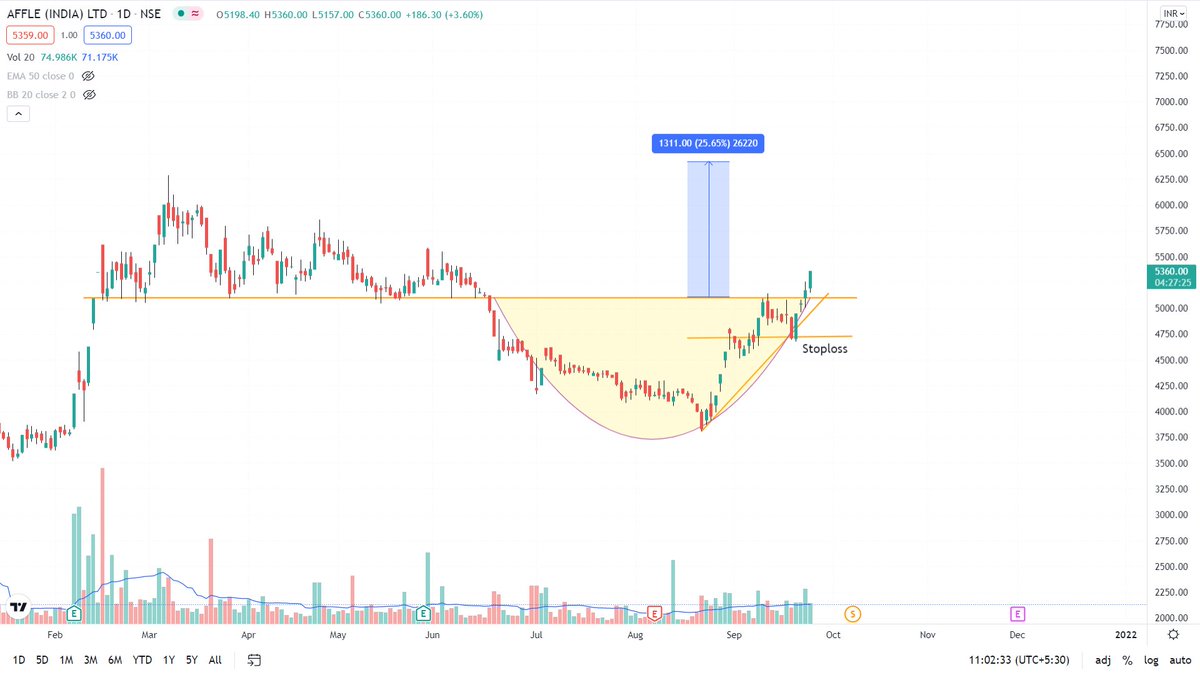
#AffleIndia
— Sheetal Rijhwani (@RijhwaniSheetal) August 8, 2021
It's at retest of weekly breakout level.. we can get a good entry with favourable risk/reward. Have a look at chart! #stockmarket #stockstowatch pic.twitter.com/cS9EOIoWJl
Here are some ways how you can do it, when you can do it and the right position sizing for doing it... 🧵 (1/25)
Traders who are trading in cash and want to explore options generally start with options buying without much knowledge. They buy OTM strikes and trade with wrong position sizing. With no idea about the perfect entry, they end up feeling that F&O is risky. (2/25)
After losses in F&O buying, this is how I approached it and it rewarded me pretty well in initial phase. I find this strategy easy to start things off. And then, you can explore other strategies too and find what works for you. (3/25)
Vertical spread is a directional, defined risk options trading strategy:
1. Bull call spread (Debit spread)
2. Bull put spread (Credit spread)
3. Bear call spread (Credit spread)
4. Bear put spread (Debit spread)
Read about these strategies in the below articles. (4/25)
https://t.co/KQvYOsu9kv
While going through these strategies, you must have thought you have to wait till expiry for profits/loss. (5/25)
Read and follow this.. he has aptly explained about various methods to trail.
2. TRAILING METHODS-
— Trader knight (@Traderknight007) December 24, 2020
1. SWING POINT METHOD-
In this method we use the swing points or the HH- HL OR LH-LL points for placing sl,
In this method we trail our sl when the stock make a Higher low after our entry and keep Trailing the sl till it hits. pic.twitter.com/CqzCkLdWmC
More from Screeners
Here I will share what I believe are essentials for anybody who is interested in stock markets and the resources to learn them, its from my experience and by no means exhaustive..
First the very basic : The Dow theory, Everybody must have basic understanding of it and must learn to observe High Highs, Higher Lows, Lower Highs and Lowers lows on charts and their
Even those who are more inclined towards fundamental side can also benefit from Dow theory, as it can hint start & end of Bull/Bear runs thereby indication entry and exits.
Next basic is Wyckoff's Theory. It tells how accumulation and distribution happens with regularity and how the market actually
Dow theory is old but
Old is Gold....
— Professor (@DillikiBiili) January 23, 2020
this Bharti Airtel chart is a true copy of the Wyckoff Pattern propounded in 1931....... pic.twitter.com/tQ1PNebq7d
You May Also Like
Hello!! 👋
• I have curated some of the best tweets from the best traders we know of.
• Making one master thread and will keep posting all my threads under this.
• Go through this for super learning/value totally free of cost! 😃
1. 7 FREE OPTION TRADING COURSES FOR
A THREAD:
— Aditya Todmal (@AdityaTodmal) November 28, 2020
7 FREE OPTION TRADING COURSES FOR BEGINNERS.
Been getting lot of dm's from people telling me they want to learn option trading and need some recommendations.
Here I'm listing the resources every beginner should go through to shorten their learning curve.
(1/10)
2. THE ABSOLUTE BEST 15 SCANNERS EXPERTS ARE USING
Got these scanners from the following accounts:
1. @Pathik_Trader
2. @sanjufunda
3. @sanstocktrader
4. @SouravSenguptaI
5. @Rishikesh_ADX
The absolute best 15 scanners which experts are using.
— Aditya Todmal (@AdityaTodmal) January 29, 2021
Got these scanners from the following accounts:
1. @Pathik_Trader
2. @sanjufunda
3. @sanstocktrader
4. @SouravSenguptaI
5. @Rishikesh_ADX
Share for the benefit of everyone.
3. 12 TRADING SETUPS which experts are using.
These setups I found from the following 4 accounts:
1. @Pathik_Trader
2. @sourabhsiso19
3. @ITRADE191
4.
12 TRADING SETUPS which experts are using.
— Aditya Todmal (@AdityaTodmal) February 7, 2021
These setups I found from the following 4 accounts:
1. @Pathik_Trader
2. @sourabhsiso19
3. @ITRADE191
4. @DillikiBiili
Share for the benefit of everyone.
4. Curated tweets on HOW TO SELL STRADDLES.
Everything covered in this thread.
1. Management
2. How to initiate
3. When to exit straddles
4. Examples
5. Videos on
Curated tweets on How to Sell Straddles
— Aditya Todmal (@AdityaTodmal) February 21, 2021
Everything covered in this thread.
1. Management
2. How to initiate
3. When to exit straddles
4. Examples
5. Videos on Straddles
Share if you find this knowledgeable for the benefit of others.
Like company moats, your personal moat should be a competitive advantage that is not only durable—it should also compound over time.
Characteristics of a personal moat below:
I'm increasingly interested in the idea of "personal moats" in the context of careers.
— Erik Torenberg (@eriktorenberg) November 22, 2018
Moats should be:
- Hard to learn and hard to do (but perhaps easier for you)
- Skills that are rare and valuable
- Legible
- Compounding over time
- Unique to your own talents & interests https://t.co/bB3k1YcH5b
2/ Like a company moat, you want to build career capital while you sleep.
As Andrew Chen noted:
People talk about \u201cpassive income\u201d a lot but not about \u201cpassive social capital\u201d or \u201cpassive networking\u201d or \u201cpassive knowledge gaining\u201d but that\u2019s what you can architect if you have a thing and it grows over time without intensive constant effort to sustain it
— Andrew Chen (@andrewchen) November 22, 2018
3/ You don’t want to build a competitive advantage that is fleeting or that will get commoditized
Things that might get commoditized over time (some longer than
Things that look like moats but likely aren\u2019t or may fade:
— Erik Torenberg (@eriktorenberg) November 22, 2018
- Proprietary networks
- Being something other than one of the best at any tournament style-game
- Many "awards"
- Twitter followers or general reach without "respect"
- Anything that depends on information asymmetry https://t.co/abjxesVIh9
4/ Before the arrival of recorded music, what used to be scarce was the actual music itself — required an in-person artist.
After recorded music, the music itself became abundant and what became scarce was curation, distribution, and self space.
5/ Similarly, in careers, what used to be (more) scarce were things like ideas, money, and exclusive relationships.
In the internet economy, what has become scarce are things like specific knowledge, rare & valuable skills, and great reputations.