He was complaining about how he had hired his video projector out for a party, and it had come back with one of the lenses missing.
@I_Make_It_All One approach that i have found that works, is to work out how you can make a new tool pay for itself.
After that point, it's yours, free and clear. :)
He was complaining about how he had hired his video projector out for a party, and it had come back with one of the lenses missing.
This was his original reason for buying the machine.
He hadn't thought about it, so he started scribbling down some figures.
He didn't NEED to hire it out again.
He could afford to say No to annoying customers. :D
I'll find ways of making the hardware pay for itself, then after that it's mine to use as i wish. :D
Everything after that is a bonus. :D
Every machine i work on, should be able to pay for itself, and as long as that the time taken to do that, is a fraction of the machine's rated lifespan, then it's a profitable purchase. :D
It'll pay for itself in 24-36 months, but with maintenance, it'll last for 50 years. :D

Once the first 3 years are done, it's free for the next 47 years. :D
How long will it last?
How much does it cost?
How long till i make my original money back?
After that i don't need to hire it out. :D
More from Science


This is a thread on statistics in science: 1/7 (via @LogicofScience)
Basic Statistics Part 1: The Law of Large Numbers https://t.co/wUH8eAAIak
#Science #Statistics
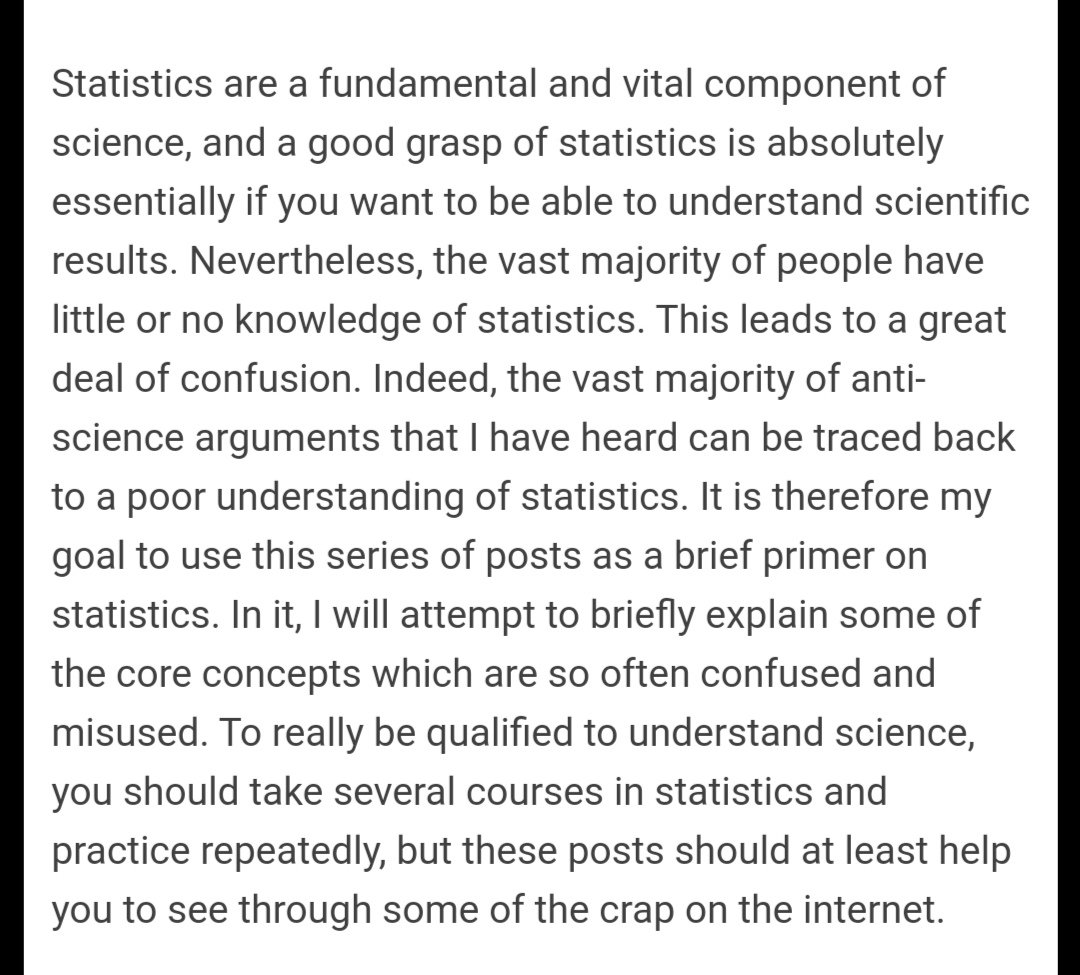
Basic Statistics Part 2: Correlation vs. Causation
https://t.co/Azhyl8pDsX (2/7)
Basic Statistics Part 3: The Dangers of Large Data Sets: A Tale of P values, Error Rates, and Bonferroni Corrections
https://t.co/LetN6aEBRM (3/7)
Basic statistics part 4: understanding P values
https://t.co/K8MMMgTCOf (4/7)
Basic Statistics Part 5: Means vs Medians, Is the “Average”
Basic Statistics Part 1: The Law of Large Numbers https://t.co/wUH8eAAIak
#Science #Statistics
Basic Statistics Part 2: Correlation vs. Causation
https://t.co/Azhyl8pDsX (2/7)
Basic Statistics Part 3: The Dangers of Large Data Sets: A Tale of P values, Error Rates, and Bonferroni Corrections
https://t.co/LetN6aEBRM (3/7)
Basic statistics part 4: understanding P values
https://t.co/K8MMMgTCOf (4/7)
Basic Statistics Part 5: Means vs Medians, Is the “Average”