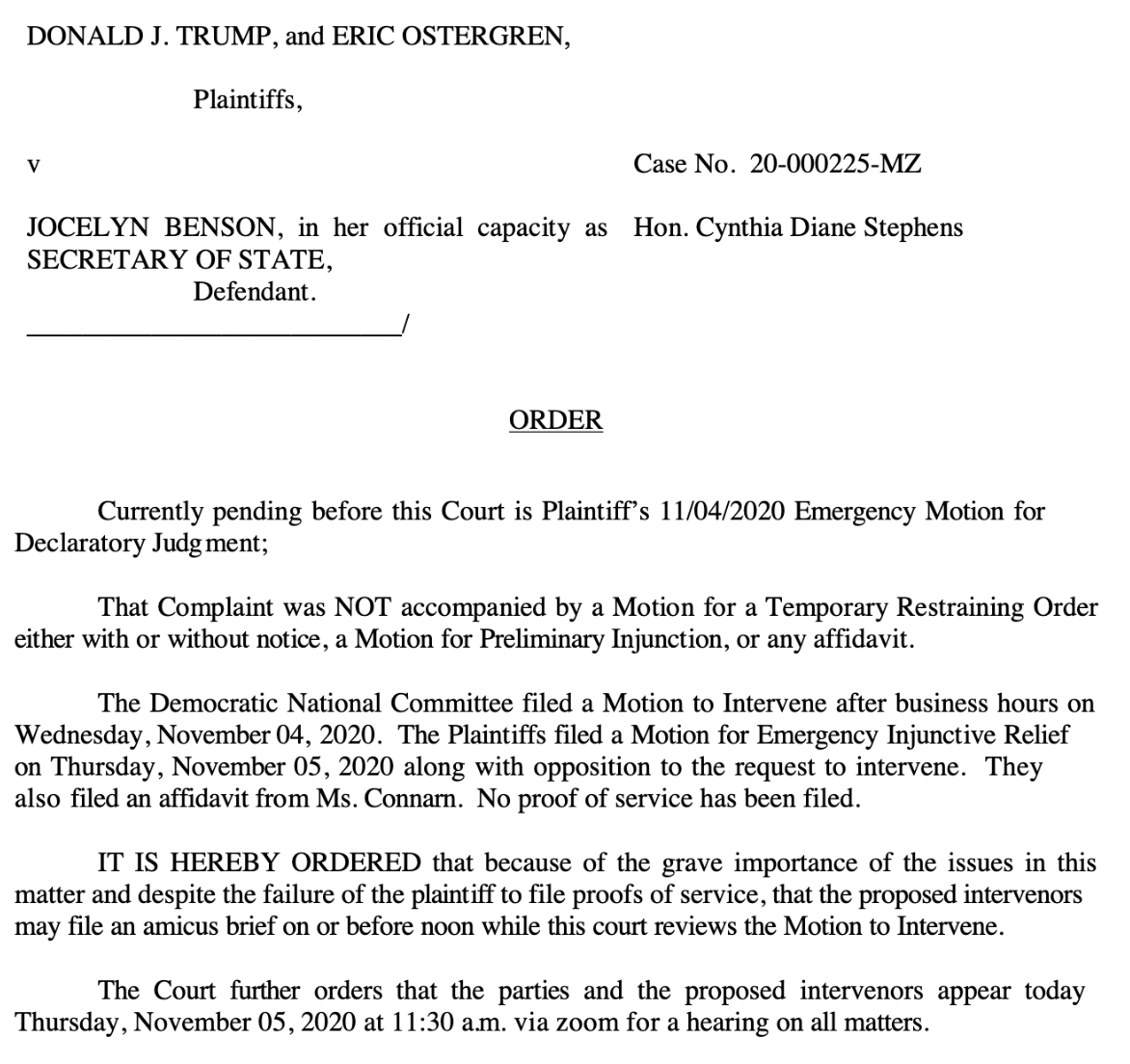
Georgia GOP and Trump campaign's suit in Chatham County is in court this morning.
GOP witness conceded that he did not know whether a stack of 53 challenged ballots were received on time.
The board's witness testified they were.
Background:
We'll be on top of them both at @LawCrimeNews.
Sabrina German, the director of Chatham County's Voter Registration Office, backs up the prior witness's testimony that those 53 ballots were received on time.
None of them were double votes, she said.
"They have been flatly incapable of proffering competent evidence to prove that point."
Two board of elections witnesses testify ballots received on time.
It wasn't a close call for the judge, who quickly dispatched the petition. https://t.co/eiKdubRsOm
More from Adam Klasfeld
The Supreme Court also found vaccine mandates legal since 1905, making it more than century-old settled law.
(The decision was over the state enforcing vaccine mandates, but the same principle applies.)
Feds say employers can require workers to get COVID vaccine https://t.co/TNGPJkneRU pic.twitter.com/xh1hrTHaar
— New York Post (@nypost) May 29, 2021
(The decision was over the state enforcing vaccine mandates, but the same principle applies.)
More from Politics


We’ve been getting calls and outreach from Queens residents all day about this.
The community’s response? Outrage.
Amazon is a billion-dollar company. The idea that it will receive hundreds of millions of dollars in tax breaks at a time when our subway is crumbling and our communities need MORE investment, not less, is extremely concerning to residents here.
When we talk about bringing jobs to the community, we need to dig deep:
- Has the company promised to hire in the existing community?
- What’s the quality of jobs + how many are promised? Are these jobs low-wage or high wage? Are there benefits? Can people collectively bargain?
Displacement is not community development. Investing in luxury condos is not the same thing as investing in people and families.
Shuffling working class people out of a community does not improve their quality of life.
We need to focus on good healthcare, living wages, affordable rent. Corporations that offer none of those things should be met w/ skepticism.
It’s possible to establish economic partnerships w/ real opportunities for working families, instead of a race-to-the-bottom competition.
The community’s response? Outrage.
Amazon will divide its second headquarters evenly between New York's Long Island City and Arlington County's Crystal City neighborhoods. Other cities may also receive major sites. https://t.co/c1lKmeQinX
— The Wall Street Journal (@WSJ) November 13, 2018
Amazon is a billion-dollar company. The idea that it will receive hundreds of millions of dollars in tax breaks at a time when our subway is crumbling and our communities need MORE investment, not less, is extremely concerning to residents here.
When we talk about bringing jobs to the community, we need to dig deep:
- Has the company promised to hire in the existing community?
- What’s the quality of jobs + how many are promised? Are these jobs low-wage or high wage? Are there benefits? Can people collectively bargain?
Displacement is not community development. Investing in luxury condos is not the same thing as investing in people and families.
Shuffling working class people out of a community does not improve their quality of life.
We need to focus on good healthcare, living wages, affordable rent. Corporations that offer none of those things should be met w/ skepticism.
It’s possible to establish economic partnerships w/ real opportunities for working families, instead of a race-to-the-bottom competition.