

This week marks 12 months since Josephine Cashman supplied Andrew Bolt with a letter falsely attributed to a Yolngu lawman that Bolt published via NewsCorp on Jan 26 as parcel of his persecution of Bruce Pascoe. Cashman & Bolt still haven’t provided a satisfactory explanation
More from News



Could it be the MSM played a hoax on us? What if the inauguration was prior filmed and aired as “live TV”? Why was sun shining in some while snow/non sun shining falling in some shots? Why bright lights in front of WH? What if CGI was used? Would our media do that? Why?
The “stage” is still there last night👇🏻👀

Why was BiDEn sworn in before noon? The Constitution(Supreme Law of the Land) says noon is time of swearing in.... why did BiDEn sign “17” Executive Orders” which were only blank pieces of paper?
Can a new POTUS be sworn in during time of war? NO! We are at war! Remember Emergency Act in Spring of 2020 signed due to China Bioweapon? Then, EO signed and China election interference. THESE are ACTS of WAR!
Did POTUS Trump sign the Insurrection Act allowing Military to take the reigns of Government control? By law, POTUS does not have to announce it...but if HE does, then he has to physically SHOW the document signed. Could this be why we hear he signed it but have not seen it?
7:11 1/21/21 what is this in front of the White House this morning? Could it be the remains of the fake inauguration set up!?? pic.twitter.com/rSYidKoAmX
— AngelaFaith (@AngelaF86527788) January 21, 2021
The “stage” is still there last night👇🏻👀
Why was BiDEn sworn in before noon? The Constitution(Supreme Law of the Land) says noon is time of swearing in.... why did BiDEn sign “17” Executive Orders” which were only blank pieces of paper?
Can a new POTUS be sworn in during time of war? NO! We are at war! Remember Emergency Act in Spring of 2020 signed due to China Bioweapon? Then, EO signed and China election interference. THESE are ACTS of WAR!
Did POTUS Trump sign the Insurrection Act allowing Military to take the reigns of Government control? By law, POTUS does not have to announce it...but if HE does, then he has to physically SHOW the document signed. Could this be why we hear he signed it but have not seen it?

As someone who's spent, conservatively, thousands of hours reporting on and thinking about Seth Rich, Fox News, and conspiracy theories, the timing of the settlement highlighted in @benyt's new column doesn't infuriate me as much as the substance of it 1/x
What's infuriating is the absence of any contrition, apology, or remediation by Fox, especially @seanhannity.
As I've reported, Hannity arguably did more than anyone else to amplify the baseless, discredited, and cruel conspiracy theories about Seth. 2/x
.@seanhannity hyped it on multiple nights on his Fox show, on his radio show, and on Twitter. We're talking about a combined potential audience here of ~tens of millions of people.~
Imagine one of the loudest voices in TV saying the following about your dead brother or dead son:
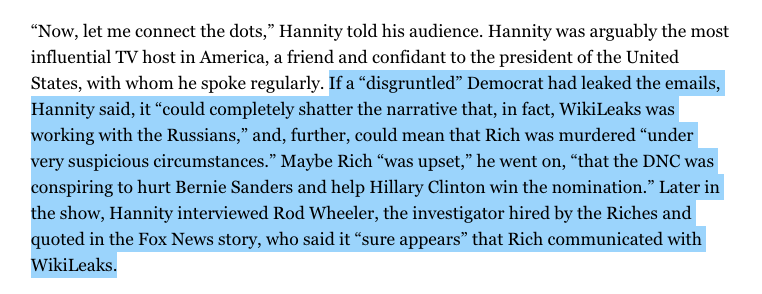
Even after https://t.co/jg1xOw4YqF retracted its original story about Seth and WikiLeaks, Hannity kept hammering away.
“All you in the liberal media,” he said on his radio show, “I am not https://t.co/YVoDTvSQbr or https://t.co/jg1xOw4YqF. I retracted nothing.” 4/x
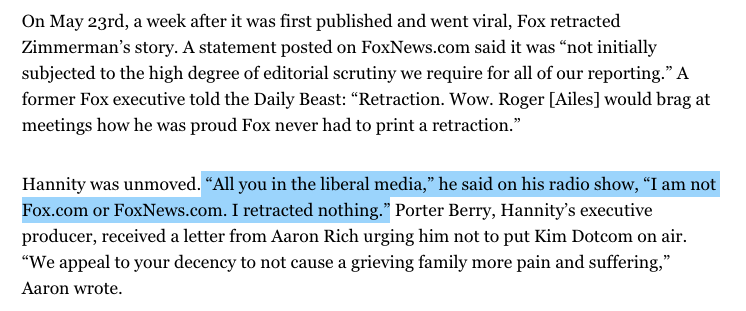
Only when Aaron, Seth's brother, pleaded with Hannity and one of his producers, Porter Berry, did Hannity back down.
Even then, he didn't retract or apologize.
Instead he said: “Out of respect for the family’s wishes, for now, I am not discussing this matter at this time.” 5/x
What's infuriating is the absence of any contrition, apology, or remediation by Fox, especially @seanhannity.
As I've reported, Hannity arguably did more than anyone else to amplify the baseless, discredited, and cruel conspiracy theories about Seth. 2/x
.@seanhannity hyped it on multiple nights on his Fox show, on his radio show, and on Twitter. We're talking about a combined potential audience here of ~tens of millions of people.~
Imagine one of the loudest voices in TV saying the following about your dead brother or dead son:
Even after https://t.co/jg1xOw4YqF retracted its original story about Seth and WikiLeaks, Hannity kept hammering away.
“All you in the liberal media,” he said on his radio show, “I am not https://t.co/YVoDTvSQbr or https://t.co/jg1xOw4YqF. I retracted nothing.” 4/x
Only when Aaron, Seth's brother, pleaded with Hannity and one of his producers, Porter Berry, did Hannity back down.
Even then, he didn't retract or apologize.
Instead he said: “Out of respect for the family’s wishes, for now, I am not discussing this matter at this time.” 5/x

You May Also Like





1/OK, data mystery time.
This New York Times feature shows China with a Gini Index of less than 30, which would make it more equal than Canada, France, or the Netherlands. https://t.co/g3Sv6DZTDE
That's weird. Income inequality in China is legendary.
Let's check this number.
2/The New York Times cites the World Bank's recent report, "Fair Progress? Economic Mobility across Generations Around the World".
The report is available here:
3/The World Bank report has a graph in which it appears to show the same value for China's Gini - under 0.3.
The graph cites the World Development Indicators as its source for the income inequality data.
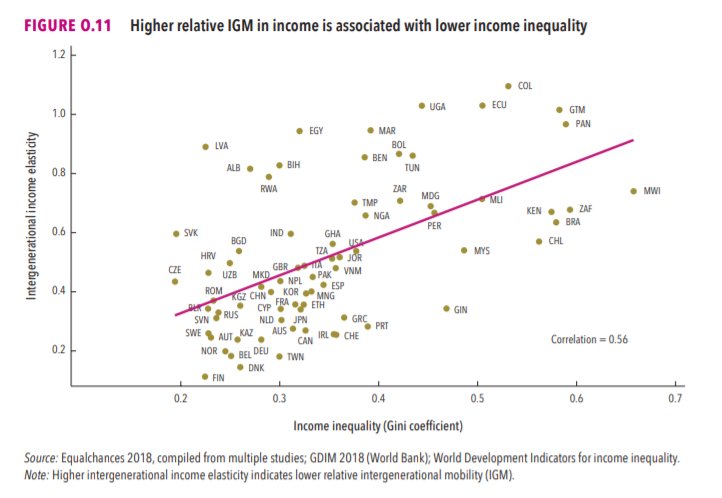
4/The World Development Indicators are available at the World Bank's website.
Here's the Gini index: https://t.co/MvylQzpX6A
It looks as if the latest estimate for China's Gini is 42.2.
That estimate is from 2012.
5/A Gini of 42.2 would put China in the same neighborhood as the U.S., whose Gini was estimated at 41 in 2013.
I can't find the <30 number anywhere. The only other estimate in the tables for China is from 2008, when it was estimated at 42.8.
This New York Times feature shows China with a Gini Index of less than 30, which would make it more equal than Canada, France, or the Netherlands. https://t.co/g3Sv6DZTDE
That's weird. Income inequality in China is legendary.
Let's check this number.
2/The New York Times cites the World Bank's recent report, "Fair Progress? Economic Mobility across Generations Around the World".
The report is available here:
3/The World Bank report has a graph in which it appears to show the same value for China's Gini - under 0.3.
The graph cites the World Development Indicators as its source for the income inequality data.
4/The World Development Indicators are available at the World Bank's website.
Here's the Gini index: https://t.co/MvylQzpX6A
It looks as if the latest estimate for China's Gini is 42.2.
That estimate is from 2012.
5/A Gini of 42.2 would put China in the same neighborhood as the U.S., whose Gini was estimated at 41 in 2013.
I can't find the <30 number anywhere. The only other estimate in the tables for China is from 2008, when it was estimated at 42.8.