In your business, how do you handle the sales and price and T&C parts of the sales?
Specifically, when clients try to haggle, or try to make you play by their rules - what do you do?
It’s very common to then start to appease the buyer - and it's a grave mistake.
[Thread]
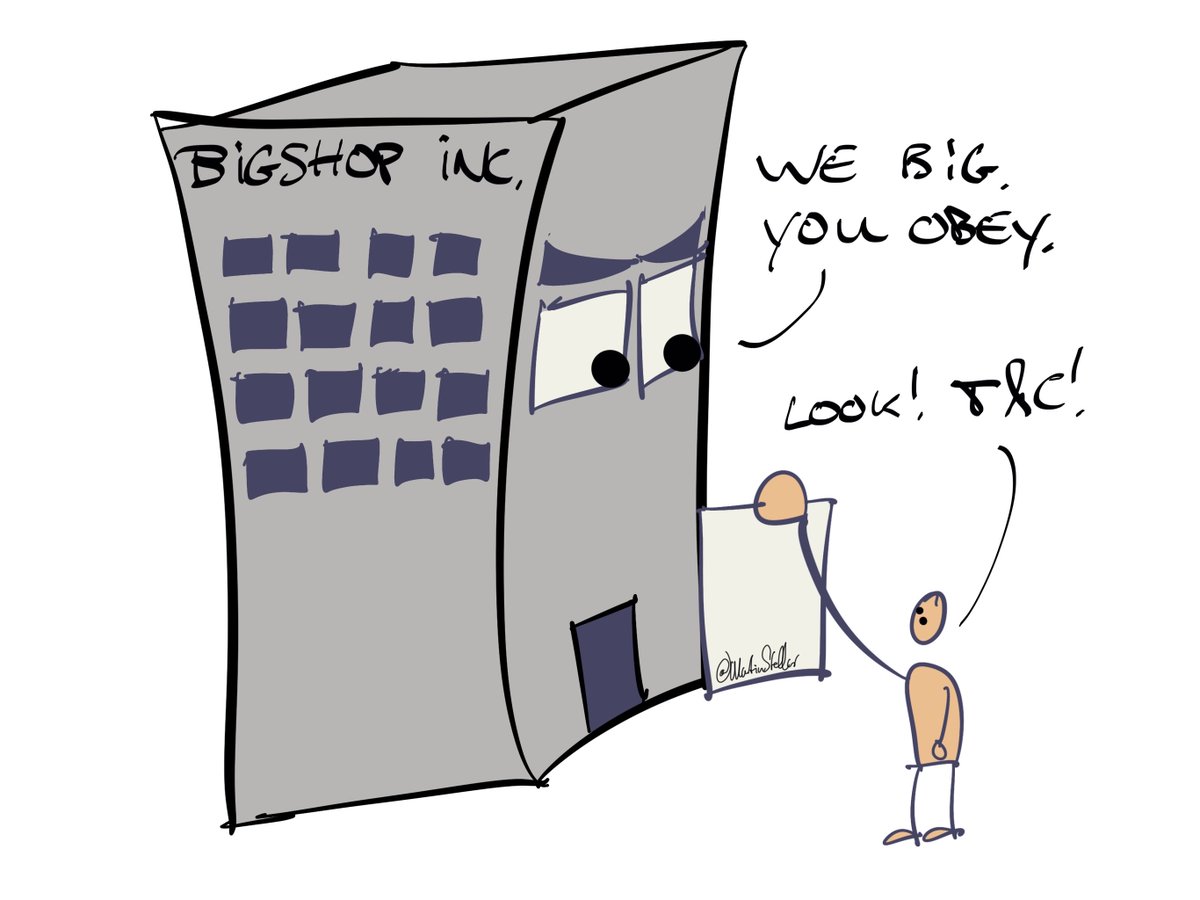
Saw this tweet the other day:
"But we're BIG and you're small. You can be flexible."
"No. It's because I'm small that I can't be."
Because how big a client is doesn’t have to affect your terms and conditions, and shouldn’t.
Because with that reply, the client heard ‘you’re right, you’re bigger and therefore dominant.
‘And you are small, so you do what we say’.
If you then agree with the first part of the statement, nothing you’ll say afterwards will change things for the better.
It’s a lost case.
So a good and useful reply would be:
[...]“Size doesn’t matter.
With two sentences, you can turn the tables, and position yourself back where you belong, meaning:
The owner and protector of the buying process.
But don’t be intimidated, and never let them bully you just because they’re bigger.
You run the business, you get to define your terms and conditions.
This element of social frames is a big part of the ethical selling framework I'm teaching this Friday.
Don't miss it - sign up here: https://t.co/Ti5pjvndbJ
More from Marketing


I get DM's from founders with the same specific problems.
Here's a public list of marketing tools I recommend:
↓
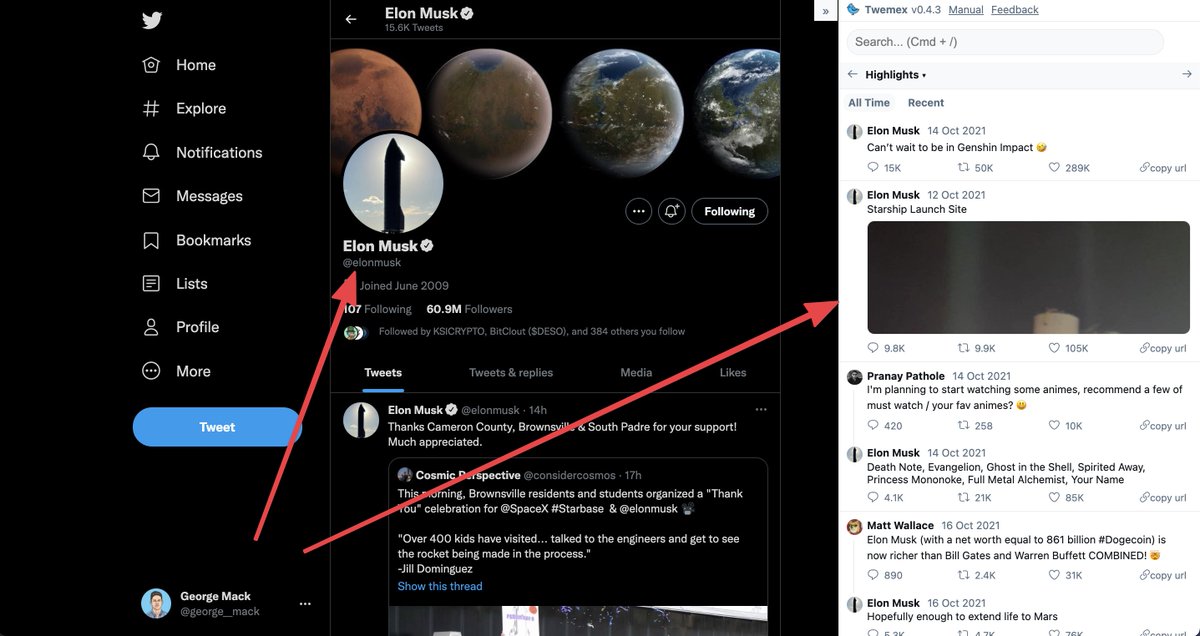
1. Twemex
Twitter Advanced search on steroids.
Whenever you visit someone's account, see their most popular Tweets of all time in order.
H/T @Julian for this
https://t.co/8P2YJ3Jrf0
2. Good UI
Historical log of successful and failed A/B tests from the likes of Amazon, Netflix, Google
3. Blisk
See how your website looks across every device.
Got an Android user complaining how your website looks but you only have an iPhone? Use Blisk.
4. Really Good Emails
Struggling with email ideas?
Library of thousands of quality emails to get inspo from.
Here's a public list of marketing tools I recommend:
↓
1. Twemex
Twitter Advanced search on steroids.
Whenever you visit someone's account, see their most popular Tweets of all time in order.
H/T @Julian for this
https://t.co/8P2YJ3Jrf0
2. Good UI
Historical log of successful and failed A/B tests from the likes of Amazon, Netflix, Google
3. Blisk
See how your website looks across every device.
Got an Android user complaining how your website looks but you only have an iPhone? Use Blisk.
4. Really Good Emails
Struggling with email ideas?
Library of thousands of quality emails to get inspo from.

Can't run FB ads on your own profile?
No problem.
Here's how you use a virtual browser to run ads safely on someone else's FB account.
** Thread **
In order for this to work, you need to have permission from someone to use their FB profile.
Whether that's a friend/family of yours or some random guy/gal you pay.
Because you'll need the login information to their FB profile.
Just a heads up.
A virtual browser is the best solution I've found for this.
A remote access tool like Splashtop is an alternative option but the user has to have their computer on if you want to access it.
This can create a bunch of headaches which is why I prefer to use a virtual browser.
It allows you to access the user's computer alongside them so you're able to log on whenever you like no matter if the user is using their computer or not.
I'm sure there are a bunch of options for virtual browsers but I use Multilogin ==> https://t.co/RF6s0Mto8f
99% of you will be fine with the Solo package which is around $100 a month.
Small price to pay, if this is the only option you have to run ads.
No problem.
Here's how you use a virtual browser to run ads safely on someone else's FB account.
** Thread **
In order for this to work, you need to have permission from someone to use their FB profile.
Whether that's a friend/family of yours or some random guy/gal you pay.
Because you'll need the login information to their FB profile.
Just a heads up.
A virtual browser is the best solution I've found for this.
A remote access tool like Splashtop is an alternative option but the user has to have their computer on if you want to access it.
This can create a bunch of headaches which is why I prefer to use a virtual browser.
It allows you to access the user's computer alongside them so you're able to log on whenever you like no matter if the user is using their computer or not.
I'm sure there are a bunch of options for virtual browsers but I use Multilogin ==> https://t.co/RF6s0Mto8f
99% of you will be fine with the Solo package which is around $100 a month.
Small price to pay, if this is the only option you have to run ads.
You May Also Like




IMPORTANCE, ADVANTAGES AND CHARACTERISTICS OF BHAGWAT PURAN
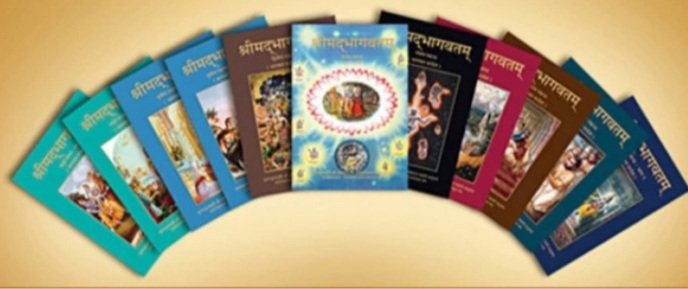
It was Ved Vyas who edited the eighteen thousand shlokas of Bhagwat. This book destroys all your sins. It has twelve parts which are like kalpvraksh.
In the first skandh, the importance of Vedvyas
and characters of Pandavas are described by the dialogues between Suutji and Shaunakji. Then there is the story of Parikshit.
Next there is a Brahm Narad dialogue describing the avtaar of Bhagwan. Then the characteristics of Puraan are mentioned.
It also discusses the evolution of universe.( https://t.co/2aK1AZSC79 )
Next is the portrayal of Vidur and his dialogue with Maitreyji. Then there is a mention of Creation of universe by Brahma and the preachings of Sankhya by Kapil Muni.
In the next section we find the portrayal of Sati, Dhruv, Pruthu, and the story of ancient King, Bahirshi.
In the next section we find the character of King Priyavrat and his sons, different types of loks in this universe, and description of Narak. ( https://t.co/gmDTkLktKS )
In the sixth part we find the portrayal of Ajaamil ( https://t.co/LdVSSNspa2 ), Daksh and the birth of Marudgans( https://t.co/tecNidVckj )
In the seventh section we find the story of Prahlad and the description of Varnashram dharma. This section is based on karma vaasna.
It was Ved Vyas who edited the eighteen thousand shlokas of Bhagwat. This book destroys all your sins. It has twelve parts which are like kalpvraksh.
In the first skandh, the importance of Vedvyas
and characters of Pandavas are described by the dialogues between Suutji and Shaunakji. Then there is the story of Parikshit.
Next there is a Brahm Narad dialogue describing the avtaar of Bhagwan. Then the characteristics of Puraan are mentioned.
It also discusses the evolution of universe.( https://t.co/2aK1AZSC79 )
Next is the portrayal of Vidur and his dialogue with Maitreyji. Then there is a mention of Creation of universe by Brahma and the preachings of Sankhya by Kapil Muni.
HOW LIFE EVOLVED IN THIS UNIVERSE AS PER OUR SCRIPTURES.
— Anshul Pandey (@Anshulspiritual) August 29, 2020
Well maximum of Living being are the Vansaj of Rishi Kashyap. I have tried to give stories from different-different Puran. So lets start.... pic.twitter.com/MrrTS4xORk
In the next section we find the portrayal of Sati, Dhruv, Pruthu, and the story of ancient King, Bahirshi.
In the next section we find the character of King Priyavrat and his sons, different types of loks in this universe, and description of Narak. ( https://t.co/gmDTkLktKS )
Thread on NARK(HELL) / \u0928\u0930\u094d\u0915
— Anshul Pandey (@Anshulspiritual) August 11, 2020
Well today i will take you to a journey where nobody wants to go i.e Nark. Hence beware of doing Adharma/Evil things. There are various mentions in Puranas about Nark, But my Thread is only as per Bhagwat puran(SS attached in below Thread)
1/8 pic.twitter.com/raHYWtB53Q
In the sixth part we find the portrayal of Ajaamil ( https://t.co/LdVSSNspa2 ), Daksh and the birth of Marudgans( https://t.co/tecNidVckj )
In the seventh section we find the story of Prahlad and the description of Varnashram dharma. This section is based on karma vaasna.
#THREAD
— Anshul Pandey (@Anshulspiritual) August 12, 2020
WHY PARENTS CHOOSE RELIGIOUS OR PARAMATMA'S NAMES FOR THEIR CHILDREN AND WHICH ARE THE EASIEST WAY TO WASH AWAY YOUR SINS.
Yesterday I had described the types of Naraka's and the Sin or Adharma for a person to be there.
1/8 pic.twitter.com/XjPB2hfnUC