@patel0phone and I have been working 1:1 w/all-star instructors (like @APompliano @lennysan). Now we're ready to apply these lessons to your course
Over the last 5 years, I’ve helped build courses taken by 40,000 students w/ $30M+ in revenue.
Today we’re launching a *free* cohort-based course on How to Build a CBC!
At the end of this, you’ll have a full course ready to launch.
Apply here: https://t.co/kp2vyBWE9K
Read on
@patel0phone and I have been working 1:1 w/all-star instructors (like @APompliano @lennysan). Now we're ready to apply these lessons to your course
It's not one-size-fits-all. We teach underlying skills & create an accountability system so you build a course that's uniquely yours.
It’s the same process I’ve used for @alt_MBA @david_perell @fortelabs @section_four
https://t.co/TxbH15QTpA
The course creation process is complex. There are lots of interconnected
decisions & second order effects.
We help you make sense of it with:
+ Step by step process
+ Clear deliverables
+ Feedback from us & peers
+ Gut checks
+ Weekly homework
It's an iterative process to get ideas out of your head, share feedback, discuss, build, refine, lock it in. Piece by piece, brick by brick
By the end of this course, you’ll have a CBC that's ready to launch. We’ll cover:
What to build: Figuring out your audience & course brief
How to build: Group exercises, lectures, projects, even slides
How to sell: Building buzz for your course & filling seats
This is just a taste of the types of questions we’ll help you answer:
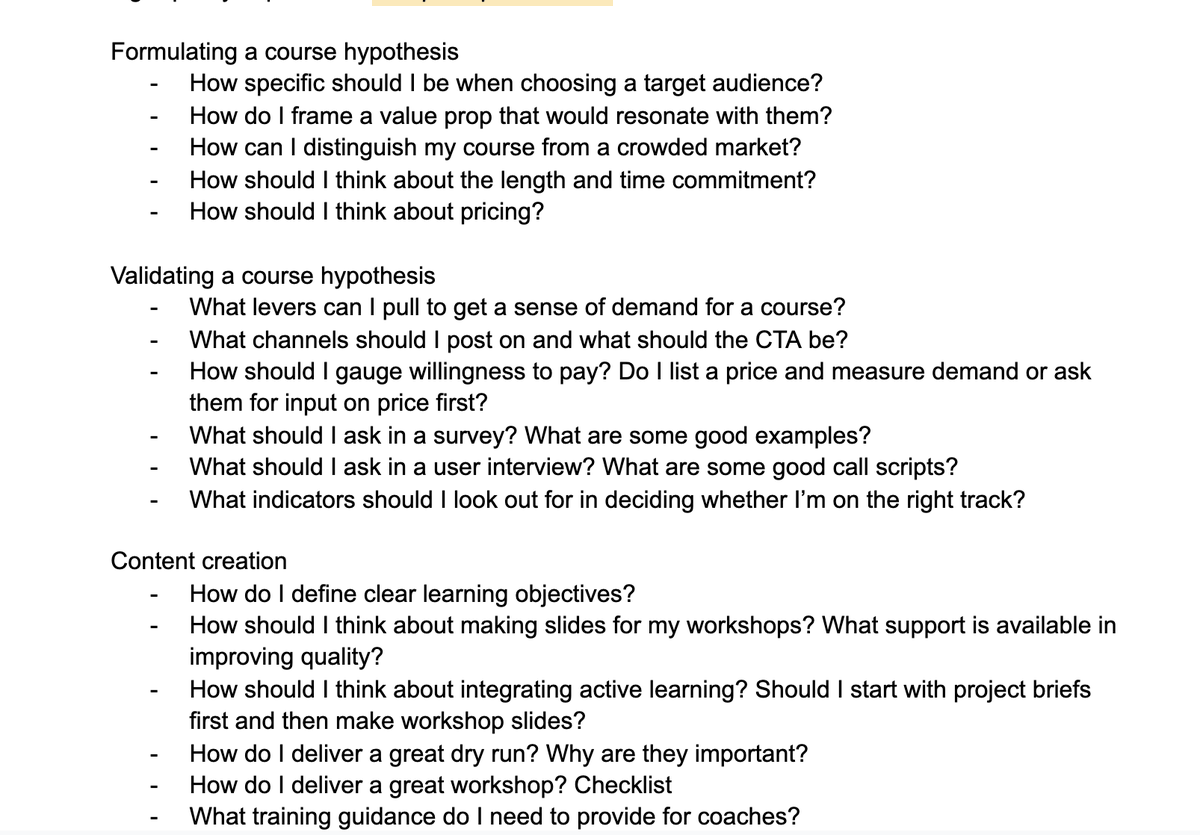
CBCs are not set it & forget it. They require work to build the first time; if you build it right, it’s easier to run in the future.
The upside: many courses I’ve worked on had 80-90%+ profit margins & premium pricing of $500-$5,000/student.
You can certainly build a course faster or lower quality, and you might still fill your first few cohorts. But it’s hard to grow and scale with a shoddy foundation.
That’s why we spend MORE time upfront bc your CBC is an investment.
Cohort-based courses are complex. There are lots more moving parts compared to pre-recorded, on-demand courses.
There’s a mix of live vs asynchronous. Coach-facilitated vs student-led. Solo vs group work. Too much or too little of one & students disengage
We believe in building courses that are modular--each course component can be reused & rearranged. The building blocks of CBCs are live lectures, small group discussions, projects/exercises, coaches, etc.
In a well-designed course you can mix & match w/minimal effort.
You have to constantly sell a student to make it to day 2, week 1, etc. The selling never ends. We help you reinforce the value students are getting because perceived value = value.
We focus on both curriculum & marketing bc they go hand in hand.
It’s easy to fill the first few cohorts. It’s cohort #4 - #100 that show whether you have course-market fit.
We’ll help you think about how to create a flywheel to drive new students.
https://t.co/jOHPncDssk
(a) You have a course (in-person workshop, recorded video course) but don't know how to turn it into an interactive CBC
OR
(b) You’re a subject matter expert on a topic your audience already wants to learn from you
+ Expect us to do all the work for you
+ Can’t commit to a rigorous schedule of 8-10 hours/week to produce your course
+ Are hard to coach and won’t take our advice
~10 hrs/wk for 6-8 weeks. The course will kick off in April/May 2021.
Courses are an upfront investment--with a strong foundation you can scale easily for future cohorts.
Even w/a process it still takes a lot of work to create a successful CBC though
On the spectrum of "do it for you" to "do it yourself," our approach is "do it w/you." This means we provide the structure, advisory, course work, and milestones to help you stay accountable.
But YOU are ultimately responsible for the success of your course.
We’re thoughtfully curating a cohort of course creators who you’ll build alongside, learn from, and support. These are folks who are at the top of their craft, humble, generous, and eager to contribute.
https://t.co/csTSiuy50u
+ course-market fit
+ mechanics of your course
+ ideal student profile
+ course length
+ number of students
+ price point
+ hands-on projects
+ format
+ growth / student acquisition
+ lots more
https://t.co/JNyyLVCXpD
The course is free. If you go thru it you'll be a beta customer for our new product. This product will be offered as a revenue-share.
We’ll invest signif effort in your course & you'll be part of our platform’s future launch. Will share details w/selected instructors
Apply here: https://t.co/kp2vyBWE9K
More from Marketing





20 Most Important Lesson of 2020
// A THREAD //

It was a fast and weird year.
The year of change.
My life changed a lot and I learned even more.
Here are the 20 most important lessons - which will shape the upcoming decade for me.

1. Systems Are Better Than Goals
In the past, I failed many of my goals.
This year I've realized that it could be caused by the fact that they were goals, not systems.
Thanks, @ScottAdamsSays for helping me realize this.
Short article on the topic: https://t.co/lyBqGBR0yM

2. Use Notion More
@NotionHQ is definitely the most useful tool I've discovered this year.
I use it for:
- Twitter
- Freelance CRM
- Content Creation
- Website project management
And for personal use, it's completely free.

3. Email Is Immortal
This year we saw on social sites:
- Shadow bans
- Normal bans
- Decreasing reach (e.g. during the presidential election)
That's why I believe building an independent audience e.g. email list is mandatory.
P.S. https://t.co/iuhQJIf80K

// A THREAD //
It was a fast and weird year.
The year of change.
My life changed a lot and I learned even more.
Here are the 20 most important lessons - which will shape the upcoming decade for me.
1. Systems Are Better Than Goals
In the past, I failed many of my goals.
This year I've realized that it could be caused by the fact that they were goals, not systems.
Thanks, @ScottAdamsSays for helping me realize this.
Short article on the topic: https://t.co/lyBqGBR0yM
2. Use Notion More
@NotionHQ is definitely the most useful tool I've discovered this year.
I use it for:
- Freelance CRM
- Content Creation
- Website project management
And for personal use, it's completely free.
3. Email Is Immortal
This year we saw on social sites:
- Shadow bans
- Normal bans
- Decreasing reach (e.g. during the presidential election)
That's why I believe building an independent audience e.g. email list is mandatory.
P.S. https://t.co/iuhQJIf80K