With hard work and determination, anyone can learn to code.

Here’s a list of my favorites resources if you’re learning to code in 2021.

👇

1. freeCodeCamp.

I’d suggest picking one of the projects in the curriculum to tackle and then completing the lessons on syntax when you get stuck. This way you know *why* you’re learning what you’re learning, and you're building things immediately.

https://t.co/USHKYI5VHp
2. https://t.co/7XC50GlIaa is a hidden gem. Things I love about it:

1) You can see the most upvoted solutions so you can read really good code

2) You can ask questions in the discussion section if you're stuck, and people often answer. Free mentorship!

https://t.co/bX28PngH4i
3. https://t.co/V9gcXqqLN6 and https://t.co/KbEYGL21iE

On stackoverflow you can find answers to almost every problem you encounter. On GitHub you can read so much great code. You can build so much just from using these two resources and a blank text editor.
4. https://t.co/xX2J00fSrT @eggheadio specifically for frontend dev.

Their tutorials are designed to maximize your time, so you never feel overwhelmed by a 14-hour course. Also, the amount of prep they put into making great courses is unlike any other online course I've seen.
5. https://t.co/7MU2nHpsz2

This site is so much fun!

Especially if you feel intimidated or bored by other coding sites. It's an addicting game and you can choose what language you want to learn (JavaScript, Python etc)
6. https://t.co/uAAqbI9iTW

Similar to freeCodeCamp and has tracks in JavaScript, Ruby, HTML + CSS, node, etc. The courses have a good roadmap that takes you step by step and build up your knowledge.
7. https://t.co/JwwBlncZZF

For frontend development. These workshops are special. One of my favorite things about them are the live questions that teachers answer throughout the workshops. If you join a live workshop you can interact with your teacher, which is pretty awesome.
8. Colt Steele's Web Dev Bootcamp course.

For so many people, this teacher inspired them to get into coding and left them with the belief that they could do it. Colt's courses are magical.

https://t.co/GJgg2Adi06
I specifically left this list as short as possible because I don't think it's helpful to be bombarded with a list of 101 resources. That can be overwhelming. Lastly, I hold group coding sessions where we tackle coding problems every Sunday in @CodeBookClub!

More from Machine learning

Starting a new project using #Angular? Here is a list of all the stuff i use to launch my projects the fastest i can.

A THREAD 👇

Have you heard about Monorepo? I created one with all my Angular (and Nest) projects using
https://t.co/aY5llDtXg8.

I can share A LOT of code with it. Ex: Everytime i start a new project, i just need to import an Auth lib, that i created, and all Auth related stuff is set up.

Everyone in the Angular community knows about https://t.co/kDnunQZnxE. It's not the most beautiful component library out there, but it's good and easy to work with.

There's a bunch of state management solutions for Angular, but https://t.co/RJwpn74Qev is by far my favorite.

There's a lot of boilerplate, but you can solve this with the built-in schematics and/or with your own schematics

Are you not using custom schematics yet? Take a look at this:

https://t.co/iLrIaHVafm
https://t.co/3382Tn2k7C

You can automate all the boilerplate with hundreds of files associates with creating a new feature.
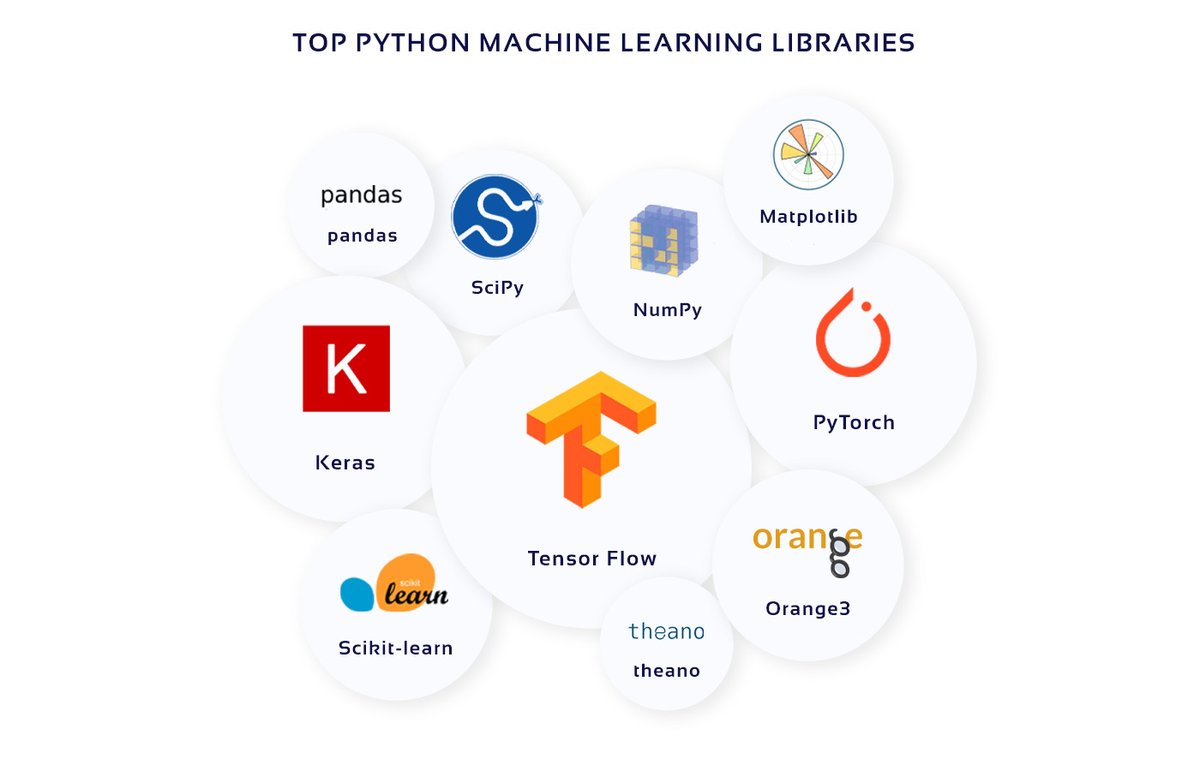
10 PYTHON 🐍 libraries for machine learning.

Retweets are appreciated.
[ Thread ]


1. NumPy (Numerical Python)

- The most powerful feature of NumPy is the n-dimensional array.

- It contains basic linear algebra functions, Fourier transforms, and tools for integration with other low-level languages.

Ref:
https://t.co/XY13ILXwSN


2. SciPy (Scientific Python)

- SciPy is built on NumPy.

- It is one of the most useful libraries for a variety of high-level science and engineering modules like discrete Fourier transform, Linear Algebra, Optimization, and Sparse matrices.

Ref: https://t.co/ALTFqM2VUo


3. Matplotlib

- Matplotlib is a comprehensive library for creating static, animated, and interactive visualizations in Python.

- You can also use Latex commands to add math to your plot.

- Matplotlib makes hard things possible.

Ref: https://t.co/zodOo2WzGx


4. Pandas

- Pandas is for structured data operations and manipulations.

- It is extensively used for data munging and preparation.

- Pandas were added relatively recently to Python and have been instrumental in boosting Python’s usage.

Ref: https://t.co/IFzikVHht4

You May Also Like

My top 10 tweets of the year

A thread 👇

https://t.co/xj4js6shhy


https://t.co/b81zoW6u1d


https://t.co/1147it02zs


https://t.co/A7XCU5fC2m