
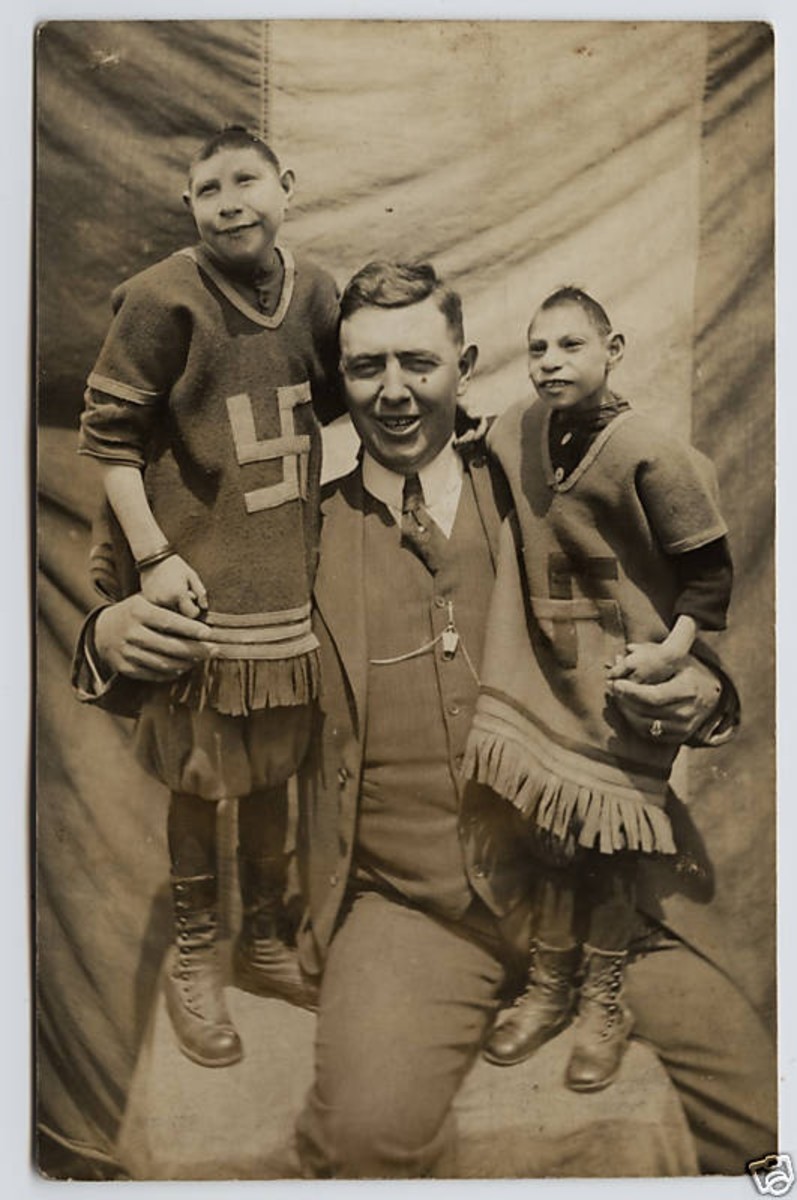
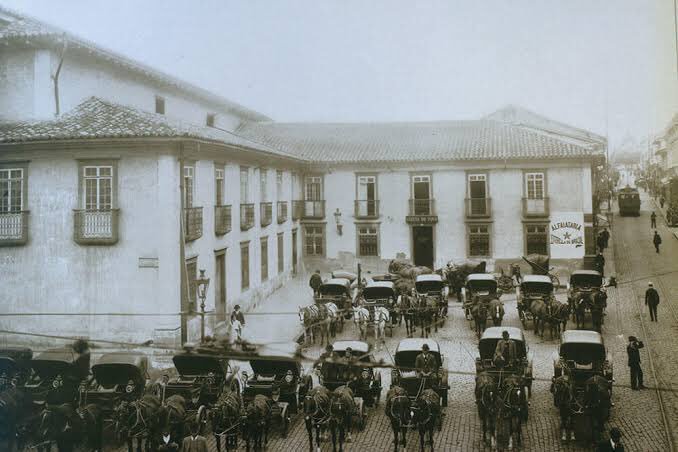
During the late 19th century and the early 20th century freak shows were at their height of popularity; the period 1840s through to the 1940s saw the organized for-profit exhibition of people with physical, mental or behavioral disabilities.



https://t.co/m2N6gHdfQZ
More from Marina Amaral







More from History


This is THEFT!
Indians had Algebra BEFORE Mμslim prophet & religion was even born.
Here is Bakhshali Manuscript dating back to 3rd century CE. It is an Algebraic treatise. Have you anything like this from the Arabian desert? No, you simply plagiarized Algebra from Indians! https://t.co/cWXRNYMgDt

The Bakhshali manuscript, which has been carbon dated to 3rd century CE, is an ancient Hindu treatise on Arithmetic and Algebra.
The Algebraic problems deal with simultaneous equations, quadratic equations, arithmetic
geometric progressions & quadratic indeterminate equations.

Bakhshali isn't earliest Indian Algebraic treatise. Early Algebra is found in Shulba Sutras dating back to at least 800 BC. Traditional Algebra reached its pinnacle in the works of Aryabhata & Bhaskara.
What makes Bakhshali special is it offers mathematical proof to its theories

It is surprising to see that even after the ancient Indian algebraic treatise has been carbon dated to 3rd century CE by Oxford, they persist with "oh we invented Algebra. It is Halal".
A brief examination of the origins of "Halal Algebra" follows
https://t.co/eFIZ98FDrI

The earliest work of "Arabic Algebra" is the "Al-Kitāb Al-Jabr wal-muqābala" by Al Khwarizmi. The term "Algebra" comes from this book ("Al Jabr").
Before writing his treatise, Al Khwarizmi visited India. His book is a plagiarism from Indian Mathematics and an obvious one at that
Indians had Algebra BEFORE Mμslim prophet & religion was even born.
Here is Bakhshali Manuscript dating back to 3rd century CE. It is an Algebraic treatise. Have you anything like this from the Arabian desert? No, you simply plagiarized Algebra from Indians! https://t.co/cWXRNYMgDt
Muslims gave the world Algebra, so here's a "halal" way to say Merry Christmas to our Christian friends :)#MerryChristmas2020 pic.twitter.com/aLXEw2K2I1
— Qasim Rashid, Esq. (@QasimRashid) December 25, 2020
The Bakhshali manuscript, which has been carbon dated to 3rd century CE, is an ancient Hindu treatise on Arithmetic and Algebra.
The Algebraic problems deal with simultaneous equations, quadratic equations, arithmetic
geometric progressions & quadratic indeterminate equations.
Bakhshali isn't earliest Indian Algebraic treatise. Early Algebra is found in Shulba Sutras dating back to at least 800 BC. Traditional Algebra reached its pinnacle in the works of Aryabhata & Bhaskara.
What makes Bakhshali special is it offers mathematical proof to its theories
It is surprising to see that even after the ancient Indian algebraic treatise has been carbon dated to 3rd century CE by Oxford, they persist with "oh we invented Algebra. It is Halal".
A brief examination of the origins of "Halal Algebra" follows
https://t.co/eFIZ98FDrI
The earliest work of "Arabic Algebra" is the "Al-Kitāb Al-Jabr wal-muqābala" by Al Khwarizmi. The term "Algebra" comes from this book ("Al Jabr").
Before writing his treatise, Al Khwarizmi visited India. His book is a plagiarism from Indian Mathematics and an obvious one at that







You May Also Like












Trading view scanner process -
1 - open trading view in your browser and select stock scanner in left corner down side .
2 - touch the percentage% gain change ( and u can see higest gainer of today)
3. Then, start with 6% gainer to 20% gainer and look charts of everyone in daily Timeframe . (For fno selection u can choose 1% to 4% )
4. Then manually select the stocks which are going to give all time high BO or 52 high BO or already given.
5. U can also select those stocks which are going to give range breakout or already given range BO
6 . If in 15 min chart📊 any stock sustaing near BO zone or after BO then select it on your watchlist
7 . Now next day if any stock show momentum u can take trade in it with RM
This looks very easy & simple but,
U will amazed to see it's result if you follow proper risk management.
I did 4x my capital by trading in only momentum stocks.
I will keep sharing such learning thread 🧵 for you 🙏💞🙏
Keep learning / keep sharing 🙏
@AdityaTodmal
1 - open trading view in your browser and select stock scanner in left corner down side .
2 - touch the percentage% gain change ( and u can see higest gainer of today)
Making thread \U0001f9f5 on trading view scanner by which you can select intraday and btst stocks .
— Vikrant (@Trading0secrets) October 22, 2021
In just few hours (Without any watchlist)
Some manual efforts u have to put on it.
Soon going to share the process with u whenever it will be ready .
"How's the josh?"guys \U0001f57a\U0001f3b7\U0001f483
3. Then, start with 6% gainer to 20% gainer and look charts of everyone in daily Timeframe . (For fno selection u can choose 1% to 4% )
4. Then manually select the stocks which are going to give all time high BO or 52 high BO or already given.
5. U can also select those stocks which are going to give range breakout or already given range BO
6 . If in 15 min chart📊 any stock sustaing near BO zone or after BO then select it on your watchlist
7 . Now next day if any stock show momentum u can take trade in it with RM
This looks very easy & simple but,
U will amazed to see it's result if you follow proper risk management.
I did 4x my capital by trading in only momentum stocks.
I will keep sharing such learning thread 🧵 for you 🙏💞🙏
Keep learning / keep sharing 🙏
@AdityaTodmal