This #thread describes Banda Singh Bahadur's entry into Delhi on February 27th, 1716, taken from from a letter dated March 10, 1716, written by Messrs. John Surman and Edward Stephenson to the Hon'ble Robert Hedges, President and Governor of Fort William, Council in Bengal.

John Surman and Edward Stephenson and their Secretary, Hugh Barker, were then present in the Mughal capital as ambassadors of the East India Company's Council in Bengal to the Court of Emperor Farruk-Siyar.
Under instructions of their principals, the ambassadors maintained a regular diary of the events and transactions at the royal court, and wrote to Calcutta to keep the headquarters informed of the political and other developments there.

🗺️Historical Map of India 1700-1792
The letter can be found in the Madras Diary and Consultation Book for 1715 to 1719, No 87, Range 237 in the India Office (Commonwealth Relations Office), London.
It has been reproduced in C.R Wilson's The Early Annals of the English in Bengal, volume II, part II (Calcutta, 1991), pp. 96-98, it has also been reproduced in J.T Wheeler's Early Records of British India, pp. 180.
It can also be found in Sicques, Tigers and Thieves, chapter 4, by @amanmadra & Paramjit Singh.
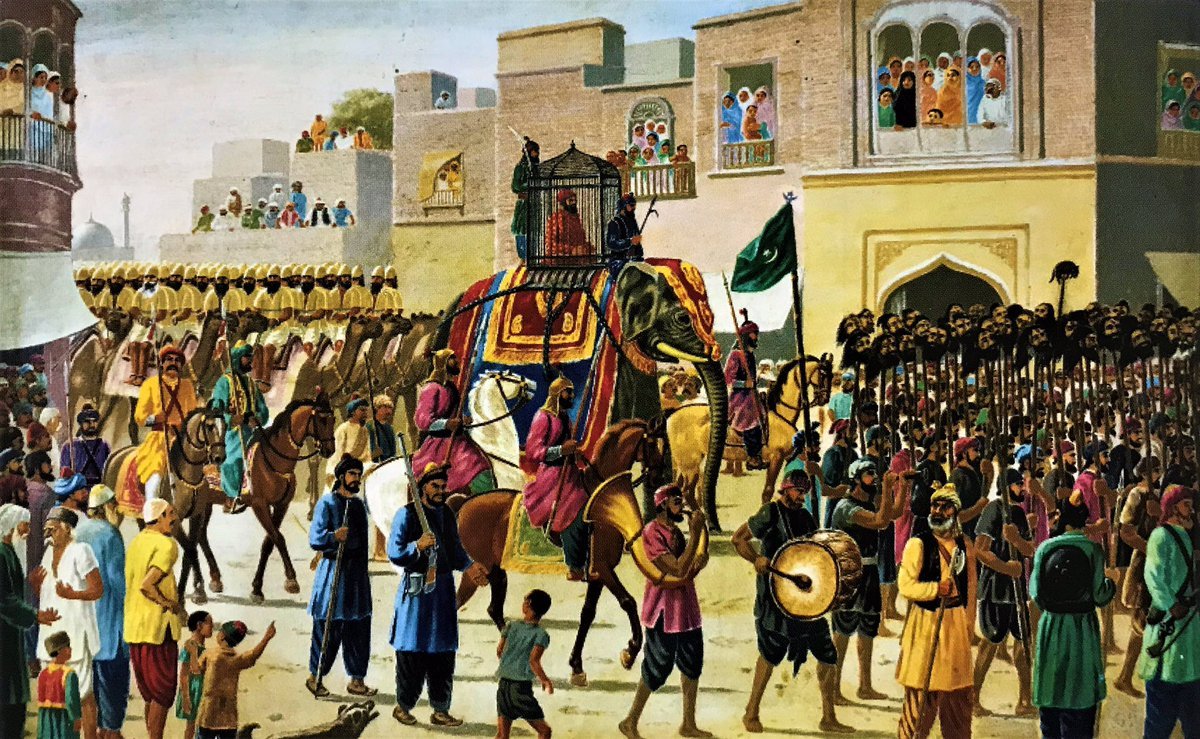
"Malice did its utmost to cover the vanquished with ridicule and shame. First came the heads of the executed Sikhs, stuffed with straw, and stuck on bamboos, their long hair streaming in the wind like a veil,
and along with them to show that every living creature in Gurdaspur had perished, a dead cat on a pole.
The Guru himself [Banda Singh Bahadaur] dressed out of mockery in a turban of red cloth, embroidered with gold, and a heavy robe of brocade, flowered with pomegranates, sat in an iron cage, placed on the back of an elephant.
Behind him stood a mail-clad officer, with a drawn sword.

(Also note the cage Banda was sat in was specially made by Bahadur Shah & had numerous metal spikes pointing inwards as to cause maximum harm & remove any comfort, unfortunately not captured in the image above)
After him came the other prisoners, seven hundred and fourty in number, seated two and two upon camels without saddles. Each wore a high fool's cap of sheepskin and had one hand pinned to his neck, between two pieces of wood.
At the end of the procession rode the Grand Vizier Muhammad Amin Khan (died in 1721), sent by the Emperor to bring in the prisoners, from Agharabad to the Lahori gate of the palace.
Kamr-ud-Din, his son, and Zakariya Khan, his son-in-law, who being also the son of Abd-us-Samad Khan had been deputed to present his father at the ceremony.
The road to the palace, for several miles, was lined with troops and filled with exultant crowds, who mocked at the teacher and laughed at the grotesque appearance of his followers.
They wagged their heads and pointed the finger of scorn at the poor wretched as they passed. Infidel dog worshippers, your day has come.
Not all the insults that their enemies had invented could rob the Guru and his followers of their dignity. Without any sign of dejection or shame, they rode on, calm, cheerful, even anxious to die the death of martyrs.
Life was promised to any who would renounce their faith, but they would not prove false to their Guru, and at the place of suffering their constancy was wonderful to look at.
"Me, deliverer, kill me first" was the prayer which constantly rang in the ears of the executioner.
There was a youngman, whose widow mother had made many applications to the Mughal officials, declaring that her son was a prisoner.
A release was granted and she hastened to claim her son. But the boy turned from her to meet his doom crying, "I know not this woman, what does she want with me?" I am a true and loyal Sikh.
For a whole week the sword of the executioner did its butcher's work. Every day a hundred brave men perished and at night the headless bodies were loaded into carts, taken out of the city, and hung upon trees.
It was not until June 19, that Banda himself was led out to execution, all efforts having failed to buy him off.

(June 19th, is almost 4 months after Banda Singh & other Shaheeds were led into Delhi. 4 months of having to witness the torture and executions of numerous Shaheeds)
They dress him, as on the day of his entry, set him again on an elephant, and took him away to the old city, where the red Qutb Minar lifts its proud head of marble over the crumbling walls of the Hindu fortress.
Here they peraded him round the tomb of the late emperor, Bahadur Shah, and put him to a barbarous death.
First they made him dismount, placed his child in his arm and bade him kill it. Then, as he shrank with horror from the act, they ripped open the child before its father's eyes, thrust it's quivering flesh into his mouth and hacked him to piece limb by limb.
You can read the letter here: https://t.co/nzothTGrP9
Book Review #03 - Rajasthani Documents on Banda Singh Bahadur by Dr Balwant Singh Dhillon
https://t.co/nzothTGrP9
Only 3 in stock currently
https://t.co/lIHxd5PGwA
If you wish to support/contribute to the work I'm doing you can become a Patreon https://t.co/TLqT2w7Nk9 or contribute via https://t.co/uDcY3XOdF3

More from History

You May Also Like

@franciscodeasis https://t.co/OuQaBRFPu7
Unfortunately the "This work includes the identification of viral sequences in bat samples, and has resulted in the isolation of three bat SARS-related coronaviruses that are now used as reagents to test therapeutics and vaccines." were BEFORE the


chimeric infectious clone grants were there.https://t.co/DAArwFkz6v is in 2017, Rs4231.
https://t.co/UgXygDjYbW is in 2016, RsSHC014 and RsWIV16.
https://t.co/krO69CsJ94 is in 2013, RsWIV1. notice that this is before the beginning of the project

starting in 2016. Also remember that they told about only 3 isolates/live viruses. RsSHC014 is a live infectious clone that is just as alive as those other "Isolates".

P.D. somehow is able to use funds that he have yet recieved yet, and send results and sequences from late 2019 back in time into 2015,2013 and 2016!

https://t.co/4wC7k1Lh54 Ref 3: Why ALL your pangolin samples were PCR negative? to avoid deep sequencing and accidentally reveal Paguma Larvata and Oryctolagus Cuniculus?
The chorus of this song uses the shlokas taken from Sundarkand of Ramayana.

It is a series of Sanskrit shlokas recited by Jambavant to Hanuman to remind Him of his true potential.

1. धीवर प्रसार शौर्य भरा: The brave persevering one, your bravery is taking you forward.


2. उतसारा स्थिरा घम्भीरा: The one who is leaping higher and higher, who is firm and stable and seriously determined.

3. ुग्रामा असामा शौर्या भावा: He is strong, and without an equal in the ability/mentality to fight

4. रौद्रमा नवा भीतिर्मा: His anger will cause new fears in his foes.

5.विजिटरीपुरु धीरधारा, कलोथरा शिखरा कठोरा: This is a complex expression seen only in Indic language poetry. The poet is stating that Shivudu is experiencing the intensity of climbing a tough peak, and likening

it to the feeling in a hard battle, when you see your enemy defeated, and blood flowing like a rivulet. This is classical Veera rasa.

6.कुलकु थारथिलीथा गम्भीरा, जाया विराट वीरा: His rough body itself is like a sharp weapon (because he is determined to win). Hail this complete

hero of the world.

7.विलयगागनथाला भिकारा, गरज्जद्धरा गारा: The hero is destructive in the air/sky as well (because he can leap at an enemy from a great height). He can defeat the enemy (simply) with his fearsome roar of war.
"I lied about my basic beliefs in order to keep a prestigious job. Now that it will be zero-cost to me, I have a few things to say."


We know that elite institutions like the one Flier was in (partial) charge of rely on irrelevant status markers like private school education, whiteness, legacy, and ability to charm an old white guy at an interview.

Harvard's discriminatory policies are becoming increasingly well known, across the political spectrum (see, e.g., the recent lawsuit on discrimination against East Asian applications.)

It's refreshing to hear a senior administrator admits to personally opposing policies that attempt to remedy these basic flaws. These are flaws that harm his institution's ability to do cutting-edge research and to serve the public.

Harvard is being eclipsed by institutions that have different ideas about how to run a 21st Century institution. Stanford, for one; the UC system; the "public Ivys".