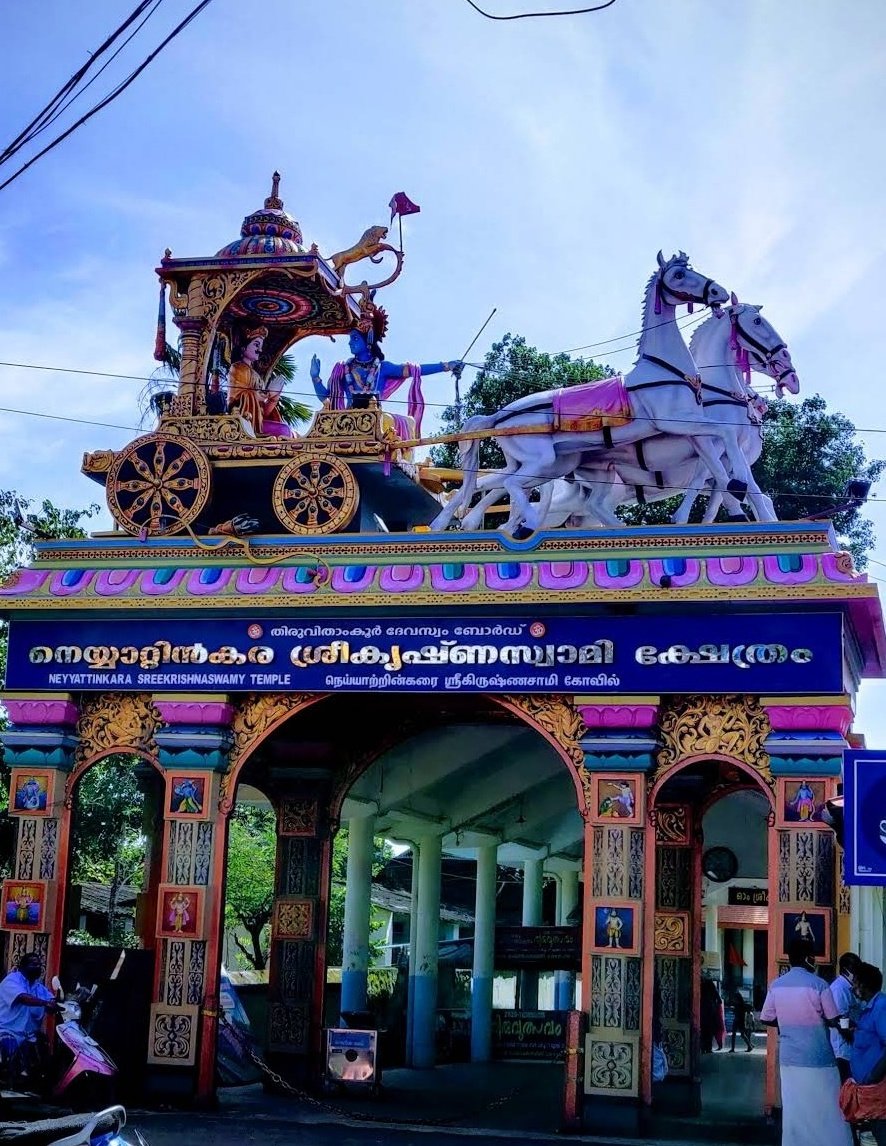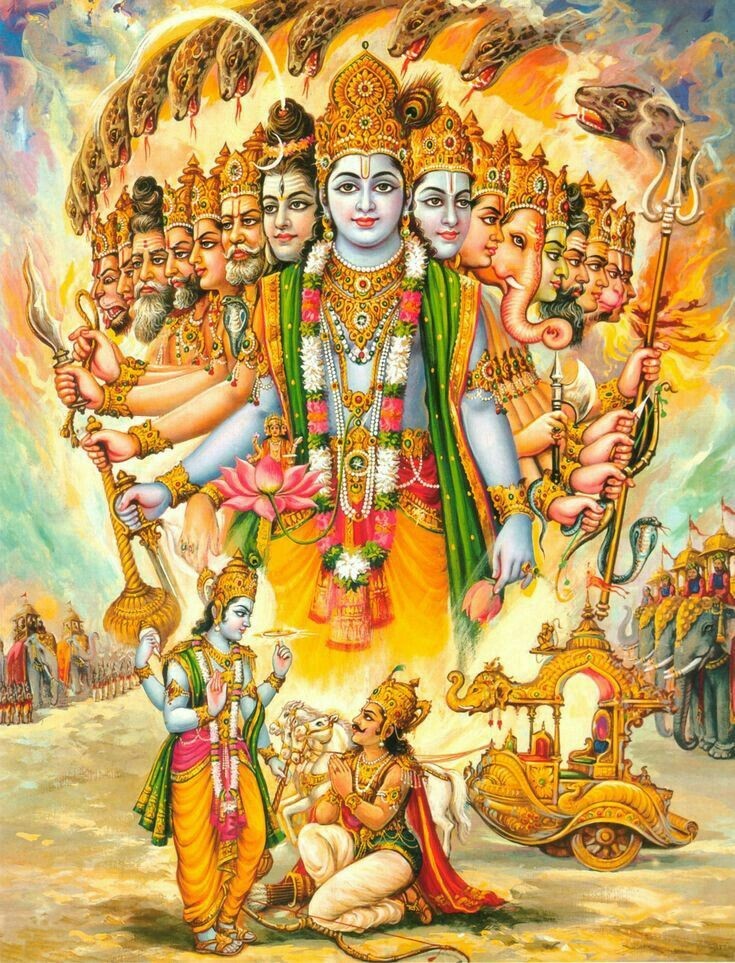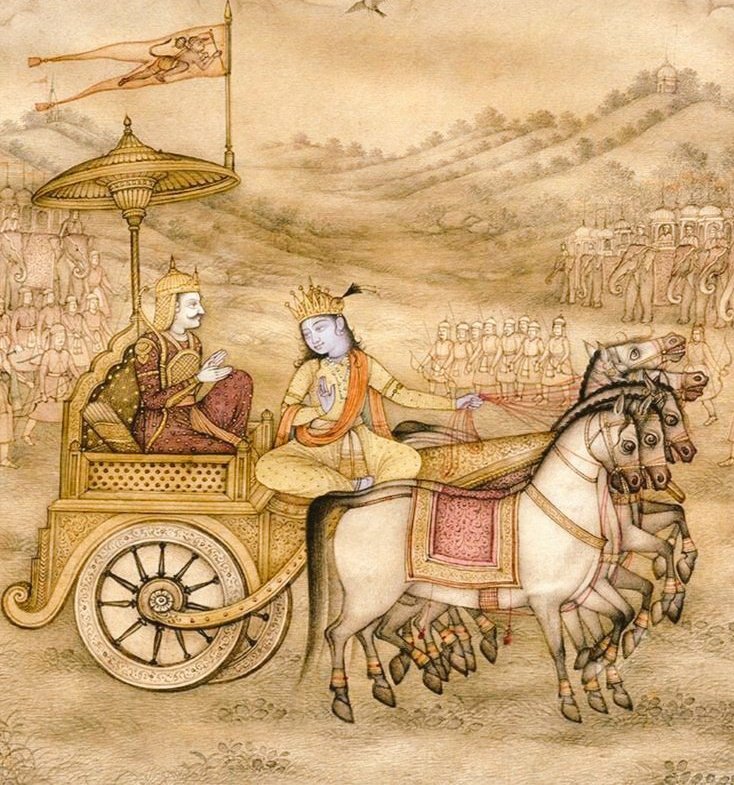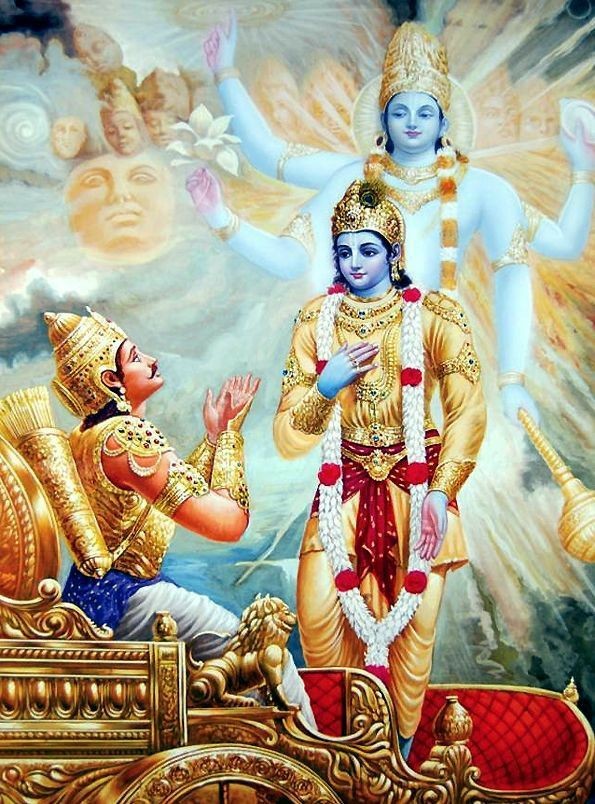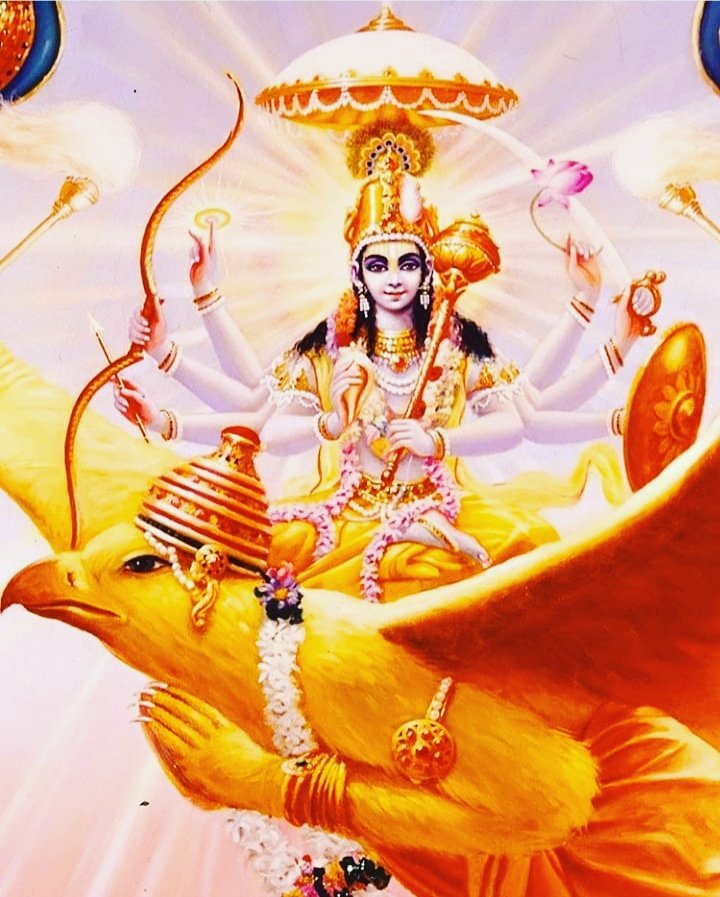
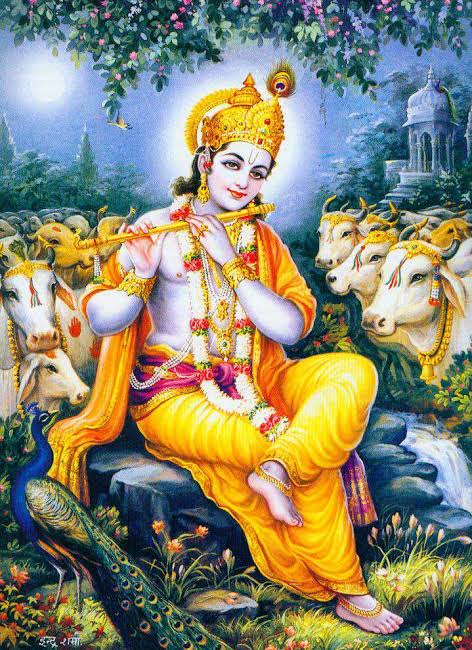
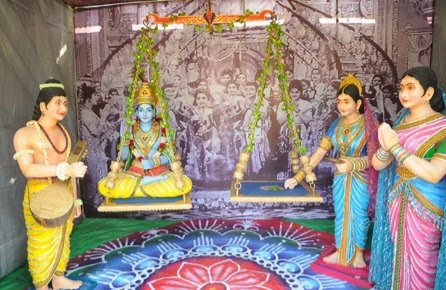
Beautiful story of Shri Krishna, Mata Rukmini & Satyabhama which teaches the importance of Bhakthi.
Devotion is important than anything.
#bhakthi
🕉
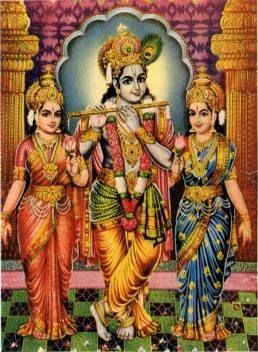
Satyabhama, royal princess was very proud of herself. Rukmini was very humble, her devotion was pure to Shri Krishna.

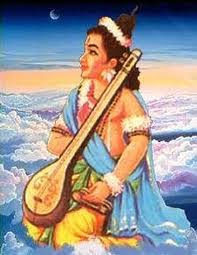
One day, Rishi Narada( Kalahapriya) arrived in Dwaraka and met Sathyabhama. In between the conversation he hinted that Krishna exhibits affection more to Rukmini than her. Worried Sathyabhama asked what can should be done to gain Krishna's undivided attention.
@SriramKannan77
Narada asked Satyabhama to make a vow, that she will hand over Krishna to him as a slave, if she cannot trade wealth equivalent to Krishna's weight. Narada thus convinces Sathyabhama that Krishna will admire her for sacrificing all her wealth for him.
Sathyabhama was sure that she have enough wealth to balance Krishna.

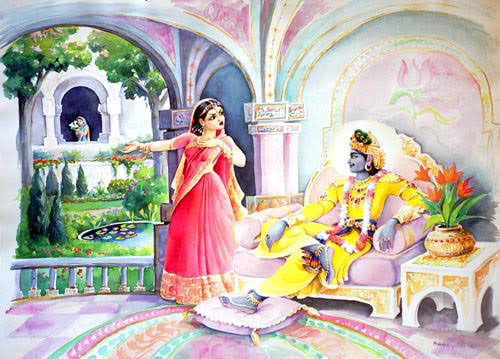
She went to Krishna and told about her vow to Narada. Krishna patiently listened to her and accepted the challenge. Satyabhama arranged to bring large scales to weigh and brought all her precious jewels.
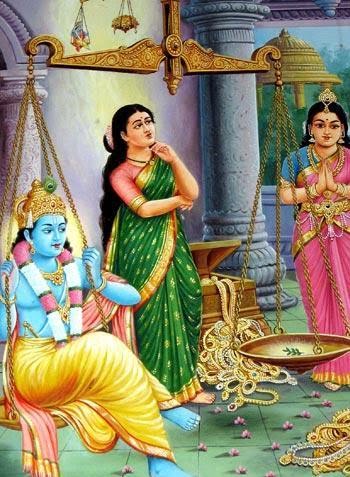
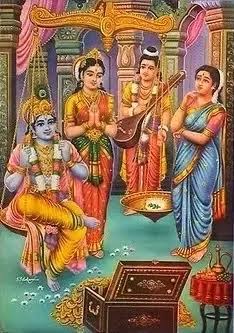
Krishna patiently sat on one plate of the Scales (tula). Sathyabhama started piling up the gold, jewels on the other plate. She kept adding more and more wealth, but the pan with Krishna did not even budge. Even after keeping all her jewels the scale did not move a little
A worried Sathyabhama looked at Krishna. Shri Krishna told her to consult Rukmini.

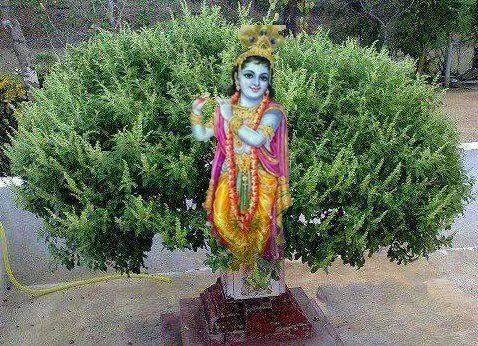
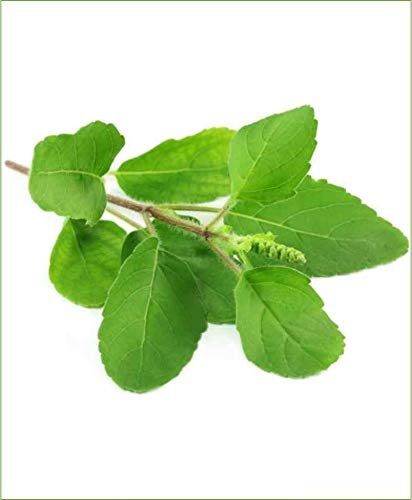
Sathyabhama went to Rukmini and informed her everything. Rukmini assured to help Sathyabhama and plucked a single leaf of Tulasi (Basil) while walking to the hall.
She walked towards the balance and praying to Krishna, placed the single Tulasi leaf on piled up wealth. The pan containing Krishna flew up.

Satyabhama looked to Krishna for explanation. Krishna asked her to remove the wealth from balance. She removed all riches until nothing
but tulasi leaf was left. Still it weighed more than Krishna. Krishna came to her, and told that eventhough Bhama gave all her wealth there was no devotion in offering. Offering made without devotion is of no use. Rukmini offered just a single tulasi leaf. But her intentions
were noble, and offered with utmost devotion. And that single leaf was sufficient to please Krishna.

With tears in eyes Sathyabhama thanked Narada to teach her Power of devotion.

More from Anu Satheesh

More from Religion

MDZS is laden with buddhist references. As a South Asian person, and history buff, it is so interesting to see how Buddhism, which originated from India, migrated, flourished & changed in the context of China. Here's some research (🙏🏼 @starkjeon for CN insight + citations)

1. LWJ’s sword Bichen ‘is likely an abbreviation for the term 躲避红尘 (duǒ bì hóng chén), which can be translated as such: 躲避: shunning or hiding away from 红尘 (worldly affairs; which is a buddhist teaching.) (
https://t.co/zF65W3roJe) (abbrev. TWX)

2. Sandu (三 毒), Jiang Cheng’s sword, refers to the three poisons (triviṣa) in Buddhism; desire (kāma-taṇhā), delusion (bhava-taṇhā) and hatred (vibhava-taṇhā).

These 3 poisons represent the roots of craving (tanha) and are the cause of Dukkha (suffering, pain) and thus result in rebirth.

Interesting that MXTX used this name for one of the characters who suffers, arguably, the worst of these three emotions.

3. The Qian kun purse “乾坤袋 (qián kūn dài) – can be called “Heaven and Earth” Pouch. In Buddhism, Maitreya (मैत्रेय) owns this to store items. It was believed that there was a mythical space inside the bag that could absorb the world.” (TWX)
First thread of the year because I have time during MCO. As requested, a thread on the gods and spirits of Malay folk religion. Some are indigenous, some are of Indian origin, some have Islamic


Before I begin, it might be worth explaining the Malay conception of the spirit world. At its deepest level, Malay religious belief is animist. All living beings and even certain objects are said to have a soul. Natural phenomena are either controlled by or personified as spirits

Although these beings had to be respected, not all of them were powerful enough to be considered gods. Offerings would be made to the spirits that had greater influence on human life. Spells and incantations would invoke their


Two known examples of such elemental spirits that had god-like status are Raja Angin (king of the wind) and Mambang Tali Arus (spirit of river currents). There were undoubtedly many more which have been lost to time

Contact with ancient India brought the influence of Hinduism and Buddhism to SEA. What we now call Hinduism similarly developed in India out of native animism and the more formal Vedic tradition. This can be seen in the multitude of sacred animals and location-specific Hindu gods

You May Also Like

This is a pretty valiant attempt to defend the "Feminist Glaciology" article, which says conventional wisdom is wrong, and this is a solid piece of scholarship. I'll beg to differ, because I think Jeffery, here, is confusing scholarship with "saying things that seem right".


The article is, at heart, deeply weird, even essentialist. Here, for example, is the claim that proposing climate engineering is a "man" thing. Also a "man" thing: attempting to get distance from a topic, approaching it in a disinterested fashion.


Also a "man" thing—physical courage. (I guess, not quite: physical courage "co-constitutes" masculinist glaciology along with nationalism and colonialism.)


There's criticism of a New York Times article that talks about glaciology adventures, which makes a similar point.


At the heart of this chunk is the claim that glaciology excludes women because of a narrative of scientific objectivity and physical adventure. This is a strong claim! It's not enough to say, hey, sure, sounds good. Is it true?