
I shared something I was working on before November...
I think it is relatable to what we have experienced. I was working on other things as well... https://t.co/U7mS9QyjFD

I was working on something before the election that became the election...
— Werise (@We_Have_Risen) January 7, 2021
Color revolutions are real and we just witnessed one live and direct...
1. pic.twitter.com/2u4rDGvl9N
More from Werise


More from For later read

Today's Twitter threads (a Twitter thread).
Inside: Planet Money on HP's myriad ripoffs; Strength in numbers; and more!
Archived at: https://t.co/esjoT3u5Gr
#Pluralistic
1/
On Feb 22, I'm delivering a keynote address for the NISO Plus conference, "The day of the comet: what trustbusting means for digital manipulation."
https://t.co/Z84xicXhGg
2/

Planet Money on HP's myriad ripoffs: Ink-stained wretches of the world, unite!
https://t.co/k5ASdVUrC2
3/

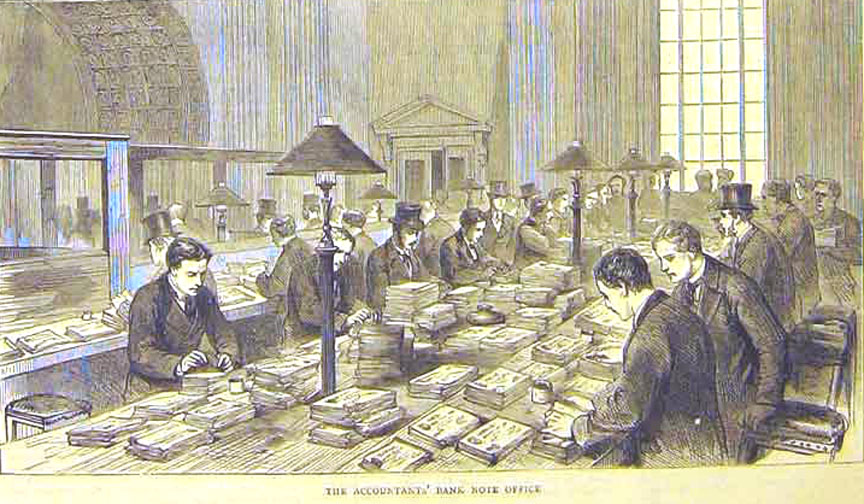
Strength in numbers: The crisis in accounting.
https://t.co/DjfAfHWpNN
4/
#15yrsago Bad Samaritan family won’t return found expensive camera https://t.co/Rn9E5R1gtV
#10yrsago What does Libyan revolution mean for https://t.co/Jz28qHVhrV? https://t.co/dN1e4MxU4r
5/
Inside: Planet Money on HP's myriad ripoffs; Strength in numbers; and more!
Archived at: https://t.co/esjoT3u5Gr
#Pluralistic
1/
On Feb 22, I'm delivering a keynote address for the NISO Plus conference, "The day of the comet: what trustbusting means for digital manipulation."
https://t.co/Z84xicXhGg
2/
Planet Money on HP's myriad ripoffs: Ink-stained wretches of the world, unite!
https://t.co/k5ASdVUrC2
3/
Back in November, I published an article for @EFF about @HP's latest printer-ink ripoff: after offering its customers a free-ink-for-life plan, it unilaterally switched them all to a $1/month-for-life plan.https://t.co/bsc73xPSuo
— Cory Doctorow #BLM (@doctorow) February 18, 2021
1/ pic.twitter.com/tagduPupA5
Strength in numbers: The crisis in accounting.
https://t.co/DjfAfHWpNN
4/
Accountancy is more likely to be mocked than celebrated (or condemned), but accountants, far more than poets, are the unacknowledged legislators of the world.
— Cory Doctorow #BLM (@doctorow) February 18, 2021
1/ pic.twitter.com/FaNQc66gQN
#15yrsago Bad Samaritan family won’t return found expensive camera https://t.co/Rn9E5R1gtV
#10yrsago What does Libyan revolution mean for https://t.co/Jz28qHVhrV? https://t.co/dN1e4MxU4r
5/

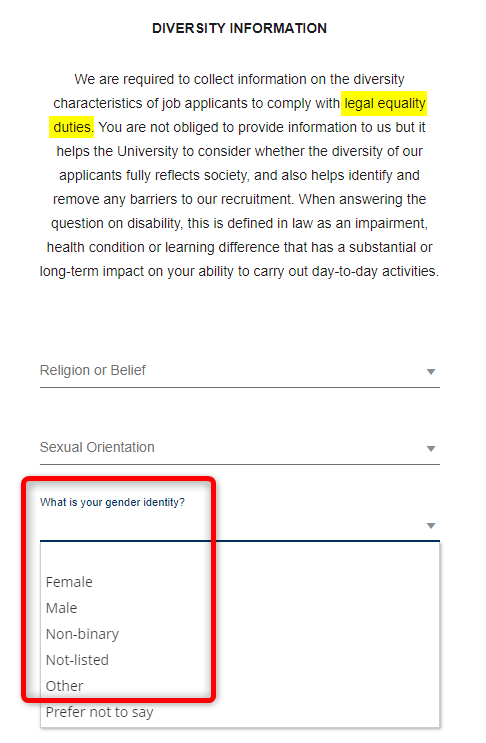
Hi @EdinburghUni @EHRC @EHRCChair @KishwerFalkner @RJHilsenrath @trussliz @GEOgovuk
The DIVERSITY INFORMATION section in yr job application mentions 'legal equality duties'. You then ask "What is your gender identity?" with options
Female
Male
Non-binary
Not-listed
Other
1/13
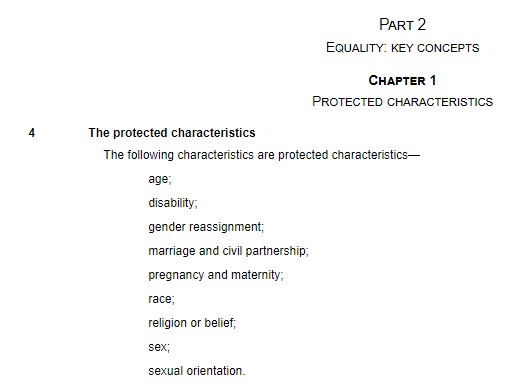
'Gender identity' is not a protected characteristic under the Equality Act 2010 and is not defined in the Act.
https://t.co/qisFhCiV1u
2/13
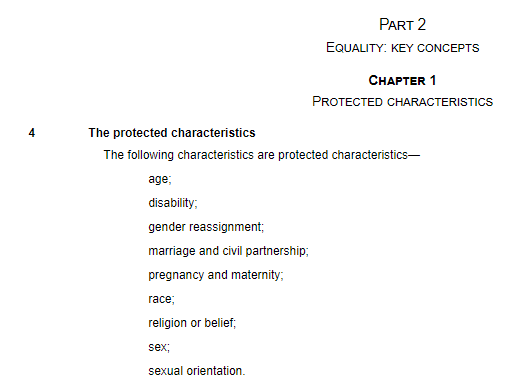
Sex is the protected characteristic and the only two possible options for sex are 'Female' and 'Male' as defined in the Act and consistent with biology - 'non-binary' and 'other' are not valid options.
https://t.co/CEJ0gkr6nF
'Gender identity' is not a synonym for sex.
3/13

You then ask "Does your gender identity match your sex registered at birth?"
4/13
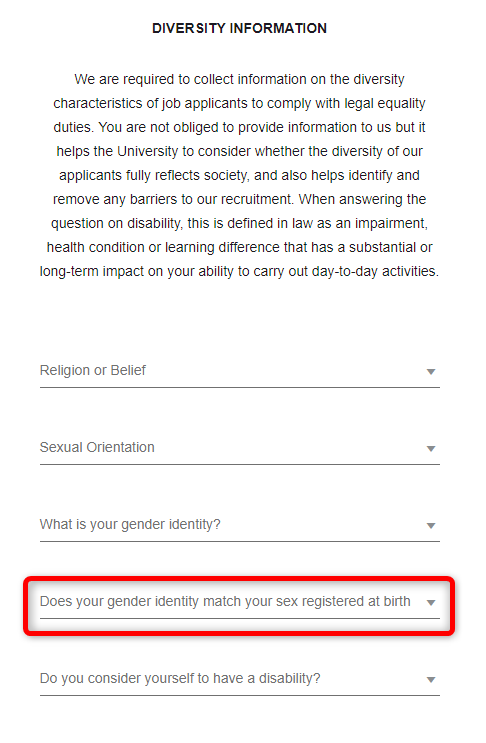
Again, 'gender identity' is not a protected characteristic under the Equality Act 2010 and is not defined in the Act.
https://t.co/qisFhCiV1u
5/13
The DIVERSITY INFORMATION section in yr job application mentions 'legal equality duties'. You then ask "What is your gender identity?" with options
Female
Male
Non-binary
Not-listed
Other
1/13
'Gender identity' is not a protected characteristic under the Equality Act 2010 and is not defined in the Act.
https://t.co/qisFhCiV1u
2/13
Sex is the protected characteristic and the only two possible options for sex are 'Female' and 'Male' as defined in the Act and consistent with biology - 'non-binary' and 'other' are not valid options.
https://t.co/CEJ0gkr6nF
'Gender identity' is not a synonym for sex.
3/13
You then ask "Does your gender identity match your sex registered at birth?"
4/13
Again, 'gender identity' is not a protected characteristic under the Equality Act 2010 and is not defined in the Act.
https://t.co/qisFhCiV1u
5/13


The #worldwildlifeday2021 theme is Forests and Livelihoods: Sustaining People and Planet aligning with UN Sustainable Development Goals 1, 12, 13 and 15. So, what are the UN Sustainable Development Goals (SDGs) & how can children begin to learn about them & get involved ?
https://t.co/8ICvHxE9QL is easy & fun to follow for our smallest of people #EYFS. Early childhood is the perfect stage to introduce the core concepts of what it means to be a global citizen. For our reception & KS1 children please take a look at this fabulous free resource
https://t.co/tZx8UIS58Q Storytelling is a powerful communications tool and helps children remember lessons and virtues that they will use in everyday life. The idea is to simplify the lessons of the (SDGs) so young children can relate to – and better understand – the SDGs.
For older children here’s a board game that aims to help teach children around the world about the Sustainable Development Goals in a simple and child-friendly way
This is a lovely free book for children to enjoy flicking through themselves https://t.co/ScMbQCfpjl Elyx, the United Nations’ digital ambassador, uses various expressions and actions to help demonstrate the meaning of each Sustainable Development Goal.
https://t.co/8ICvHxE9QL is easy & fun to follow for our smallest of people #EYFS. Early childhood is the perfect stage to introduce the core concepts of what it means to be a global citizen. For our reception & KS1 children please take a look at this fabulous free resource
https://t.co/tZx8UIS58Q Storytelling is a powerful communications tool and helps children remember lessons and virtues that they will use in everyday life. The idea is to simplify the lessons of the (SDGs) so young children can relate to – and better understand – the SDGs.
For older children here’s a board game that aims to help teach children around the world about the Sustainable Development Goals in a simple and child-friendly way
This is a lovely free book for children to enjoy flicking through themselves https://t.co/ScMbQCfpjl Elyx, the United Nations’ digital ambassador, uses various expressions and actions to help demonstrate the meaning of each Sustainable Development Goal.


You May Also Like



https://t.co/6cRR2B3jBE
Viruses and other pathogens are often studied as stand-alone entities, despite that, in nature, they mostly live in multispecies associations called biofilms—both externally and within the host.
https://t.co/FBfXhUrH5d

Microorganisms in biofilms are enclosed by an extracellular matrix that confers protection and improves survival. Previous studies have shown that viruses can secondarily colonize preexisting biofilms, and viral biofilms have also been described.

...we raise the perspective that CoVs can persistently infect bats due to their association with biofilm structures. This phenomenon potentially provides an optimal environment for nonpathogenic & well-adapted viruses to interact with the host, as well as for viral recombination.

Biofilms can also enhance virion viability in extracellular environments, such as on fomites and in aquatic sediments, allowing viral persistence and dissemination.

Viruses and other pathogens are often studied as stand-alone entities, despite that, in nature, they mostly live in multispecies associations called biofilms—both externally and within the host.
https://t.co/FBfXhUrH5d
Microorganisms in biofilms are enclosed by an extracellular matrix that confers protection and improves survival. Previous studies have shown that viruses can secondarily colonize preexisting biofilms, and viral biofilms have also been described.
...we raise the perspective that CoVs can persistently infect bats due to their association with biofilm structures. This phenomenon potentially provides an optimal environment for nonpathogenic & well-adapted viruses to interact with the host, as well as for viral recombination.
Biofilms can also enhance virion viability in extracellular environments, such as on fomites and in aquatic sediments, allowing viral persistence and dissemination.


