Newlane University Manifesto--12 tenets: 1. Education should be available and accessible to every person on earth; making quality education inaccessible or exclusive is immoral. Education belongs in the same category as shelter, clean water, and basic food.
More from Education


An appallingly tardy response to such an important element of reading - apologies. The growing recognition of fluency as the crucial developmental area for primary education is certainly encouraging helping us move away from the obsession with reading comprehension tests.
It is, as you suggest, a nuanced pedagogy with the tripartite algorithm of rate, accuracy and prosody at times conflating the landscape and often leading to an educational shrug of the shoulders, a convenient abdication of responsibility and a return to comprehension 'skills'.
Taking each element separately (but not hierarchically) may be helpful but always remembering that for fluency they occur simultaneously (not dissimilar to sentence structure, text structure and rhetoric in fluent writing).
Rate, or words-read-per-minute, is the easiest. Faster reading speeds are EVIDENCE of fluency development but attempting to 'teach' children(or anyone) to read faster is fallacious (Carver, 1985) and will result in processing deficit which in young readers will be catastrophic.
Reading rate is dependent upon eye-movements and cognitive processing development along with orthographic development (more on this later).
Sorry - a bit of a brain dump post - but I'd appreciate any responses and/or directions towards any applicable research.@Suchmo83 @Mr_AlmondED @TimRasinski1 @ReadingShanahan @mrspennyslater @TheReadingApe @PieCorbett @ReadingRockets @teach_well
— Mr Leyshon (@RyonWLeyshon) February 4, 2021
It is, as you suggest, a nuanced pedagogy with the tripartite algorithm of rate, accuracy and prosody at times conflating the landscape and often leading to an educational shrug of the shoulders, a convenient abdication of responsibility and a return to comprehension 'skills'.
Taking each element separately (but not hierarchically) may be helpful but always remembering that for fluency they occur simultaneously (not dissimilar to sentence structure, text structure and rhetoric in fluent writing).
Rate, or words-read-per-minute, is the easiest. Faster reading speeds are EVIDENCE of fluency development but attempting to 'teach' children(or anyone) to read faster is fallacious (Carver, 1985) and will result in processing deficit which in young readers will be catastrophic.
Reading rate is dependent upon eye-movements and cognitive processing development along with orthographic development (more on this later).



Our preprint on the impact of reopening schools on reproduction number in England is now available online: https://t.co/CpfUGzAJ2S. With @Jarvis_Stats @amyg225 @kerrylmwong @KevinvZandvoort @sbfnk + John Edmunds. NOT YET PEER REVIEWED. 1/

We used contact survey data collected by CoMix (https://t.co/ezbCIOgRa1) to quantify differences in contact patterns during November (Schools open) and January (Schools closed) 'Lockdown periods'. NOT YET PEER REVIEWED 2/
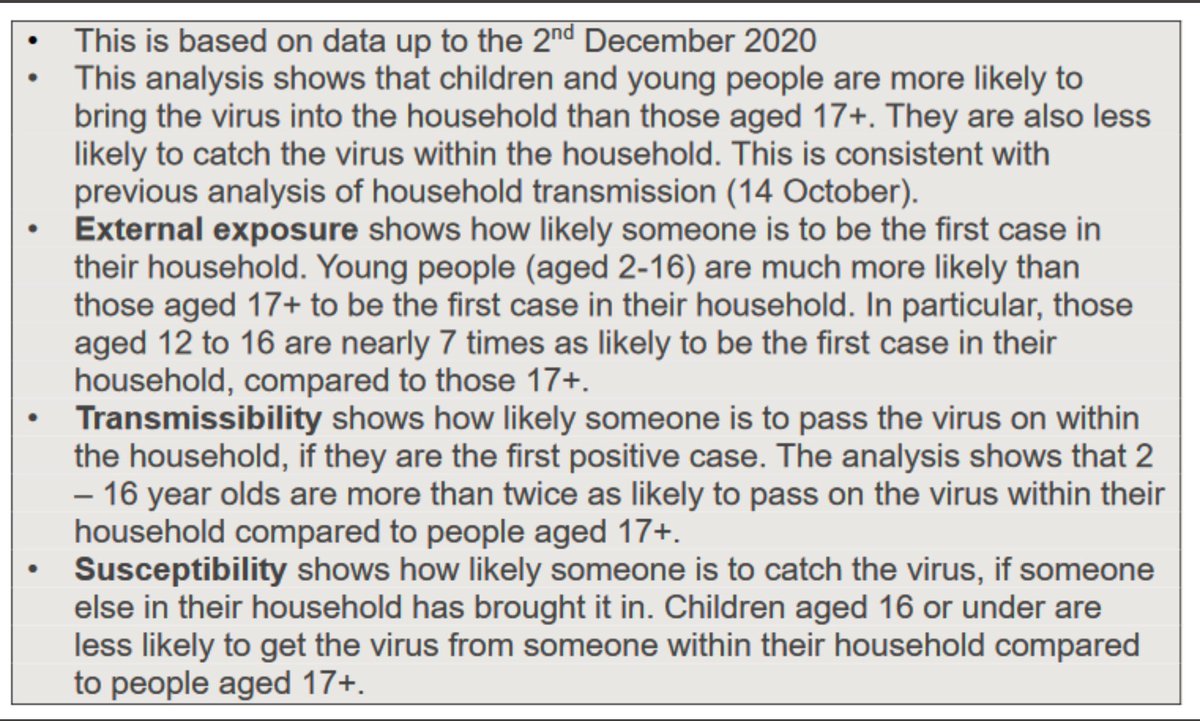
We combined this analysis with estimates of susceptibility and infectiousness of children relative to adults from literature. We also inferred relative susceptibility by fitting R estimates from CoMix to EpiForecasts estimates(https://t.co/6lUM2wK0bn). NOT YET PEER REVIEWED 3/

We estimated that reopening all schools would increase R by between 20% to 90% whereas reopening primary or secondary schools alone would increase R by 10% to 40%, depending on the infectiousness/susceptibility profile we used. NOT YET PEER REVIEWED 4/

Assuming a current R of 0.8 (in line with Govt. estimates: https://t.co/ZZhCe79zC4). Reopening all schools would increase R to between 1.0 and 1.5 and reopening either primary or secondary schools would increase R to between 0.9 and 1.2. NOT YET PEER REVIEWED 5/

We used contact survey data collected by CoMix (https://t.co/ezbCIOgRa1) to quantify differences in contact patterns during November (Schools open) and January (Schools closed) 'Lockdown periods'. NOT YET PEER REVIEWED 2/
We combined this analysis with estimates of susceptibility and infectiousness of children relative to adults from literature. We also inferred relative susceptibility by fitting R estimates from CoMix to EpiForecasts estimates(https://t.co/6lUM2wK0bn). NOT YET PEER REVIEWED 3/
We estimated that reopening all schools would increase R by between 20% to 90% whereas reopening primary or secondary schools alone would increase R by 10% to 40%, depending on the infectiousness/susceptibility profile we used. NOT YET PEER REVIEWED 4/
Assuming a current R of 0.8 (in line with Govt. estimates: https://t.co/ZZhCe79zC4). Reopening all schools would increase R to between 1.0 and 1.5 and reopening either primary or secondary schools would increase R to between 0.9 and 1.2. NOT YET PEER REVIEWED 5/