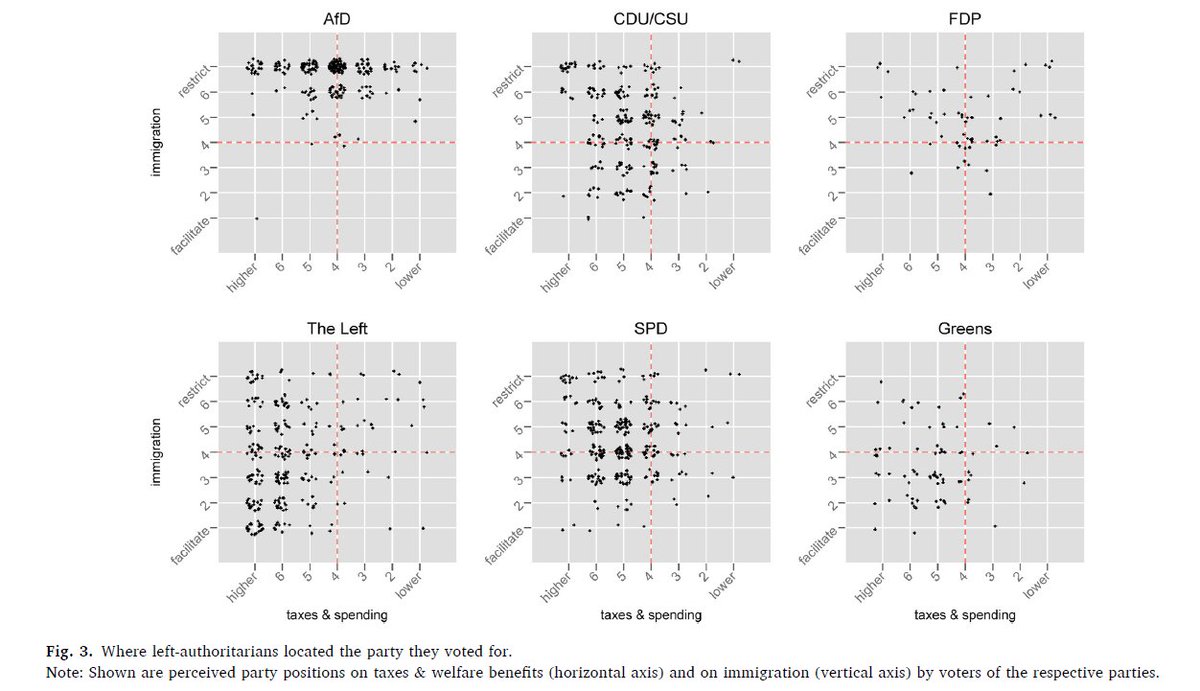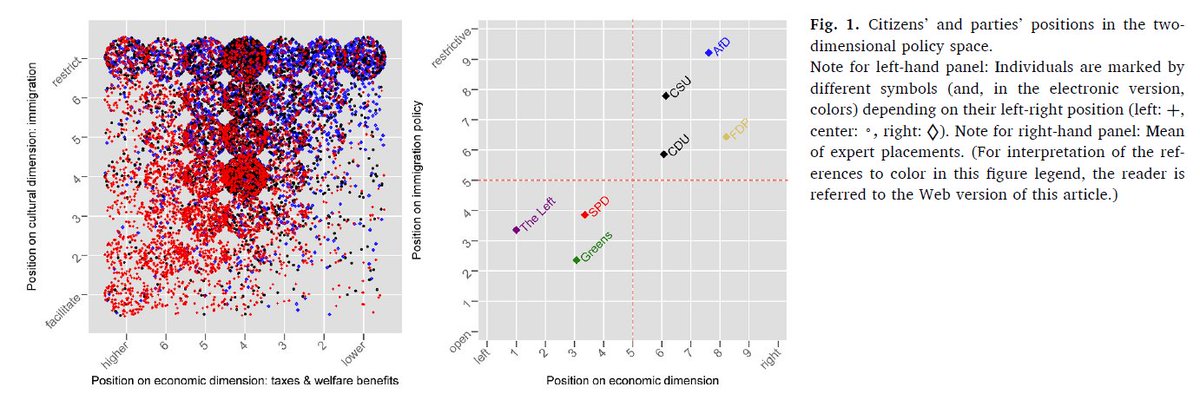
In this paper, we study vote choices of voters who are left-wing on economic issues and authoritarian/nationalist on cultural issues, especially immigration. For these voters, there is no often party combining positions in this way.

In the data from the Campaign Panel of the German Election Study 2017, many voters prefer higher social benefits and taxes and want to restrict immigration. @ches_data show that no party bundles issue positions in this way.
In the article, we show that many such “left-authoritarians” perceive the party they voted for to also hold a left-authoritarian position. Interestingly, this includes many AfD voters who report a perceived left-wing economic position of the party.
Our statistical models study the interplay between this (mis-)perceived congruence and issue importance, using an open-ended question on the most important political problem in Germany.
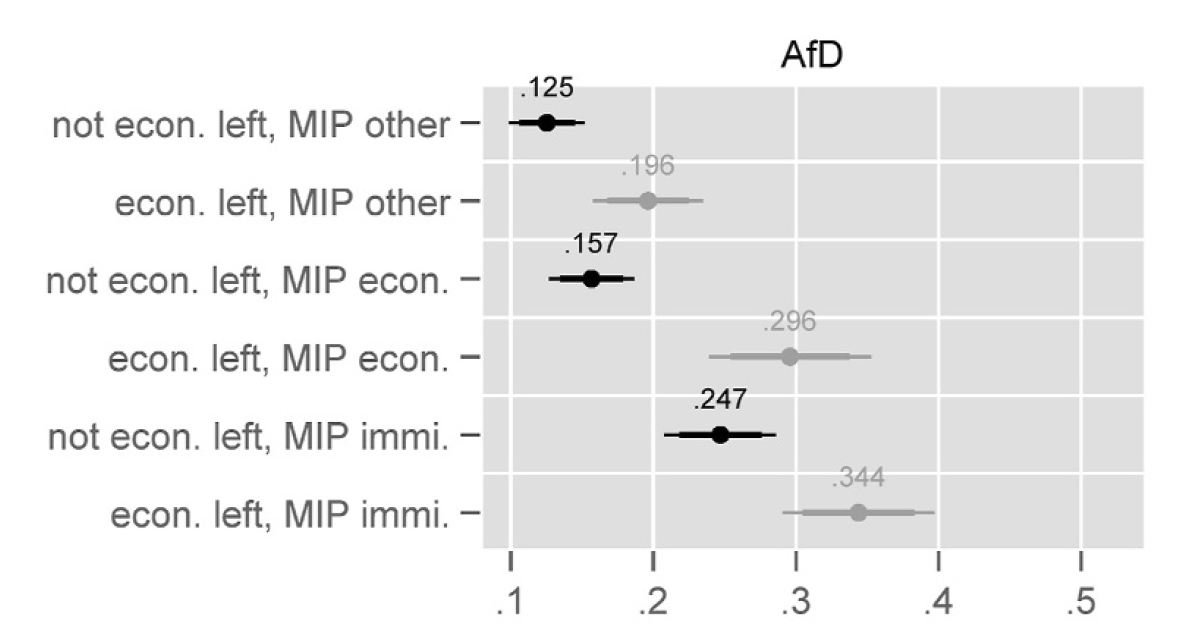
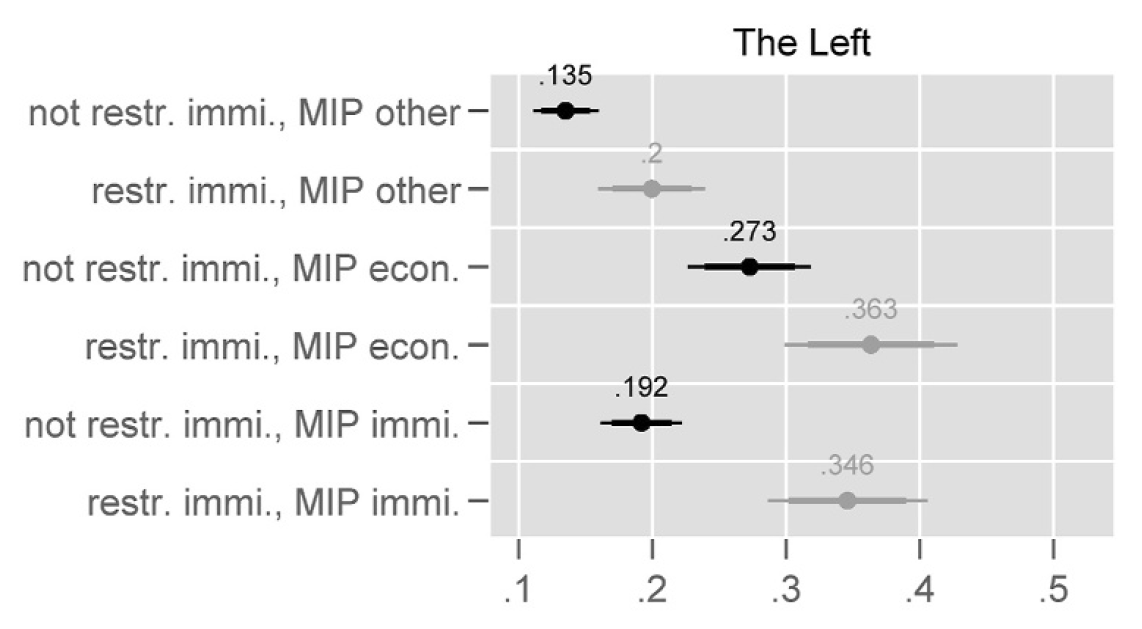
We find that (mis-)perceived congruence and issue importance interactively shape the left-authoritarian vote. Simply, perceived congruence matters more on an important issue—and issue salience matters most if voters accurately perceive incongruent party supply.
Left-authoritarians who care most about immigration have a relatively high probability to vote for the AfD, largely no matter what its perceived economic position is. Left-authoritarians who care most about the economy (only) if they misperceive the party to favor higher taxes.
Similarly, caring most about the economy makes left-authoritarians (more) likely to vote for Die Linke. Yet, the combination of caring most about immigration and misperceiving the party to be restrictive on immigration also results in a high probability to vote for the party.
Free copies to the article are available (for a limited time) to the kind people who made it to the end of this thread: https://t.co/RNZnMqwFW4.
One last note: This article was finished for submission during very sad times for us and at our institution. We felt the need to bring this up and dedicated this article to the memory of our former boss, Edeltraud Roller.

More from Economy

On Jan 6, 2021, the always stellar Mr @deepakshenoy tweeted, this:

https://t.co/fa3GX9VnW0

Innocuous 1 sentence, but its a full economic theory at play.
Let me break it down for you. (1/n)


On September 30, 2020, I wrote an article for @CFASocietyIndia where I explained that RBI is all set to lose its ability to set interest rates if it continues to fiddle with the exchange rate (2/n)

What do I mean, "fiddle with the exchange rate"?

In essence, if RBI opts and continues to manage exchange rate, then that is "fiddling with the exchange rate"

RBI has done that in the past and has restarted it in 2020 - very explicitly. (3/n)

First in March 2020, it opened a Dollar/INR swap of $2B with far leg to be unwound in September 2020.

Implying INR will be bought from the open markets in order to prevent INR from falling vis a vis USD (4/n)

The Second aspect is now, that dollar inflow is happening, and the forex reserves swelled -> implying the rupee is appreciating, RBI again intervened from September, by selling INR in spot markets. (5/n)
https://t.co/9kpWP7ovyM
Let's discuss how little you actually understand about economics and energy.

The first thing to understand is that energy is not globally fungible. Electricity decays as it leaves its point of origin; it’s expensive to transport. There is a huge excess (hydro) in many areas.


In other words, it can also be variable. It's estimated that in Sichuan there is twice as much electricity produced as is needed during the rainy season. Indeed, there is seasonality to how Bitcoin mining works. You can see here:

Bitcoin EXPORTS energy in this scenario. Fun fact, most industrial nations would steer this excess capacity towards refining aluminum by melting bauxite ore, which is very energy intensive.

You wouldn't argue that we are producing *too much* electricity from renewables, right?

"But what about the carbon footprint! ITS HUGE!"

Many previous estimates have quite faulty methods and don't take into account the actual energy sources. Is it fair to put a GHG equivalent on hydro or solar power? That would seem a bit disingenuous, no?

Well that's exactly what some have done.

You May Also Like