That's step 1
I'm sure someone else has explained this, but it is just so cool and I want to explain how this works.
— Andre Cronje (@AndreCronjeTech) January 15, 2021
That's step 1
Swap $1m sUSD for $1m sBTC? flat 0.3% fee
Swap $10m sUSD for $10m sBTC? flat 0.3% fee
swap $100m sUSD for $100m sBTC? Well, there isn't that many synths in Curve, yet but you get the point. The only limit is the pool depth
1. Curve lets you swap like-assets with extremely low slippage and a low fee
2. Synthetix lets you convert synths to other synths, with no slippage and a low fee
What happens if we just... combine them?
1. I swap my "real asset" (e.g. USDC) for a "synthetic" one (e.g. sUSD)
2. I exchange one synthetic asset for another (e.g. sUSD -> sBTC)
3. I swap my new synthetic asset to a "real" asset again (e.g. wBTC)
It is. It's not cheap either, at over 1m gas to execute. And to make matters worse, due to how a Synthetix swap works, you actually have to wait a few minutes between the swap, so it isn't even full atomic!
The answer is capital efficiency. AMMs with a curve that allows trading assets that are dissimilar are inefficient with larger and larger swaps.
For example, a $10m USDC -> wBTC swap on Uniswap right now has >13% slippage!
Of course you would pick this option now!
But on principle, this will be the best way to perform a high-value swap!
I think as we have seen, gas fees are just going up and up and up. Optimism soft-launched their L2 today, but Ethereum's success means that block space will always be at a premium.
The gas costs will not be coming down as much as you'd think!
This more efficient means of large-value swaps will see a lot of use on base layer Ethereum, as gas prices continue to grow.
Hobbyist/frequent traders will move to Layer 2, where smaller value trades will be economically more efficient.
More from Crypto





Out of curiosity I dug into how NFT's actually reference the media you're "buying" and my eyebrows are now orbiting the moon
Short version:
The NFT token you bought either points to a URL on the internet, or an IPFS hash. In most circumstances it references an IPFS gateway on the internet run by the startup you bought the NFT from.
Oh, and that URL is not the media. That URL is a JSON metadata file
Here's an example. This artwork is by Beeple and sold via Nifty:
https://t.co/TlJKH8kAew
The NFT token is for this JSON file hosted directly on Nifty's servers:
https://t.co/GQUaCnObvX
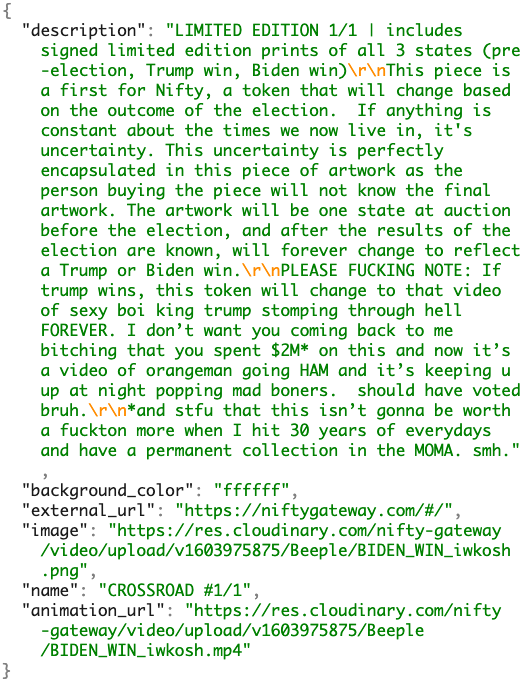
THAT file refers to the actual media you just "bought". Which in this case is hosted via a @cloudinary CDN, served by Nifty's servers again.
So if Nifty goes bust, your token is now worthless. It refers to nothing. This can't be changed.
"But you said some use IPFS!"
Let's look at the $65m Beeple, sold by Christies. Fancy.
https://t.co/1G9nCAdetk
That NFT token refers directly to an IPFS hash (https://t.co/QUdtdgtssH). We can take that IPFS hash and fetch the JSON metadata using a public gateway:
https://t.co/CoML7psBhF

Short version:
The NFT token you bought either points to a URL on the internet, or an IPFS hash. In most circumstances it references an IPFS gateway on the internet run by the startup you bought the NFT from.
Oh, and that URL is not the media. That URL is a JSON metadata file
Here's an example. This artwork is by Beeple and sold via Nifty:
https://t.co/TlJKH8kAew
The NFT token is for this JSON file hosted directly on Nifty's servers:
https://t.co/GQUaCnObvX
THAT file refers to the actual media you just "bought". Which in this case is hosted via a @cloudinary CDN, served by Nifty's servers again.
So if Nifty goes bust, your token is now worthless. It refers to nothing. This can't be changed.
"But you said some use IPFS!"
Let's look at the $65m Beeple, sold by Christies. Fancy.
https://t.co/1G9nCAdetk
That NFT token refers directly to an IPFS hash (https://t.co/QUdtdgtssH). We can take that IPFS hash and fetch the JSON metadata using a public gateway:
https://t.co/CoML7psBhF
You May Also Like

I'm going to do two history threads on Ethiopia, one on its ancient history, one on its modern story (1800 to today). 🇪🇹
I'll begin with the ancient history ... and it goes way back. Because modern humans - and before that, the ancestors of humans - almost certainly originated in Ethiopia. 🇪🇹 (sub-thread):
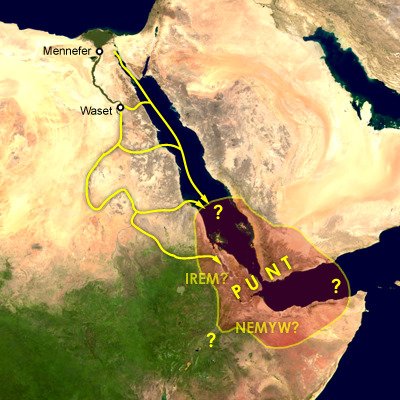
The first likely historical reference to Ethiopia is ancient Egyptian records of trade expeditions to the "Land of Punt" in search of gold, ebony, ivory, incense, and wild animals, starting in c 2500 BC 🇪🇹
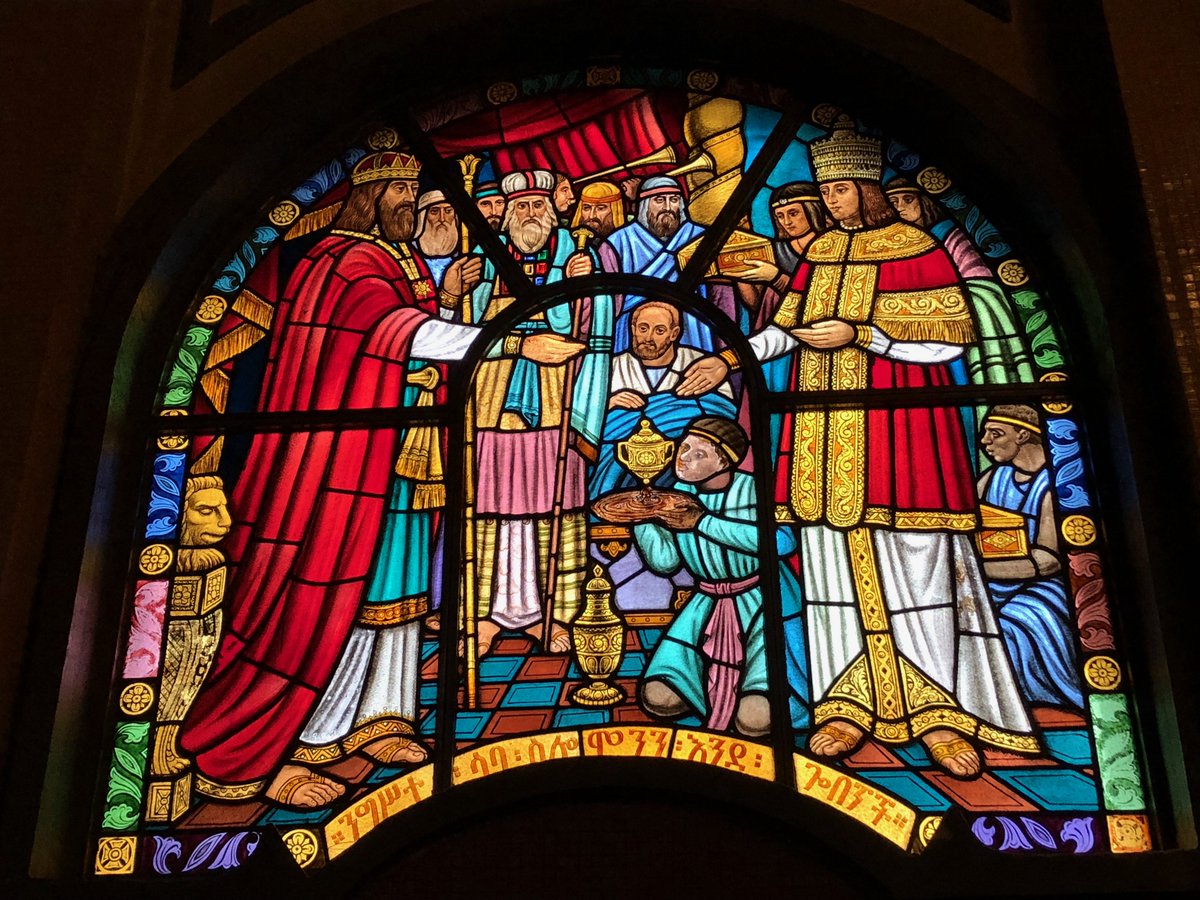
Ethiopians themselves believe that the Queen of Sheba, who visited Israel's King Solomon in the Bible (c 950 BC), came from Ethiopia (not Yemen, as others believe). Here she is meeting Solomon in a stain-glassed window in Addis Ababa's Holy Trinity Church. 🇪🇹
References to the Queen of Sheba are everywhere in Ethiopia. The national airline's frequent flier miles are even called "ShebaMiles". 🇪🇹

I'll begin with the ancient history ... and it goes way back. Because modern humans - and before that, the ancestors of humans - almost certainly originated in Ethiopia. 🇪🇹 (sub-thread):
The famous \u201cLucy\u201d, an early ancestor of modern humans (Australopithecus) that lived 3.2 million years ago, and was discovered in 1974 in Ethiopia, displayed in the national museum in Addis Ababa \U0001f1ea\U0001f1f9 pic.twitter.com/N3oWqk1SW2
— Patrick Chovanec (@prchovanec) November 9, 2018
The first likely historical reference to Ethiopia is ancient Egyptian records of trade expeditions to the "Land of Punt" in search of gold, ebony, ivory, incense, and wild animals, starting in c 2500 BC 🇪🇹
Ethiopians themselves believe that the Queen of Sheba, who visited Israel's King Solomon in the Bible (c 950 BC), came from Ethiopia (not Yemen, as others believe). Here she is meeting Solomon in a stain-glassed window in Addis Ababa's Holy Trinity Church. 🇪🇹
References to the Queen of Sheba are everywhere in Ethiopia. The national airline's frequent flier miles are even called "ShebaMiles". 🇪🇹