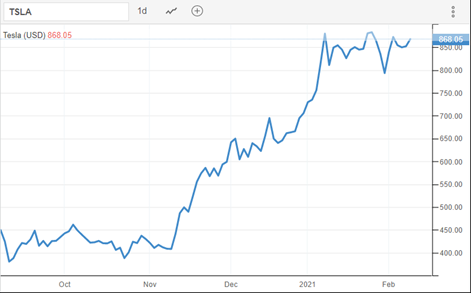
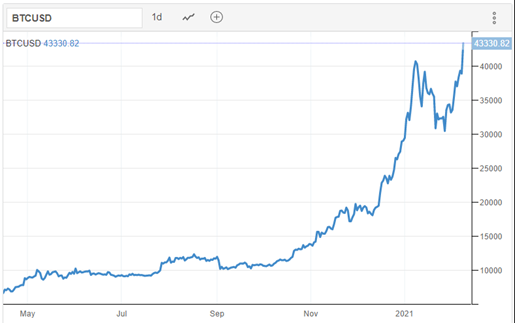
Tesla just announced that it had bought 1.5 billion dollars of bitcoin and could in the future sell cars in bitcoins. Since this morning both Bitcoin and Tesla are going up in the market. Maybe there is afterall something in the saying that“Bitcoin is Tesla without the cars”1/ 20
More from Crypto

I'm sure someone else has explained this, but it is just so cool and I want to explain how this works.
So Curve is awesome for swaps between similar assets, right? The fact that they trade very close to each other is a key part about how Curve works, using it's custom swap invariant function.
That's step 1
Step 2 is that Synthetix is awesome for creating "synthetic assets" (aka synths) which are assets that trade like other assets, that are backed by another, entirely different asset. Basically, a plastic banana that I can buy and sell like a real banana.
Synthetix has a feature that lets you swap between any two synths with zero slippage and a flat fee. That's because it is simply converting the sythentic asset into another synthetic asset, the backing for the synth doesn't change it just uses a different price oracle now.
This is important. Absolutely no slippage, at any size
Swap $1m sUSD for $1m sBTC? flat 0.3% fee
Swap $10m sUSD for $10m sBTC? flat 0.3% fee
swap $100m sUSD for $100m sBTC? Well, there isn't that many synths in Curve, yet but you get the point. The only limit is the pool depth
— Andre Cronje (@AndreCronjeTech) January 15, 2021
So Curve is awesome for swaps between similar assets, right? The fact that they trade very close to each other is a key part about how Curve works, using it's custom swap invariant function.
That's step 1
Step 2 is that Synthetix is awesome for creating "synthetic assets" (aka synths) which are assets that trade like other assets, that are backed by another, entirely different asset. Basically, a plastic banana that I can buy and sell like a real banana.
Synthetix has a feature that lets you swap between any two synths with zero slippage and a flat fee. That's because it is simply converting the sythentic asset into another synthetic asset, the backing for the synth doesn't change it just uses a different price oracle now.
This is important. Absolutely no slippage, at any size
Swap $1m sUSD for $1m sBTC? flat 0.3% fee
Swap $10m sUSD for $10m sBTC? flat 0.3% fee
swap $100m sUSD for $100m sBTC? Well, there isn't that many synths in Curve, yet but you get the point. The only limit is the pool depth


2020 was a game changer for Ethereum.
The vast majority of its success was fueled by #DeFi.
Here's what happened in 5 Tweets 🔽
1) Governance Tokens 🪙
Projects gave complete ownership of billion dollar protocols to their users, often using retroactive airdrops.
Early adopters earned tokens for past usage, and token-based voting now dictates all technical
2) Liquidity Mining ⛏️
Power users were the first to earn on-going distribution by providing liquidity.
$COMP sparked the wave, with $BAL coining the term a few weeks
3) Yield Faming 🌾
Projects coupled liquidity mining and governance tokens to boost 'yields' by combining lending rates with an incentive layer.
APYs peaked as high as 1M% during 'DeFi summer', leading to a 'food coin' craze like $YAM and
4) Fair Launches ✅
Who needs investment when you can launch using yield farming?
@iearnfinance debuted $YFI with no formal funding, seeding a community treasury for self-sustainability.
The notion of a core team and community became one and the
The vast majority of its success was fueled by #DeFi.
Here's what happened in 5 Tweets 🔽
1) Governance Tokens 🪙
Projects gave complete ownership of billion dollar protocols to their users, often using retroactive airdrops.
Early adopters earned tokens for past usage, and token-based voting now dictates all technical
It pays to be a web3 power user.
— Coopahtroopa \U0001f525_\U0001f525 (@Cooopahtroopa) December 9, 2020
Five networks that issued retroactive airdrops to value added actors \U0001f4dd
2) Liquidity Mining ⛏️
Power users were the first to earn on-going distribution by providing liquidity.
$COMP sparked the wave, with $BAL coining the term a few weeks
BAL is live!
— Balancer Labs (@BalancerLabs) June 23, 2020
The 435k BAL for liquidity providers of the first three weeks of liquidity mining (145k per week) have just been sent out to the wallets used to provide liquidity on Balancer.https://t.co/pkXFzwzPVC
3) Yield Faming 🌾
Projects coupled liquidity mining and governance tokens to boost 'yields' by combining lending rates with an incentive layer.
APYs peaked as high as 1M% during 'DeFi summer', leading to a 'food coin' craze like $YAM and
Check out @Cooopahtroopa's latest post for all the #DeFi farmers out there \U0001f468\u200d\U0001f33e
— Zerion \U0001f3e6 (@zerion_io) June 26, 2020
Turns out @synthetix_io & @CurveFinance were ploughing the fields long before $COMP & $BAL came along.
Learn how to put your #crypto to work with this #yieldfarming 101 \U0001f4b8
\U0001f449 https://t.co/zYUKtqx3BK
4) Fair Launches ✅
Who needs investment when you can launch using yield farming?
@iearnfinance debuted $YFI with no formal funding, seeding a community treasury for self-sustainability.
The notion of a core team and community became one and the
2/ What is a Fair Launch?
— fair launch capital (@fairlaunchcap) August 26, 2020
A FL enables founders to bootstrap new crypto networks that are earned, owned, and governed by their community from the outset.
In this dynamic, everyone participates on equal footing\u2014there is no early access, pre-mine, or allocation of tokens.