https://t.co/3xxjeFJroS
I usually stay away from price predictions, but this time I couldn't help it. Just published "10 reasons why bitcoin will hit $100.000 in 2021".
Share it with a normie friend, maybe he/she will understand the value proposition of
https://t.co/3xxjeFJroS
However, I believe that we should look up to gold a lot more often & look down to USD less frequently
https://t.co/dTqDaWZLr3
It's simple, really. With only a general-purpose electronic device (phone, laptop), piece of paper, or even 12 words that you memorize, you can move your wealth in a different country.
In a world where PayPal and Visa can dictate your policy as a business and can shut you up from expressing political opinions, Bitcoin has a lot of value.
Private property rights are getting weaker in the countries that traditionally used to be the best at protecting them. OTOH, nobody can confiscate your bitcoins or tax you without consent.
https://t.co/FheNwwiK5R
Mainstream media enjoys shunning Bitcoin for its low tx/s capacity. But thanks to @lightning @Blockstream @Truthcoin @SomsenRuben @RSKsmart, Bitcoin will scale with sidechains & second layers.
Today, you no longer need to use command-line input to be a first class Bitcoin citizen. @wasabiwallet & @bluewalletio offer sovereignty with great ease of use. Also, @mynodebtc, @fulmolightning & @getumbrel make full nodes simple
Let's just enumerate wealthy and influential people who tweeted about Bitcoin in the last few years: @jk_rowling @elonmusk @jack @stoolpresidente @tyler @cameron @benmezrich @MichellePhan.
Thanks to them, millions got exposed to BTC
Financial privacy boosts fungibility and therefore increases the value and utility of money. With privacy improvements such as Taproot, P2EP, and CoinJoins, Bitcoin becomes more private.
With Lightning & sidechains, it's even better
I don't expect @frances_coppola to understand this one, but scarcity and divisibility are very important. Today you can buy 2.7k sats with $1, so even the poorest people can buy in
More from Crypto


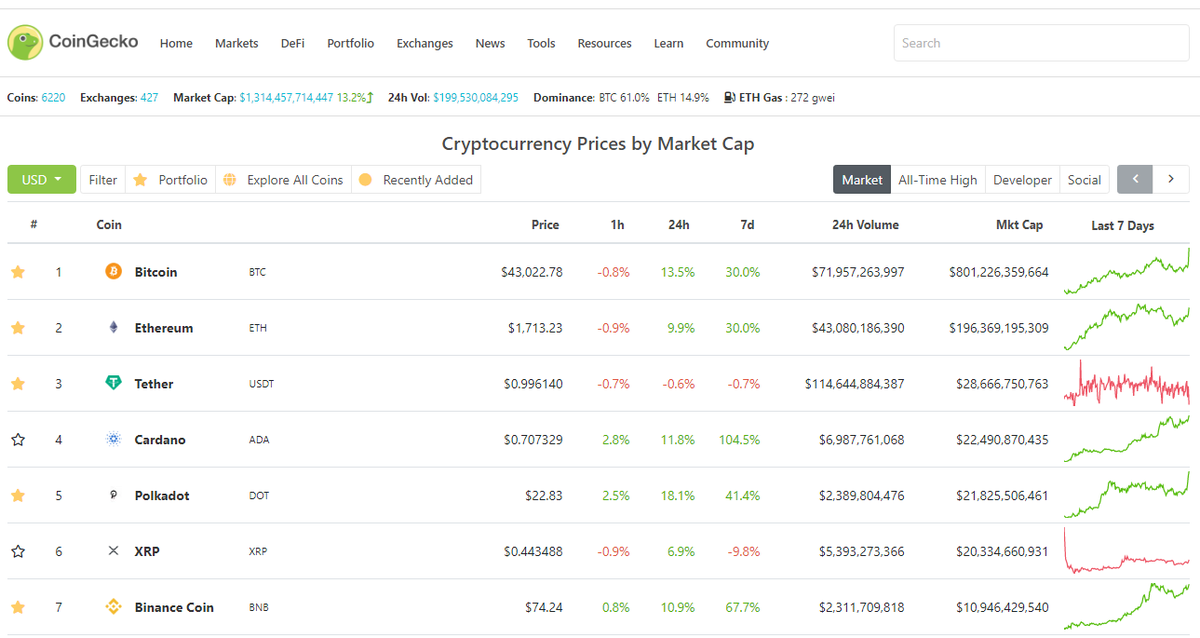
A primer on how to use @coingecko for your crypto data/research/trading needs.
Share it with a friend who needs it!
1/ Getting started with crypto and want to check prices/projects? https://t.co/LFnk4vukxj has info on just about every crypto you'll need :)
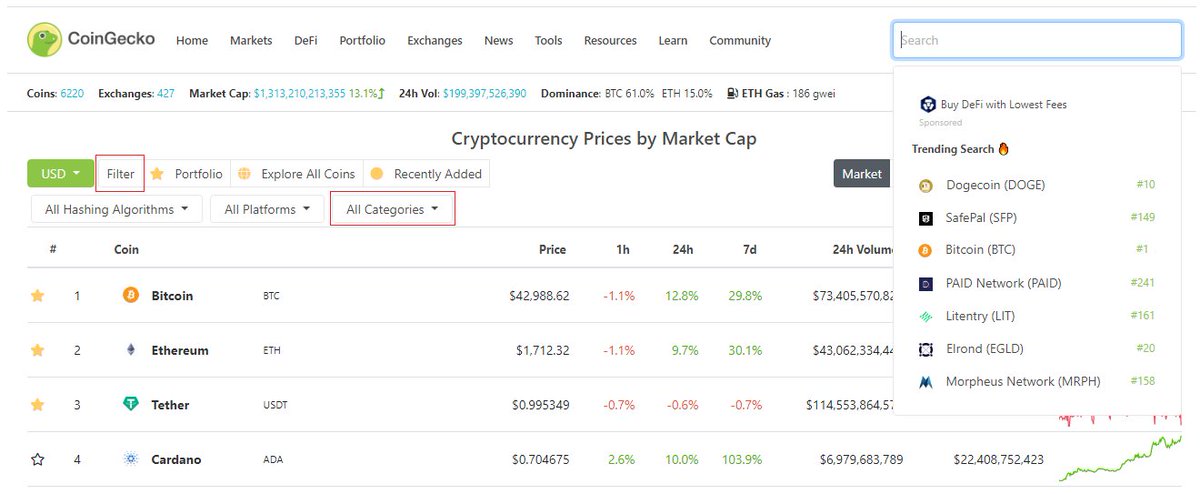
2/ Search over 6000+ cryptocurrencies available on the market. You can see what's trending in the space as well.
Researching by categories? Filter (left side) -> Select categories -> DeFi, DOT ecosystem, Exchange-based tokens, NFTs - anything!
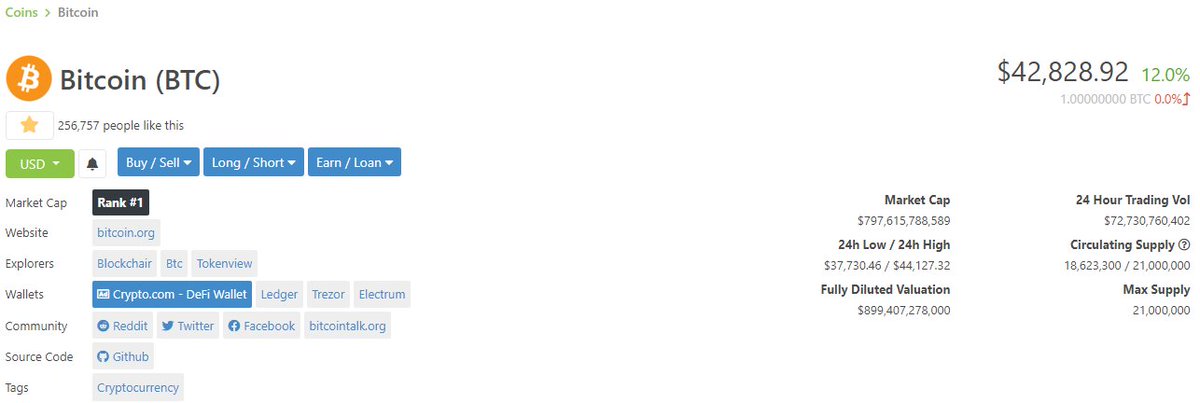
3/ Lets say you're looking at #Bitcoin https://t.co/g205lj03pG
At a glance you get:
- Price
- Mkt Capitalization (valuation)
- Circulating/Total supply
- 24h trading volume
- Links to websites, social media, block explorers
- Calculator
Next - check valuation?
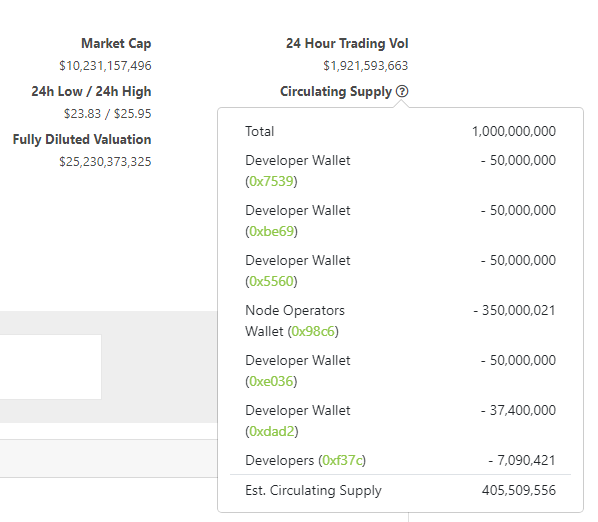
4/ Market cap is used to rank coins, and we'll show you how its calculated - Hover over Circulating Supply (?) for breakdown.
Note: used @chainlink as example here - https://t.co/Jc46fe79Ag
While MC is important also consider product fit, narrative, team, community etc.
5/ If you're trading on AMMs like @Uniswap or @SushiSwap, you can copy the contract address directly to your clipboard.
Using @metamask_io? Add the token directly so it shows as one of the "Assets" that you own in the wallet.
See: https://t.co/94XihMf5oz
Share it with a friend who needs it!
1/ Getting started with crypto and want to check prices/projects? https://t.co/LFnk4vukxj has info on just about every crypto you'll need :)
2/ Search over 6000+ cryptocurrencies available on the market. You can see what's trending in the space as well.
Researching by categories? Filter (left side) -> Select categories -> DeFi, DOT ecosystem, Exchange-based tokens, NFTs - anything!
3/ Lets say you're looking at #Bitcoin https://t.co/g205lj03pG
At a glance you get:
- Price
- Mkt Capitalization (valuation)
- Circulating/Total supply
- 24h trading volume
- Links to websites, social media, block explorers
- Calculator
Next - check valuation?
4/ Market cap is used to rank coins, and we'll show you how its calculated - Hover over Circulating Supply (?) for breakdown.
Note: used @chainlink as example here - https://t.co/Jc46fe79Ag
While MC is important also consider product fit, narrative, team, community etc.
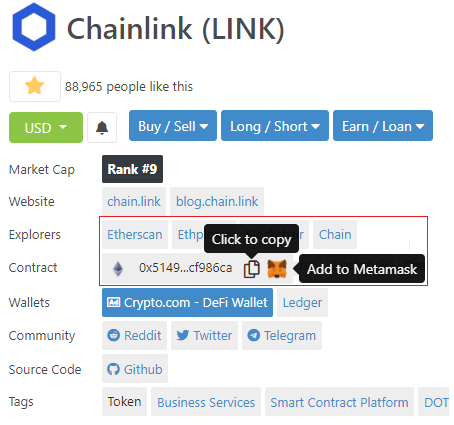
5/ If you're trading on AMMs like @Uniswap or @SushiSwap, you can copy the contract address directly to your clipboard.
Using @metamask_io? Add the token directly so it shows as one of the "Assets" that you own in the wallet.
See: https://t.co/94XihMf5oz
Introducing an effortless way to add tokens to your @metamask_io wallet \U0001f4e5
— CoinGecko (@coingecko) February 8, 2021
Skip the hassle of copying/pasting contract addresses to your wallet. Add an asset and it'll appear in your wallet with just a click - tap the \U0001f98a and try it out for yourself! pic.twitter.com/u26BA29ubs


I've just read one of the most lucid, wide-ranging, cross-disciplinary critiques of cryptocurrency and blockchain I've yet to encounter. 1/
It comes from David "DSHR" Rosenthal, a distinguished technologist whose past achievements including helping to develop X11 and the core technologies for Nvidia.
https://t.co/tkAMShno4k 2/
Rosenthal's critique is a transcript of a lecture he gave to Stanford's EE380 class, adapted from a December 2021 talk for an investor conference. 3/
It is a bang-up-to-date synthesis of many of the critical writings on the subject, glued together with Rosenthal's own deep technical expertise. He calls it "Can We Mitigate Cryptocurrencies' Externalities?"
The presence of "externalities" in Rosenthal's title is key. 4/
Rosenthal identifies blockchainism's core ideology as emerging from "the libertarian culture of Silicon Valley and the cypherpunks," and states that "libertarianism's attraction is based on ignoring externalities."
This is an important critique of libertarianism. 5/
You May Also Like






I just finished Eric Adler's The Battle of the Classics, and wanted to say something about Joel Christiansen's review linked below. I am not sure what motivates the review (I speculate a bit below), but it gives a very misleading impression of the book. 1/x
The meat of the criticism is that the history Adler gives is insufficiently critical. Adler describes a few figures who had a great influence on how the modern US university was formed. It's certainly critical: it focuses on the social Darwinism of these figures. 2/x
Other insinuations and suggestions in the review seem wildly off the mark, distorted, or inappropriate-- for example, that the book is clickbaity (it is scholarly) or conservative (hardly) or connected to the events at the Capitol (give me a break). 3/x
The core question: in what sense is classics inherently racist? Classics is old. On Adler's account, it begins in ancient Rome and is revived in the Renaissance. Slavery (Christiansen's primary concern) is also very old. Let's say classics is an education for slaveowners. 4/x
It's worth remembering that literacy itself is elite throughout most of this history. Literacy is, then, also the education of slaveowners. We can honor oral and musical traditions without denying that literacy is, generally, good. 5/x
As someone\u2019s who\u2019s read the book, this review strikes me as tremendously unfair. It mostly faults Adler for not writing the book the reviewer wishes he had! https://t.co/pqpt5Ziivj
— Teresa M. Bejan (@tmbejan) January 12, 2021
The meat of the criticism is that the history Adler gives is insufficiently critical. Adler describes a few figures who had a great influence on how the modern US university was formed. It's certainly critical: it focuses on the social Darwinism of these figures. 2/x
Other insinuations and suggestions in the review seem wildly off the mark, distorted, or inappropriate-- for example, that the book is clickbaity (it is scholarly) or conservative (hardly) or connected to the events at the Capitol (give me a break). 3/x
The core question: in what sense is classics inherently racist? Classics is old. On Adler's account, it begins in ancient Rome and is revived in the Renaissance. Slavery (Christiansen's primary concern) is also very old. Let's say classics is an education for slaveowners. 4/x
It's worth remembering that literacy itself is elite throughout most of this history. Literacy is, then, also the education of slaveowners. We can honor oral and musical traditions without denying that literacy is, generally, good. 5/x