1/ In September 1993, then-Microsoft exec Nathan Myhrvold wrote his landmark memo "Road Kill on the Information Highway", laying out a dozen-ish predictions on the rise of the internet

27 years later, I think it's a super interesting case study. Let's evaluate the predictions -

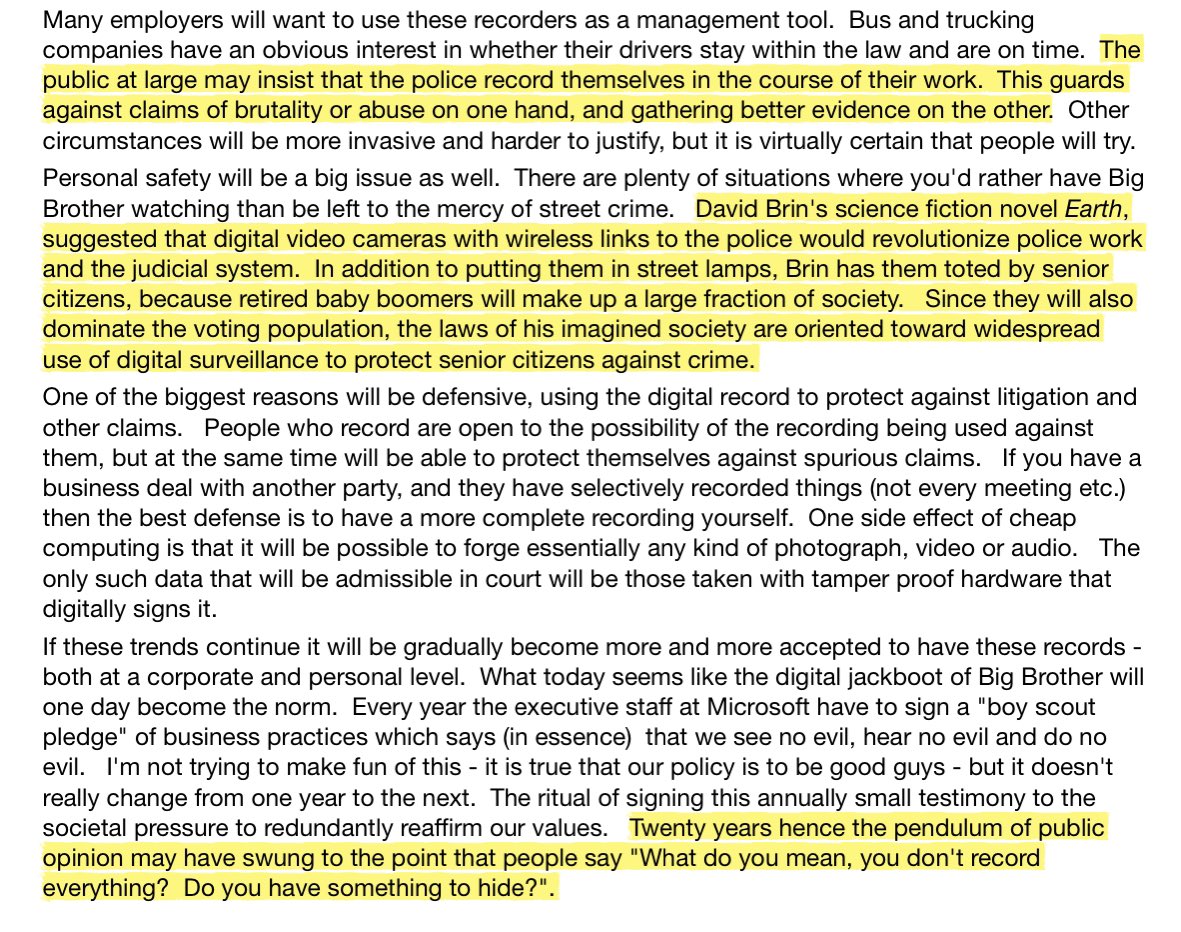
2/ PREDICTION #1: The rise of a surveillance society - police bodycams, CCTV, 24/7 personal recording, and deepfakes

GRADE: A-

Pretty close!
3/ PREDICTION #2: Telecommuting, an end to the "tyranny of geography" and gerrymandering

GRADE: B-

Alas, the electoral college still matters today. The WFH prediction hits closer, but turns out it took two and a half decades + a pandemic to get things going
4/ PREDICTION #3: Telco convergence - phone companies become cable providers and vice versa

GRADE: A-

Honestly this one was a bit of a layup, although it took 15 years longer than anyone expected
5/ PREDICTION #4: The rise of online neo-banks

GRADE: C

Three decades later, and physical banks still exist. Neobanks have a presence in emerging markets, UK, and basically nowhere else. Regulatory inertia: officially a thing
6/ PREDICTION #5: "Newspapers are in probably the worst situation of any form of print media"

GRADE: A+

Frankly I was shocked by the prescience of this section. Newspapers were once local advertising monopolies. The internet broke that monopoly
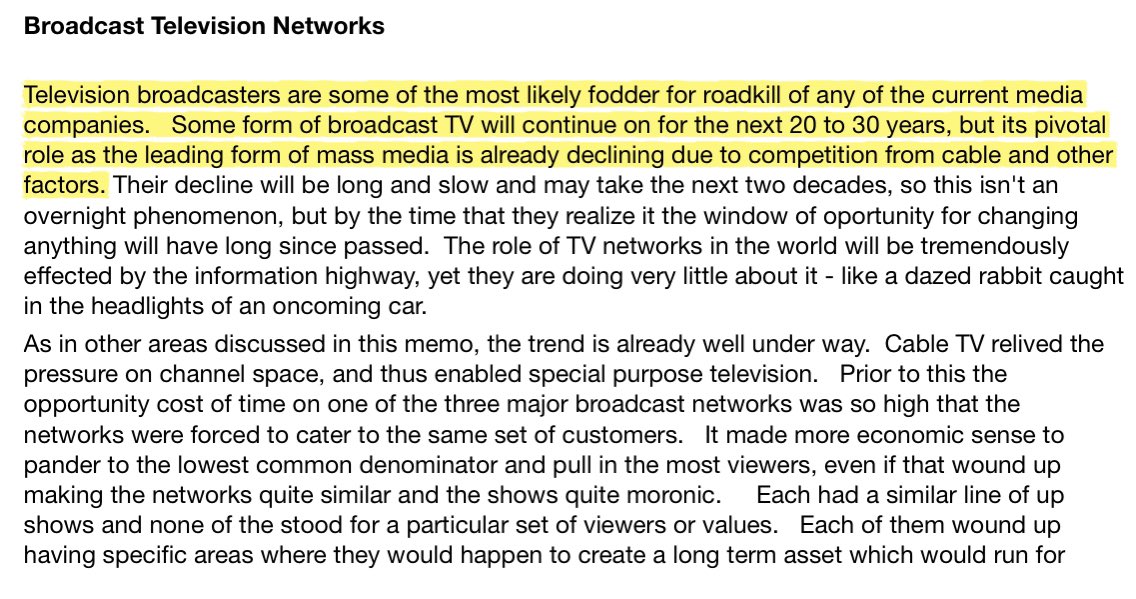
7/ PREDICTION #6: "Television broadcasters are some of the most likely fodder for roadkill of any of the current media companies"

GRADE: B+

Pretty much right, but 21 years too early. Broadcasters kept growing until 2014
8/ PREDICTION #7: The internet will expand the market for Hollywood content. Also, Blockbuster is toast

GRADE: A

The iron law of media investing is that over any long enough timeframe, value inexorably accrues to the content owner
9/ PREDICTION #8: Traditional PCs will be replaced by lightweight, low-end internet terminals

GRADE: C+

Say what you will about low end disruption, but after all these years I still don't want to use a Chromebook
10/ In retrospect, most of Myrhvold's predictions were pretty good. His call on the print media was spectacularly right. His calls on TV, Hollywood, and telcos took a while, but ultimately happened. Telecommuting and 24/7 surveillance are still shifting in realtime...
11/ The one catch? Timing

Nearly all these predictions took 15-20+ years to play out. WFH is still 25+ years in the making. Nothing in the memo (except shorting newspapers) would've been investable on any reasonable timeframe

Predicting the future is easy. Making money is hard!

More from Crime

My students @maxzks and Tushar Jois spent most of the summer going through every piece of public documentation, forensics report, and legal document we could find to figure out how police were “breaking phone encryption”. 1/


This was prompted by a claim from someone knowledgeable, who claimed that forensics companies no longer had the ability to break the Apple Secure Enclave Processor, which would make it very hard to crack the password of a locked, recent iPhone. 2/

We wrote an enormous report about what we found, which we’ll release after the holidays. The TL;DR is kind of depressing:

Authorities don’t need to break phone encryption in most cases, because modern phone encryption sort of sucks. 3/

I’ll focus on Apple here but Android is very similar. The top-level is that, to break encryption on an Apple phone you need to get the encryption keys. Since these are derived from the user’s passcode, you either need to guess that — or you need the user to have entered it. 4/

Guessing the password is hard on recent iPhones because there’s (at most) a 10-guess limit enforced by the Secure Enclave Processor (SEP). There’s good evidence that at one point in 2018 a company called GrayKey had a SEP exploit that did this for the X. See photo. 5/
This is terrible weighing of the costs and benefits of the pardon power. I think Senator Murphy woefully undervalues its utility. /1


In part because the Congress of which he is a part has established no functioning second-look mechanisms for shortening sentences or expunging convictions, commutations and pardons are the only mechanisms for correcting injustices in the federal system. /2

And it's not as if those injustices are rare. Go to any federal correctional facility, and take time to learn who is there and about their cases, and you find literally thousands of people whose sentences were grossly excessive given their offenses. /3

Those people need commutations as a corrective because there is no parole or other second look in place to address that. Some have tried to use compassionate release under the First Step Act, but DOJ tries to block those efforts at every turn and it's a limited option. /4

Presidential commutations are thus the only avenue for these folks. And under President Obama, more than 1,700 regular people (not his cronies) received relief. It was woefully inadequate for the need, but it shows the value of the power. /5

You May Also Like