Again, Fani-Kayode’s Absence Stalls His Trial
The trial of former Aviation Minister, Femi Fani-Kayode, before Justice John Tsoho of the Federal High Court, Abuja, could not hold on Wednesday, December 2, 2020, and for the third consecutive time due to his absence in court.

“My lord, we are here again this morning and the defendant is not in court and not any excuse was tendered on record by the learned counsel.
More from EFCC Nigeria





More from Crime




This is terrible weighing of the costs and benefits of the pardon power. I think Senator Murphy woefully undervalues its utility. /1
In part because the Congress of which he is a part has established no functioning second-look mechanisms for shortening sentences or expunging convictions, commutations and pardons are the only mechanisms for correcting injustices in the federal system. /2
And it's not as if those injustices are rare. Go to any federal correctional facility, and take time to learn who is there and about their cases, and you find literally thousands of people whose sentences were grossly excessive given their offenses. /3
Those people need commutations as a corrective because there is no parole or other second look in place to address that. Some have tried to use compassionate release under the First Step Act, but DOJ tries to block those efforts at every turn and it's a limited option. /4
Presidential commutations are thus the only avenue for these folks. And under President Obama, more than 1,700 regular people (not his cronies) received relief. It was woefully inadequate for the need, but it shows the value of the power. /5
Once one party allows the pardon power to become a tool of criminal enterprise, its danger to democracy outweighs its utility as an instrument of justice.
— Chris Murphy (@ChrisMurphyCT) December 24, 2020
It\u2019s time to remove the pardon power from the Constitution.
In part because the Congress of which he is a part has established no functioning second-look mechanisms for shortening sentences or expunging convictions, commutations and pardons are the only mechanisms for correcting injustices in the federal system. /2
And it's not as if those injustices are rare. Go to any federal correctional facility, and take time to learn who is there and about their cases, and you find literally thousands of people whose sentences were grossly excessive given their offenses. /3
Those people need commutations as a corrective because there is no parole or other second look in place to address that. Some have tried to use compassionate release under the First Step Act, but DOJ tries to block those efforts at every turn and it's a limited option. /4
Presidential commutations are thus the only avenue for these folks. And under President Obama, more than 1,700 regular people (not his cronies) received relief. It was woefully inadequate for the need, but it shows the value of the power. /5


You May Also Like


1/OK, data mystery time.
This New York Times feature shows China with a Gini Index of less than 30, which would make it more equal than Canada, France, or the Netherlands. https://t.co/g3Sv6DZTDE
That's weird. Income inequality in China is legendary.
Let's check this number.
2/The New York Times cites the World Bank's recent report, "Fair Progress? Economic Mobility across Generations Around the World".
The report is available here:
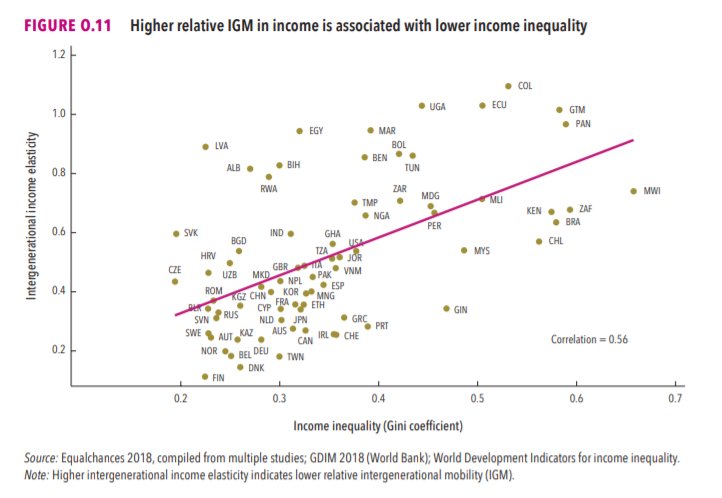
3/The World Bank report has a graph in which it appears to show the same value for China's Gini - under 0.3.
The graph cites the World Development Indicators as its source for the income inequality data.
4/The World Development Indicators are available at the World Bank's website.
Here's the Gini index: https://t.co/MvylQzpX6A
It looks as if the latest estimate for China's Gini is 42.2.
That estimate is from 2012.
5/A Gini of 42.2 would put China in the same neighborhood as the U.S., whose Gini was estimated at 41 in 2013.
I can't find the <30 number anywhere. The only other estimate in the tables for China is from 2008, when it was estimated at 42.8.
This New York Times feature shows China with a Gini Index of less than 30, which would make it more equal than Canada, France, or the Netherlands. https://t.co/g3Sv6DZTDE
That's weird. Income inequality in China is legendary.
Let's check this number.
2/The New York Times cites the World Bank's recent report, "Fair Progress? Economic Mobility across Generations Around the World".
The report is available here:
3/The World Bank report has a graph in which it appears to show the same value for China's Gini - under 0.3.
The graph cites the World Development Indicators as its source for the income inequality data.
4/The World Development Indicators are available at the World Bank's website.
Here's the Gini index: https://t.co/MvylQzpX6A
It looks as if the latest estimate for China's Gini is 42.2.
That estimate is from 2012.
5/A Gini of 42.2 would put China in the same neighborhood as the U.S., whose Gini was estimated at 41 in 2013.
I can't find the <30 number anywhere. The only other estimate in the tables for China is from 2008, when it was estimated at 42.8.