Lunchtime update from the Grenfell Tower Inquiry:

President of Arconic's French arm accepts customers were 'deliberately and dishonestly misled' over fire classification of cladding panels, as he is asked about email saying failed fire test must be kept 'VERY CONFIDENTIAL'
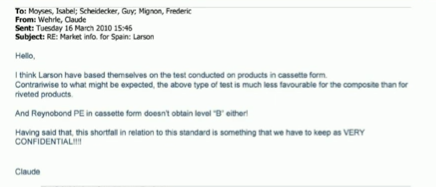
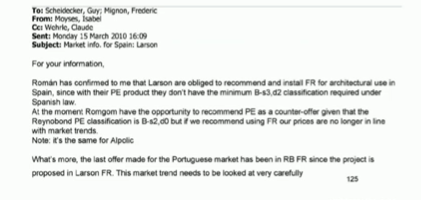
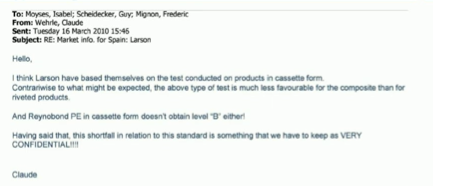
The most interesting point of this morning's evidence came right at the end of the session when Claude Schmidt was grilled about an email his colleague Claude Wehrle sent regarding the serious failure of polyethylene-cored ACM panels when bent into a cassette form in March 2010
Remember: Arconic in 2004/5 tested its ACM PE panel when bent into cassette and when bolted to a wall with rivets. The cassette version failed spectacularly, burning 10 times as fast. But Arconic dismissed this as a 'rogue result' and drew no distinction in its marketing...
... simply presenting the panel as a 'Class B' (the rating for the rivetted panel, and the required standard for many European countries). Skip forward to 2010, and this email chain.
Mr Wehrle, the firm's senior technical member of staff is told about a trend in Spain and Portugal where clients are demanding more fire resistant panels, and warned that with this type of panel "our prices are no longer in the market"
Mr Wehrle responds saying that he thinks this is because of the difference between cassette and riveted testing, notes that Reynobond PE in cassette doesn't obtain a Class B and says this should be kept "VERY CONFIDENTIAL!!!"
Millett, inquiry counsel, asks Schmidt: If Claude Wehrle genuinely believed the test on cassette to be a rogue result, he would have said so in this email? Yes
Asks if, in fact, Arconic knew cassette was not a Class B? Reading this email, yes, says Schmidt
"Do you accept that Arconic through Mr Wehrle knew that architects, designers, construction professionals were being misled by the claimed fire classification for cassette?"
"Yes."
"Do you accept that Arconic was deliberately and dishonestly misleading its customers about the claimed fire performance for the cassette variant of Reynobond PE 55?"
Long pause
"Well, in any case, regarding the B classification, I mean according to the Euro norm... yes"
A further email up the chain shows Wehrle's line manager Guy Scheidecker saying "this shouldn't even have been mentioned". Schmidt asked if this was ever reported to him. "No, I don't think so," he says.
"You would remember wouldn't you if you were told Arconic was perpertrating a deceit on it's customers. You would have remembered something like that, wouldn't you?"
"In theory, yes," says Schmidt.
Schmidt says he cannot explain how Scheidecker was "in on this" but he was not. Says he hasn't seen the emails before.

Much more discussed this morn, and I'll have a fuller report at the end of the day, but this felt like the most significant exchange.
(Note to any news editors who happen to be reading this thread: we've seen these emails before, it's Schmidt's answers about them that are the new bit)

More from Business

You May Also Like

THREAD: 12 Things Everyone Should Know About IQ

1. IQ is one of the most heritable psychological traits – that is, individual differences in IQ are strongly associated with individual differences in genes (at least in fairly typical modern environments). https://t.co/3XxzW9bxLE


2. The heritability of IQ *increases* from childhood to adulthood. Meanwhile, the effect of the shared environment largely fades away. In other words, when it comes to IQ, nature becomes more important as we get older, nurture less.
https://t.co/UqtS1lpw3n


3. IQ scores have been increasing for the last century or so, a phenomenon known as the Flynn effect. https://t.co/sCZvCst3hw (N ≈ 4 million)

(Note that the Flynn effect shows that IQ isn't 100% genetic; it doesn't show that it's 100% environmental.)


4. IQ predicts many important real world outcomes.

For example, though far from perfect, IQ is the single-best predictor of job performance we have – much better than Emotional Intelligence, the Big Five, Grit, etc. https://t.co/rKUgKDAAVx https://t.co/DWbVI8QSU3


5. Higher IQ is associated with a lower risk of death from most causes, including cardiovascular disease, respiratory disease, most forms of cancer, homicide, suicide, and accident. https://t.co/PJjGNyeQRA (N = 728,160)