1/ #Bitcoin FUD-busting time!

claim: bitcoin ownership is heavily concentrated.

@business published an article claiming "2% of accounts control 95% of all Bitcoin" 🤣

truth: the facts, my friends, simple don't line up. let's dive in!

2/ interrogating on-chain addresses is tricky.

address =/ account.

one person can control multiple addresses.

one address can hold bitcoin belonging to multiple ppl.

exchanges and trading firms will have addresses with large balances that represent client funds.
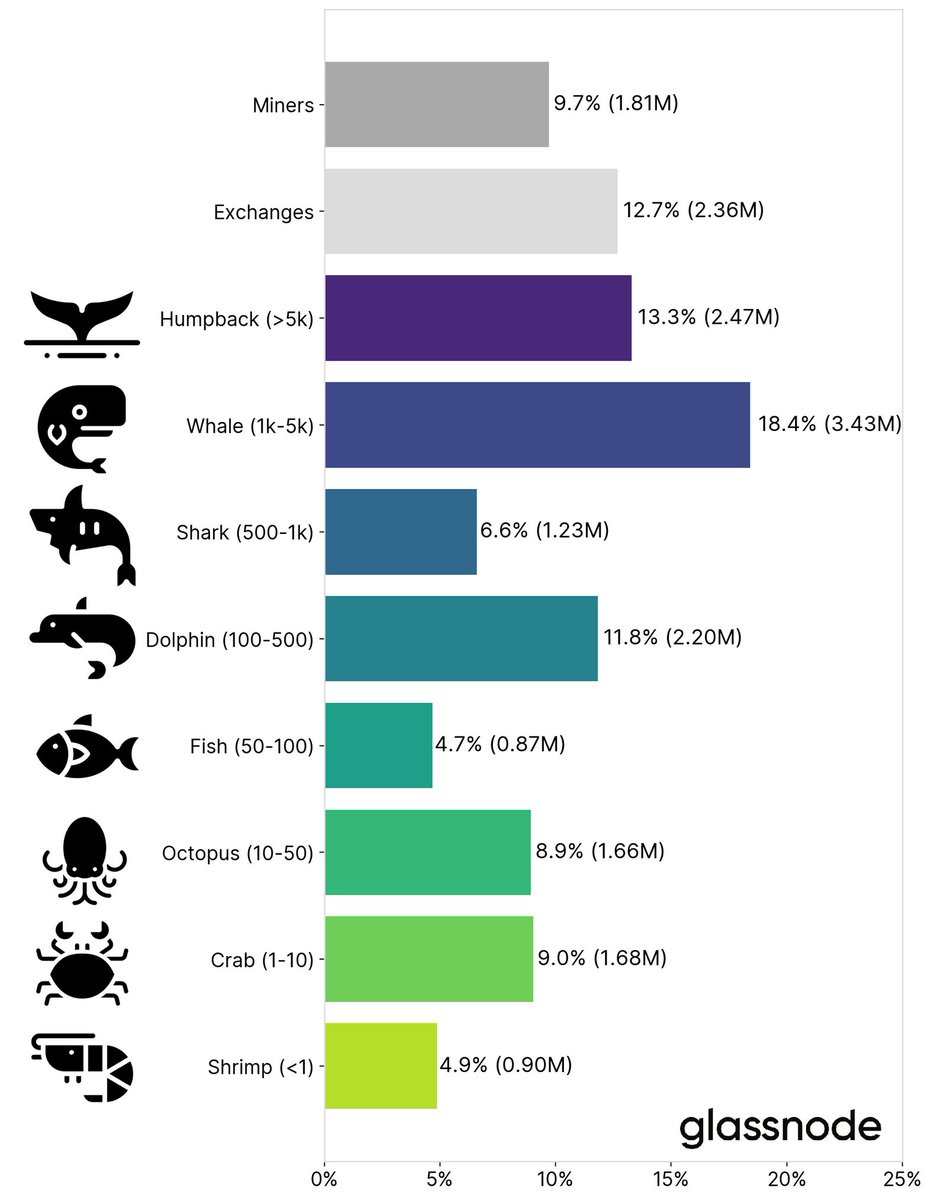
3/ the fine folks @glassnode published an excellent analysis of on-chain address balances in January

the ownership distribution of bitcoin among wallets is actually much more diverse than one might expect.

full piece here:
https://t.co/n5IdIQdNoA
4/ 31% of BTC is held in addresses not identified as exchange wallets.

these are likely institutions, funds, custodians, and OTC desks.

our analysis at @CoinSharesCo indicates >15% of all bitcoin is held in third party custody, including @coinbase and our own @KomainuCustody
5/ in fact, between asset managers @Grayscale ($36B in BTC) and our @xbtprovider ($4B in BTC), 4% of bitcoin is locked up by fund providers and asset managers!

our @CoinSharesCo research team publishes an EXCELLENT weekly report on fund flows and AUMs - https://t.co/6Kky96m3ob
6/ distribution of bitcoin over time has also changed a lot

as new market microstructure emerges, the way market participants manage and store their coins also changes.

with more institutions and more AUM in structured products and funds, inevitably we see more clustering
7/ if we look at number of participants, the trend looks as we might expect. there is a very fat tail, with the majority of wallets (22M) holding less than one bitcoin.
8/ ultimately, bitcoin ownership is not as heavily concentrated as reported. this is because the large wallets holding much of the bitcoin supply represent thousands if not millions in user funds.

these types of misconceptions lead to all sorts of wild, wrong claims.
9/ bitcoin DOES represents equality of opportunity.

you don't need a bank.

you don't need a brokerage account.

you don't need to be an accredited investor or well connected.

anyone with a smartphone and an internet connection can buy $5 of bitcoin easily and quickly.
10/ let me know what other misconceptions you want to talk about! it's important that we arm ourselves with the *facts* and support our claims with empirical evidence and data.

luckily the #bitcoin ecosystem is comprised of incredibly intelligent people who do this research!

More from Bitcoin

I will be a buyer under 13800 levels, but depending upon the reversal on smaller timeframe.
The defi matrix

As each asset class goes on-chain, it can be stored in a digital wallet. And it can be traded against other such assets. Not just cryptocurrencies, but national digital currencies, personal tokens, etc.

We’re about to enter an age of global monetary competition.

The defi matrix is the table of all pair wise trades. It’s the fiat/stablecoin pairs, the fiat/crypto pairs, the crypto/crypto pairs, and much more besides.

Uniswap-style automatic market making for everything. Every possession you have, constantly marked to market by ~2040.

More liquidity, less currency?

This is an interesting point. Cash doesn’t make you money. In fact, it can lose you money in an inflating environment.

Reliable, 24/7 mark-to-market on everything is hard — but if achieved, means less % of assets in cash.


AMMs boost BTC. Here's why.

- All assets trade against all assets in the defi matrix
- Automated market makers give liquidity for rare pairs
- Everything is marked-to-market 24/7
- Value of cash drops, as you can liquidate instantly
- The new no-op is to keep your assets in BTC

Basically, automated market makers like @Uniswap boost BTC in the long term, because they allow *everything* to be priced in BTC terms, and *anyone* to switch out of BTC into their asset of choice.

Though in practice this may mean WBTC/RenBTC [or ETH!] rather than BTC itself.
1/9 Bitcoin has performed remarkably these past few weeks despite:
-Most of DeFi falling 50-80%
-CFTC charging BitMEX
-POTUS contracting Covid
-Delayed stimulus talks
-FCA announcing a derivative ban for retail

Why? Let’s see what we can find on-chain

2/9 Bitcoin’s Realized Cap has been steadily increasing just as it did before the 2017 bull market took off. If it continues as it did in 2017, 2021 should be an interesting year.

https://t.co/nqgX7vTMDV


3/9 Bitcoin MVRV, whilst more volatile this market cycle, is also is holding the same trajectory it did during the 2016/17 bull market

https://t.co/jadbn6nCOB


4/9 Looking at the supply of Bitcoin on exchanges is a good indication as to whether or not users are increasing trading activity, or increasing hodl activity. With supply reducing it looks like the tendency recently has been driven by hodlers


5/9 Despite the recent volatility, the number of Bitcoin whales continues to increase, indicating the growing number of large holders that have positive expectations for the future of Bitcoin

You May Also Like