My new workflow for savings threads to read later:
1. Tag @buzz_chronicles save
2. Save to @instapaper
3. Highlight relevant parts
4. Automatic @readwiseio to @NotionHQ sync
Request for @readwiseio - improve Tweet / tweet thread saving workflow
More from Dickie Bush 📊
In Atomic Habits, James lays out the Four Laws of Behavior Change.
1. Make it obvious
2. Make it attractive
3. Make it easy
4. Make it satisfying
Here's how to leverage them to build a daily writing habit (🧵✍🏼):
Habits are made up of a four-part feedback loop:
1. Cue
2. Craving
3. Response
4. Reward
Building a habit means intentionally designing each part of this feedback loop.
1. Make it obvious
2. Make it attractive
3. Make it easy
4. Make it
The Habit Loop
— James Clear (@JamesClear) November 5, 2018
To better understand how a habit works and how to improve it, let's divide a habit into four stages.
1. Cue
2. Craving
3. Response
4. Reward
These four stages create a feedback loop. Your mind is endlessly running this loop and learning from its experiences. pic.twitter.com/sURCbTPp3N
Before you start to build a writing habit, it's important to understand the real goal.
Your goal isn't to start writing.
Your goal is to become a writer.
Why the subtle difference?
Because behavior change is identity change.
We don't stick to habits that aren't aligned with our identity.
Luckily, habits that align with your identity are easy to stick to.
Every action you take is a vote for the type of person you want to become.
So to become a writer, we have to consistently cast "writer votes."
Step 1: Make it obvious
Time and location are the most important habit cues.
You MUST leverage them to build your writing habit.
Every great writer has their sacred hours.
This thread can help you find
Sacred Hours...
— Dickie Bush \U0001f6a2 (@dickiebush) December 2, 2020
A life-changing concept.
What are they and how to find yours: (thread) pic.twitter.com/AHSMqwtTb0
But 90% of that growth came from 9 threads - which on their own generated 20,000,000 views.
So here's a recap of those 9 threads (and what they can help you with):
I studied math at Princeton - mostly because I hated writing.
But colleges do a horrendous job teaching you to write.
So I spent 200 hours learning to write on my own.
Then, I summarized the frameworks I
College completely failed in teaching me how to write.
— Dickie Bush \U0001f6a2 (@dickiebush) September 22, 2021
So I spent over 500 hours studying legendary authors and copywriters.
Then, I distilled what I learned into 6 simple frameworks.
But unlike college, these won't cost you $120,000.
Here they are for free:
If you're new to Twitter, it can be overwhelming.
But even people who use it every day aren't using its best features.
So here are 10 of them you can start using today to 10x your experience:
If you use it right, Twitter is the most powerful platform in the world.
— Dickie Bush \U0001f6a2 (@dickiebush) March 30, 2021
But Twitter does a horrible job of showing you its advanced features.
Here are 10 of them you probably know nothing about:
Whether you're a:
• Writer
• Creator
• Student
• Employee
• Entrepreneur
You are in the business of storytelling.
So here's a storytelling crash course from the world's most creative
The most creative company of the last 30 years:
— Dickie Bush \U0001f6a2 (@dickiebush) October 28, 2021
Pixar.
Back in 2011, Pixar storyboard artist Emma Coats shared their "22 Rules For Storytelling."
And the rules are a must-read for writers, entrepreneurs, and anyone who wants to tell captivating stories.
Here's the breakdown: pic.twitter.com/eUqUpvvbDX
If you spend any time on Twitter, you've seen the words "Web 3."
But whether you're a complete beginner or fully crypto-pilled, these quotes will help you learn where the world is
20 quotes on Crypto, Web 3, NFTs, and decentralization from Tim Ferriss, Naval Ravikant, and Chris Dixon.
— Dickie Bush \U0001f6a2 (@dickiebush) October 30, 2021
(For those who want a crash course in where the future is heading):
More from All







Introducing Voltron: Language-Driven Representation Learning for Robotics!
Paper: https://t.co/gIsRPtSjKz
Models: https://t.co/NOB3cpATYG
Evaluation: https://t.co/aOzQu95J8z
🧵👇(1 / 12)
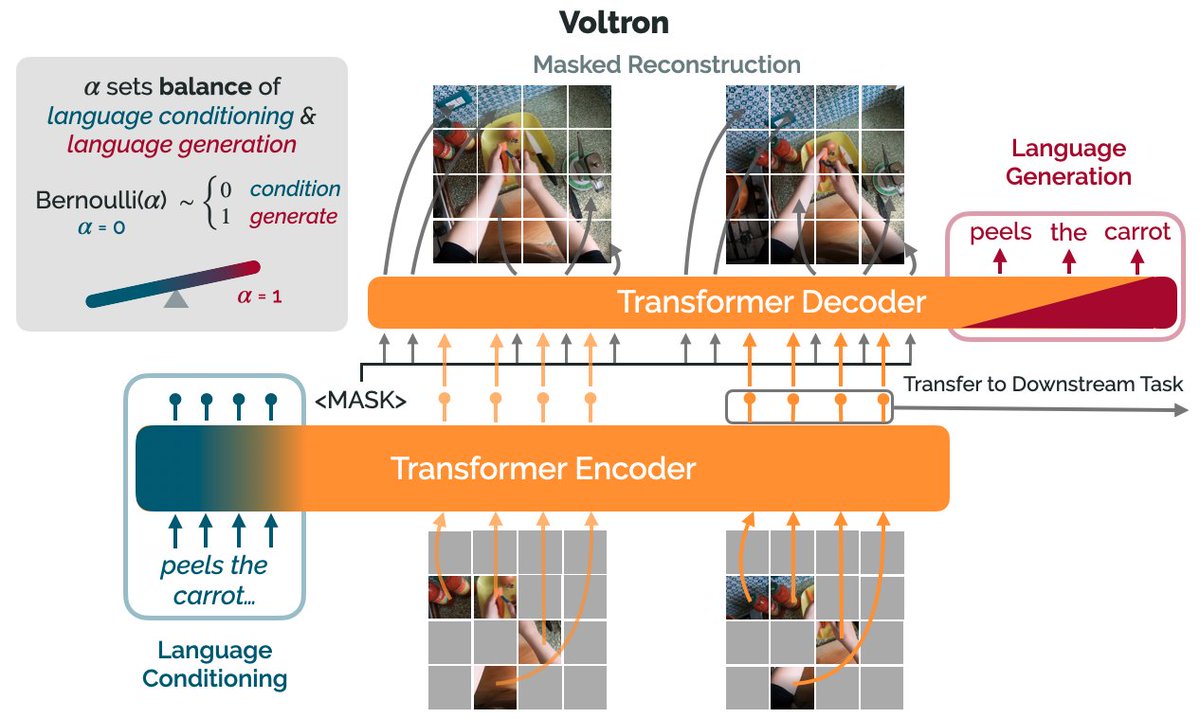
Videos of humans performing everyday tasks (Something-Something-v2, Ego4D) offer a rich and diverse resource for learning representations for robotic manipulation.
Yet, an underused part of these datasets are the rich, natural language annotations accompanying each video. (2/12)
The Voltron framework offers a simple way to use language supervision to shape representation learning, building off of prior work in representations for robotics like MVP (https://t.co/Pb0mk9hb4i) and R3M (https://t.co/o2Fkc3fP0e).
The secret is *balance* (3/12)
Starting with a masked autoencoder over frames from these video clips, make a choice:
1) Condition on language and improve our ability to reconstruct the scene.
2) Generate language given the visual representation and improve our ability to describe what's happening. (4/12)
By trading off *conditioning* and *generation* we show that we can learn 1) better representations than prior methods, and 2) explicitly shape the balance of low and high-level features captured.
Why is the ability to shape this balance important? (5/12)


You May Also Like




As someone\u2019s who\u2019s read the book, this review strikes me as tremendously unfair. It mostly faults Adler for not writing the book the reviewer wishes he had! https://t.co/pqpt5Ziivj
— Teresa M. Bejan (@tmbejan) January 12, 2021
The meat of the criticism is that the history Adler gives is insufficiently critical. Adler describes a few figures who had a great influence on how the modern US university was formed. It's certainly critical: it focuses on the social Darwinism of these figures. 2/x
Other insinuations and suggestions in the review seem wildly off the mark, distorted, or inappropriate-- for example, that the book is clickbaity (it is scholarly) or conservative (hardly) or connected to the events at the Capitol (give me a break). 3/x
The core question: in what sense is classics inherently racist? Classics is old. On Adler's account, it begins in ancient Rome and is revived in the Renaissance. Slavery (Christiansen's primary concern) is also very old. Let's say classics is an education for slaveowners. 4/x
It's worth remembering that literacy itself is elite throughout most of this history. Literacy is, then, also the education of slaveowners. We can honor oral and musical traditions without denying that literacy is, generally, good. 5/x