who were active around the ancient port of Muziris at the time. As a result, it had an influence on later European developments in analysis and calculus.
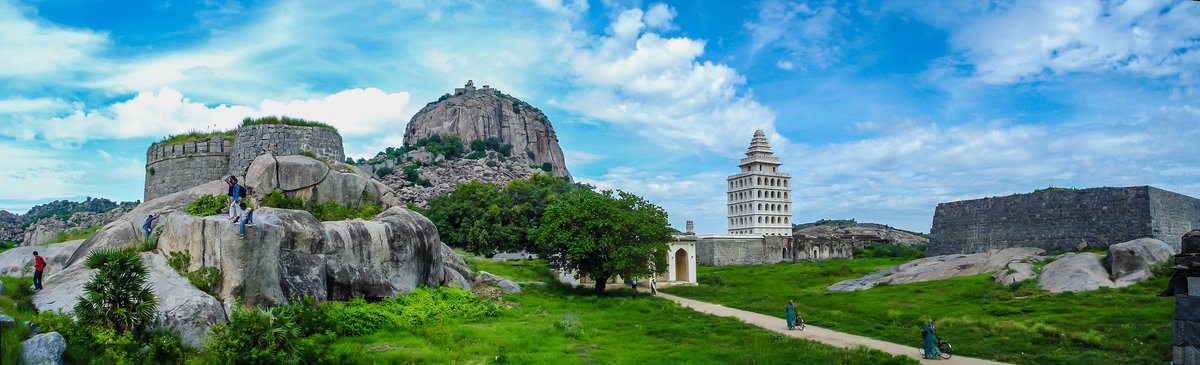
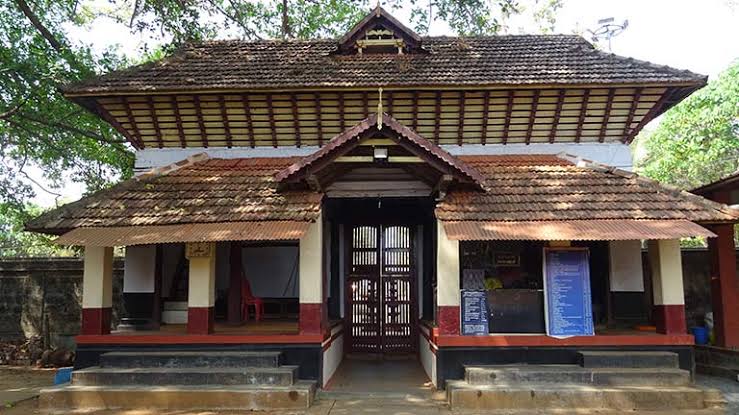
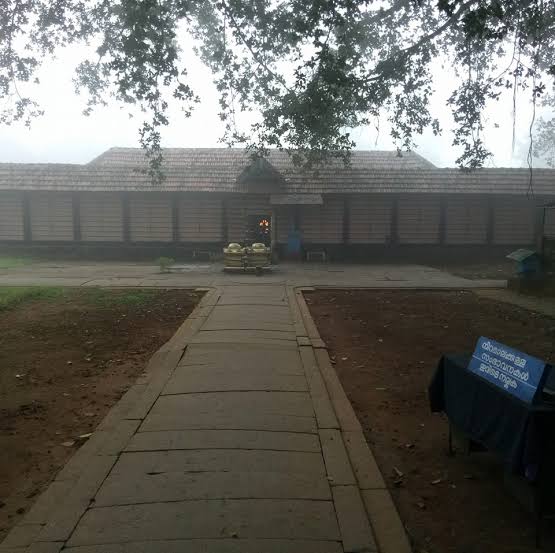
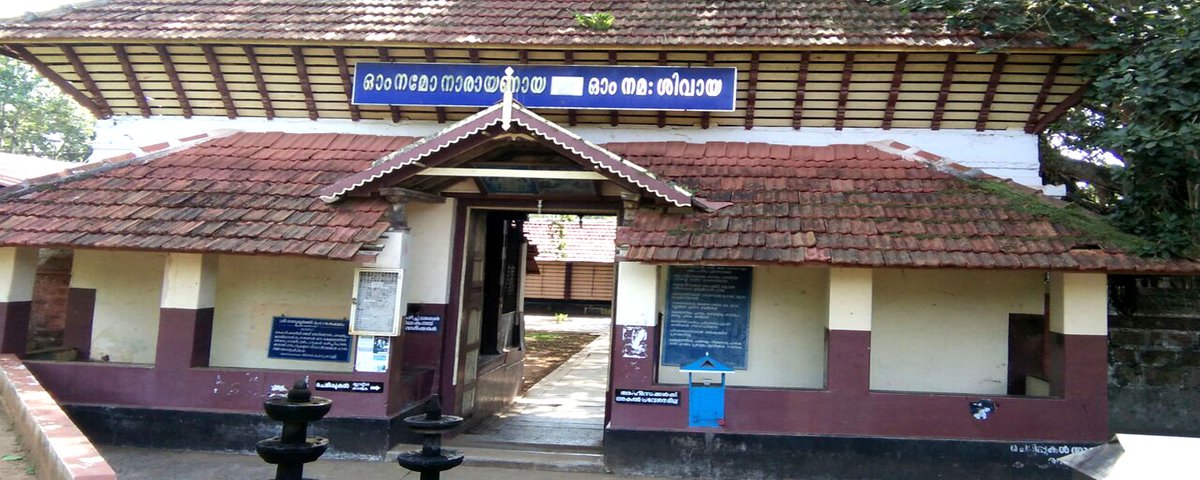
His birth place Sangamagrama is present-day Irinjalakuda near Thrissur, Kerala, India.
He was the first to use infinite
series approximations for a range of trigonometric functions, which has been called the “decisive step onward from the finite procedures of ancient mathematics to treat their limit-passage to infinity“.
One of the greatest mathematician-astronomers of the Middle Ages, Madhava
made pioneering contributions to the study of infinite series, calculus, trigonometry, geometry, and algebra.
Madhava was born as Irińńaŗappiļļy or Iriññinavaļļi Mādhava . He had written that his house name was related to the Vihar where a plant called “bakuļam” was planted.
Bakuļam was locally known as “iraňňi”.
Irinjalakuda was once known as ‘Irińńāţikuţal’. Sangamagrāmam (lit. sangamam = union, grāmam = village) is a rough translation to Sanskrit from Dravidian word ‘Irińńāţikuţal’, which means ‘iru (two) ańńāţi (market) kǖţal (union)’ or the
union of two markets. Madhava provided the creative impulse for the development of a rich mathematical tradition in medieval Kerala. However, most of Madhava’s original work (except a couple of them) is lost. He is referred to in the work of subsequent Kerala mathematicians,
particularly in Nilakantha Somayaji’s Tantrasangraha (c. 1500), as the source for several infinite series expansions, including sinθ and arctanθ.
The 16th-century text Mahajyānayana prakāra cites Madhava as the source for several series derivations for π. In Jyeṣṭhadeva’s
Yuktibhāṣā (c. 1530), written in Malayalam, these series are presented with proofs in terms of the Taylor series expansions for polynomials like 1/(1+x2), with x = tanθ, etc. As per the old Indian tradition of starting off new chapters with elementary content, the first four
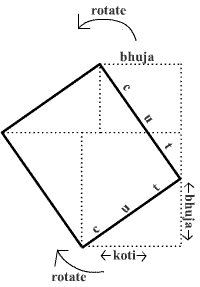
chapters of the Yuktibhasa contain elementary mathematics, such as division, proof of Pythagorean theorem, square root determination, etc.
The radical ideas are not discussed until the sixth chapter on circumference of a circle. Yuktibhasa contains the derivation and proof of
the power series for inverse tangent, discovered by Madhava.
In the text, Jyesthadeva describes Madhava’s series in the following manner:
“
The first term is the product of the given sine and radius of the desired arc divided by the cosine of the arc. The succeeding terms are
obtained by a process of iteration when the first term is repeatedly multiplied by the square of the sine and divided by the square of the cosine. All the terms are then divided by the odd numbers 1, 3, 5, …. The arc is obtained by adding and subtracting respectively the terms
of odd rank and those of even rank. It is laid down that the sine of the arc or that of its complement whichever is the smaller should be taken here as the given sine. Otherwise the terms obtained by this above iteration will not tend to the vanishing magnitude.
This is wrongly attributed to James Gregory, who discovered it three centuries after Madhava.
Madhava laid the foundations for the development of calculus, which were further developed by his successors at the Kerala school of astronomy and mathematics.
(It should be noted that certain ideas of calculus were known to earlier mathematicians.) Madhava also extended some results found in earlier works, including those of Bhāskara II.
Madhava developed some components of calculus such as differentiation, term-by-term integration, iterative methods for solutions of non-linear equations, and the theory that the area under a curve is its integral.