As Promised here is the setup
1. Strategy is meant to trade only on Wed and Thu.
2. At 9.30AM Sell 1 lot of nifty ATM and 2 lot of nifty OTM1 CE and PE.
3. Suppose nifty spot is trading at 17500 then sell 1 lot of 17500CE and 17500PE(Straddle). 2 lot of 17550CE and 17450PE.

4. Put 50%SL on CE and PE.
5. On Wed trail your SL by 10 points. It means if any leg comes in profit by 10 points then reduce the SL of that leg by 10 points. on Thu no need to trail SL
6. if SL hit in any leg than continue with remain leg.
7. Either exit at 3.10 or if SL hit
8. Capital required to do 1 set (1 lot ATM and 2 lot OTM1) is 4Lakh or something. People buy hedge of 10 strike away. After hedge required capital will be 2 to 2.5 Lakh. Everyone is doing this strategy with hedge only.
As I said I learnt it from Vishal Mehta. In his webinar he said I tried with 50% SL you can find better version of it by trying SL from 40-50%. Inspired by his words I kept searching something good from this strategy.
Biggest drawback of any stockmock kind of strategy is "Double Side SL" so is with this strategy. I felt the heat of double side SL of this strategy many times but everytime its come out from DD like a winner. In Jan 2022 this strategy hit 3 times double SL.
You can do following this to find a better version.
1. Try back testing it from 40-50% SL
2. Try back testing it with MTM Level SL. Suppose you are trading it with 2.5Lakh capital and don't want risk more than 2% of your capital then backtest if with 5K MTM SL.
3. If you want to do multiple sets say 3 sets then try backtesting one set at 9.20,9.30 and 11am or whatever time u like.
4. Execution:- You can subscribe to @Quantiply_tech algo to execute any stock mock strategy.
5. As I said I learnt this strategy by attending @vishalmehta29 Webinar and algo of this strategy is available for subscription on his platform. Name of Strategy is TSS .For charges You can visit his website.
If you want to check the stats of this strategy then simply refill your @stockmock_in and run the backtest.
Run 5-7 backtest with different different parameter like SL from 40-50%, MTM level SL etc.
This strategy work like a charm. Find out your version of this strategy

More from All

https://t.co/6cRR2B3jBE
Viruses and other pathogens are often studied as stand-alone entities, despite that, in nature, they mostly live in multispecies associations called biofilms—both externally and within the host.

https://t.co/FBfXhUrH5d


Microorganisms in biofilms are enclosed by an extracellular matrix that confers protection and improves survival. Previous studies have shown that viruses can secondarily colonize preexisting biofilms, and viral biofilms have also been described.


...we raise the perspective that CoVs can persistently infect bats due to their association with biofilm structures. This phenomenon potentially provides an optimal environment for nonpathogenic & well-adapted viruses to interact with the host, as well as for viral recombination.


Biofilms can also enhance virion viability in extracellular environments, such as on fomites and in aquatic sediments, allowing viral persistence and dissemination.
How can we use language supervision to learn better visual representations for robotics?

Introducing Voltron: Language-Driven Representation Learning for Robotics!

Paper: https://t.co/gIsRPtSjKz
Models: https://t.co/NOB3cpATYG
Evaluation: https://t.co/aOzQu95J8z

🧵👇(1 / 12)


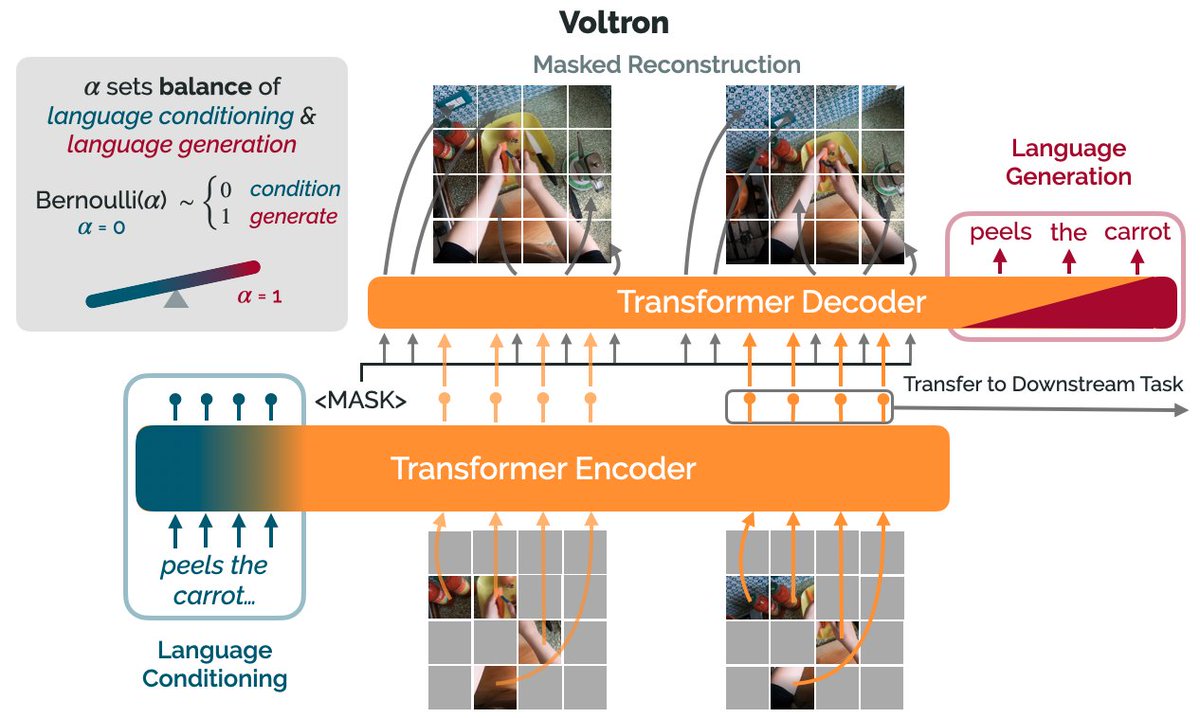
Videos of humans performing everyday tasks (Something-Something-v2, Ego4D) offer a rich and diverse resource for learning representations for robotic manipulation.

Yet, an underused part of these datasets are the rich, natural language annotations accompanying each video. (2/12)

The Voltron framework offers a simple way to use language supervision to shape representation learning, building off of prior work in representations for robotics like MVP (
https://t.co/Pb0mk9hb4i) and R3M (https://t.co/o2Fkc3fP0e).

The secret is *balance* (3/12)

Starting with a masked autoencoder over frames from these video clips, make a choice:

1) Condition on language and improve our ability to reconstruct the scene.

2) Generate language given the visual representation and improve our ability to describe what's happening. (4/12)

By trading off *conditioning* and *generation* we show that we can learn 1) better representations than prior methods, and 2) explicitly shape the balance of low and high-level features captured.

Why is the ability to shape this balance important? (5/12)

You May Also Like