First rule of thumb: customer conversations are bad by default.
It's your job to fix them.
Use The Mom Test to make customer interviews better.
The Mom Test is a set of simple rules for crafting good questions that even your mom can't lie to you about.
For customer conversations to really matter, you need to ask questions that matter.
You need to search out the world-rocking scary questions you've been unintentionally shrinking from.
More specifically, make sure every meeting counts by planning your list of 3 big questions.
During each conversation, watch out for three types of bad data:
• Compliments
• Fluff (generics, hypothetical, and the future)
• Ideas
Once you notice bad data, get back on track by:
• deflecting compliments
• anchoring fluff
• digging beneath ideas
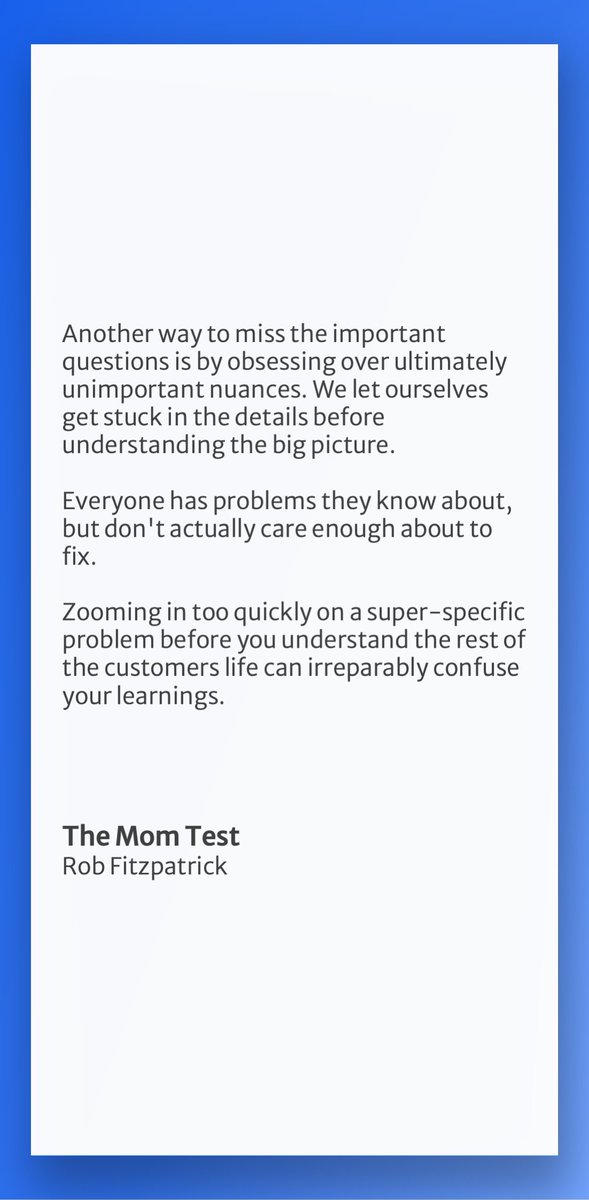
Another pitfall to avoid: zooming in too fast.
A great way to miss the important questions is by obsessing over ultimately unimportant nuances.
Keep it casual during your conversations.
Learning about a customer and their problems works better as a quick and casual chat than a long, formal meeting.
Who should you be talking to?
Good customer segments are a who-where pair.
Still not sure where to find your customers?
Keep slicing your segment into smaller pieces until you do.
But where do these conversations and meetings come from?
What if you don't already know folks?
Hustle for cold conversations to beget warm ones.
Once you've found someone to talk to, set up the meeting with:
• Vision
• Framing
• Weakness
• Pedestal
• Ask
Once the meeting starts, you have to grab the reins.
How many meetings do you need?
Under perfect circumstances, you might only need 3-5.
More typically, the answer probably lies closer to 10.
Once you've learned the facts of your industry and customers, start pushing for advancement and commitments to separate dead leads from real customers.
Even if you do everything else right, you can get bad results without the right process wrapped around your conversations.
Don’t neglect prep, note taking, and review.
Final word: don't overthink it.
Get out and use this information!
Don't spend a week prepping for meetings; spend an hour and then go talk to people.
Anything more is stalling.
If you enjoyed these tips:
1. Follow me
@GoodStrategyHQ for more threads on strategy for resource constrained businesses
2. Quote tweet the top tweet with one takeaway you're going to use immediately
3. Read about what this account is about.
https://t.co/Xu41d2QuBm
Big thanks to
@robfitz for The Mom Test.
If you made it this far, you should definitely buy the book.
The above is a great summary, but it's hard compress a book like The Mom Test without losing lots of important bits.
It's just so dense with actionable stuff.